Landing Page Tips for Email Capture
Landing Page Tips for Email Capture are becoming more important than ever as businesses compete for attention in a crowded digital world. Think about it for a second. Every brand wants customer data, but very few users are willing to hand over their email address without a strong reason. That is why a landing page is no longer just a digital brochure. It acts like a skilled salesperson working 24/7, convincing visitors to trust your brand and take action instantly. A great email capture landing page can transform random website visitors into loyal subscribers, paying customers, and long-term followers.
Businesses across industries are investing heavily in conversion-focused landing pages because email marketing still delivers one of the highest returns on investment in digital marketing. Recent industry reports show that email marketing continues to outperform many social platforms in customer retention and direct sales generation. The real challenge is not driving traffic anymore; it is converting that traffic into leads. A poorly optimized landing page can leak opportunities like a bucket full of holes, while a well-designed one quietly builds your audience every single day.
The beauty of email capture landing pages lies in their simplicity. Unlike complex websites with dozens of distractions, a landing page has one mission: capture the visitor’s email. Every headline, button, image, and sentence should support that goal. The strategies shared in this guide will help you create high-converting pages that not only attract visitors but also persuade them to subscribe willingly.
Why Email Capture Still Matters in Digital Marketing
Email marketing has survived every digital trend you can imagine. Social media platforms rise and fall, algorithms change overnight, and advertising costs keep increasing, but email remains one of the few marketing assets businesses truly own. When someone joins your email list, you gain direct access to communicate with them without depending on third-party platforms. That is incredibly valuable in today’s unpredictable marketing landscape.
The increasing importance of first-party data has also made email capture more critical than ever. Privacy regulations and browser restrictions are limiting third-party tracking, which means businesses must build their own customer databases. Smart marketers understand this shift and focus heavily on growing qualified email lists through optimized landing pages. Instead of renting audiences from social platforms, they build direct relationships with subscribers who genuinely want their content.
Another reason email capture continues to dominate digital marketing is personalization. Email allows businesses to segment audiences, deliver tailored offers, and nurture leads through automated campaigns. A single email subscriber can generate long-term revenue over several months or even years. That is why companies spend so much time improving landing page conversions. Even a small increase in signup rates can create a significant boost in revenue.
The Rising Value of First-Party Data
Digital privacy changes are reshaping the online advertising world. Cookies are disappearing, ad targeting is becoming more limited, and consumers are demanding greater transparency. In this environment, collecting first-party data through email signups has become a survival strategy for many businesses. Brands that own customer data can continue marketing effectively without relying heavily on expensive ad platforms.
Email lists also provide stability. Imagine building an audience of 100,000 followers on social media and suddenly losing reach because of an algorithm update. That happens frequently. Your email list, on the other hand, remains under your control. This makes landing page optimization one of the smartest long-term investments for marketers and businesses alike.
Why Businesses Depend on Email Lists
Email lists fuel product launches, promotions, webinars, newsletters, and customer retention campaigns. Businesses use them to nurture leads gradually instead of forcing immediate sales. This relationship-building process creates trust, and trust eventually drives conversions. A visitor who joins your email list today could become a paying customer weeks later after receiving helpful content consistently.
Successful businesses understand that capturing emails is not just about numbers. Quality matters more than quantity. A landing page designed with the right messaging attracts genuinely interested subscribers rather than random traffic. That difference dramatically impacts future campaign performance.
Understanding the Psychology Behind Email Capture
People rarely give away their email addresses without thinking twice. There is always a psychological decision happening behind the scenes. Visitors ask themselves questions like: “Is this worth it?” “Will they spam me?” or “Can I trust this brand?” Understanding this mental process is the foundation of creating successful landing pages.
Trust is one of the strongest conversion drivers. Visitors feel more comfortable subscribing when a landing page looks professional, loads quickly, and clearly explains the benefits of signing up. Confusing layouts, aggressive popups, or suspicious claims instantly reduce trust levels. Your landing page should feel like a helpful guide rather than a desperate salesperson.
Simplicity also plays a major role in user behavior. Humans naturally avoid complicated tasks. If your signup form asks for too much information, visitors may abandon the page entirely. That is why many high-converting landing pages only request a first name and email address. Removing friction makes the action feel quick and effortless.
Trust and User Intent
Visitors arrive on landing pages with different intentions. Some are curious, while others are actively searching for solutions. Your page must immediately align with their expectations. Clear messaging, transparent offers, and honest benefits reduce skepticism and encourage action. Testimonials, customer reviews, and recognizable brand logos further strengthen trust signals.
Trust also comes from consistency. If your ad promises a free ebook, the landing page should reinforce that promise immediately. Any mismatch between ad messaging and landing page content creates confusion and increases bounce rates.
The Power of Simplicity
Minimalist landing pages often outperform cluttered designs because they reduce decision fatigue. When users see too many buttons, menus, or blocks of text, their attention becomes scattered. Strong landing pages focus on one primary objective and remove unnecessary distractions completely.
Think of your landing page like a guided path. Every element should gently push the visitor toward the email signup form. Simplicity keeps that path smooth and easy to follow.
Landing Page Tips for Email Capture That Boost Conversions
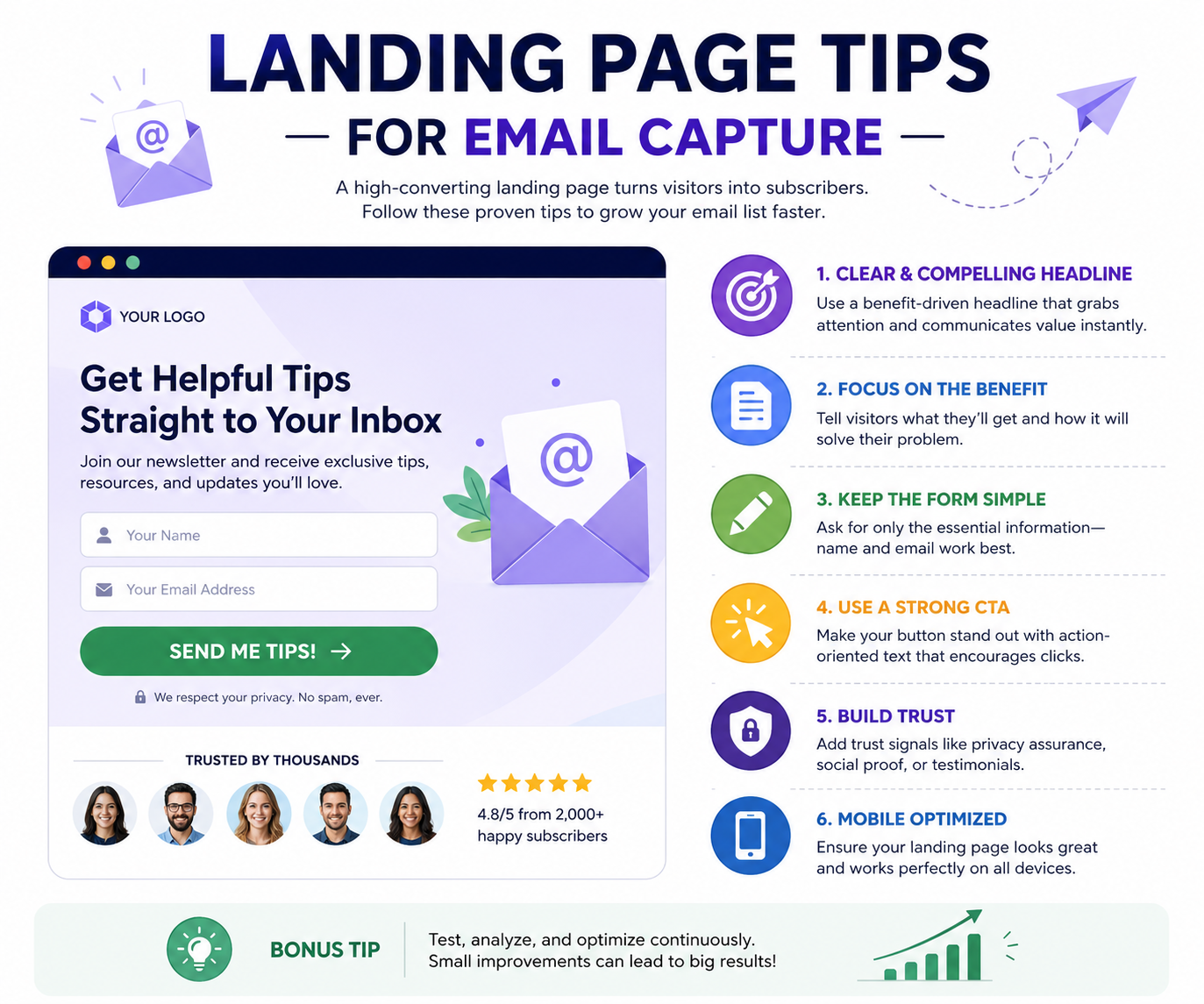
Landing Page Tips for Email Capture work best when every page element supports a single conversion goal. The headline grabs attention, the copy builds interest, the visuals create emotional engagement, and the call-to-action encourages immediate action. When these components work together, conversions improve naturally.
Your headline is often the first thing visitors notice. A weak headline kills conversions instantly because users decide within seconds whether to stay or leave. Strong headlines focus on benefits instead of features. Instead of saying “Join Our Newsletter,” try something more compelling like “Get Weekly Marketing Strategies That Increase Sales.” The second option communicates value clearly.
Calls-to-action are equally important. Generic buttons like “Submit” or “Click Here” feel uninspiring. High-performing CTAs create urgency and excitement. Phrases like “Download My Free Guide” or “Start Growing Today” feel more action-oriented and persuasive. Small wording changes can produce surprisingly large improvements in conversion rates.
Create a Strong and Clear Headline
A headline acts like the front door of your landing page. If it feels boring or confusing, visitors simply walk away. Strong headlines focus on solving a problem or promising a benefit. Numbers, emotional triggers, and power words can make headlines more compelling without sounding overly dramatic.
Your headline should also align perfectly with the visitor’s expectations. If someone clicks an ad about increasing email subscribers, the landing page headline should reinforce that exact topic immediately.
Use a Compelling Call-to-Action
CTA buttons deserve more attention than many marketers give them. Their placement, wording, size, and color all influence user behavior. High-converting landing pages make CTAs impossible to ignore while still maintaining a clean design.
Action-oriented language performs best because it encourages immediate engagement. Words like “Get,” “Start,” “Download,” and “Unlock” create momentum and make users feel they are gaining something valuable.
Keep Forms Short and Simple
Long forms scare users away. Every additional field creates friction and reduces signup rates. Unless absolutely necessary, avoid asking for phone numbers, addresses, or company details during the first interaction.
Best Form Fields to Include
| Form Field | Importance | Impact on Conversion |
|---|---|---|
| First Name | Moderate | Helps personalization |
| Email Address | Essential | Required for communication |
| Phone Number | Low | Can reduce signups |
| Company Name | Optional | Useful for B2B targeting |
Short forms feel fast and manageable. That simplicity encourages more users to complete the signup process.
Add Social Proof and Testimonials
Humans naturally follow the behavior of others. That is why testimonials, reviews, and subscriber counts improve landing page performance significantly. When visitors see that thousands of others trust your brand, their hesitation decreases.
Authentic testimonials work better than generic praise. Specific success stories create stronger emotional connections and feel more believable. Adding photos or real names can increase credibility even further.
Design Strategies That Improve Email Signups
Design influences conversions far more than many businesses realize. Visitors form impressions about your landing page within seconds, often before reading a single sentence. A clean, modern design instantly creates professionalism and trust, while cluttered layouts create confusion and skepticism.
Mobile optimization has become absolutely essential because most traffic now comes from smartphones. A landing page that looks perfect on desktop but frustrating on mobile will lose countless potential subscribers. Buttons should be easy to tap, forms should fit small screens comfortably, and page speed must remain fast across devices.
Visual hierarchy also guides user attention strategically. Headlines should stand out immediately, important benefits should appear clearly, and CTA buttons should remain highly visible throughout the page. White space helps organize information and prevents the design from feeling overwhelming.
Mobile-Friendly Landing Pages
Mobile users behave differently from desktop users. They scroll quickly, have shorter attention spans, and expect seamless experiences. A slow-loading or poorly optimized mobile landing page can destroy conversion opportunities instantly.
Responsive design ensures your page adapts naturally to different screen sizes. Testing your landing page on multiple devices is one of the simplest yet most effective optimization practices.
Color Psychology and CTA Buttons
Colors influence emotions and decision-making subtly. Bright CTA buttons often attract more attention, but contrast matters more than specific colors. The button should stand out clearly against the rest of the page design.
Consistency is also important. Using too many colors creates visual chaos, while a focused color palette improves readability and professionalism.
Visual Hierarchy and White Space
White space acts like breathing room for your design. It helps users focus on important elements without feeling overwhelmed. Strategic spacing around headlines, forms, and buttons improves readability and guides user attention naturally.
Good visual hierarchy works almost like storytelling. It directs users through the page step by step until they reach the final conversion action.
Lead Magnets That Encourage More Subscribers
People exchange their email addresses when they perceive enough value in return. That value usually comes through lead magnets. A lead magnet is essentially a free resource or incentive offered in exchange for contact information.
The best lead magnets solve specific problems quickly. General offers feel weak, while targeted solutions feel highly valuable. For example, a checklist titled “10 Landing Page Mistakes Killing Your Conversions” feels more compelling than a vague “Marketing Guide.”
Different audiences respond to different incentives. Ebooks work well for educational audiences, while discounts perform better for ecommerce brands. Testing multiple lead magnets helps identify what resonates most with your target audience.
Free Ebooks and Guides
Educational resources remain some of the most effective lead magnets because they provide immediate value. People love actionable insights that help them solve real problems. Well-designed ebooks also position your brand as an authority within your industry.
The key is relevance. Your lead magnet should align closely with your products or services so subscribers remain highly qualified.
Discounts, Webinars, and Checklists
Discounts create urgency and work exceptionally well for ecommerce stores. Webinars attract audiences seeking deeper knowledge, while checklists appeal to users who want quick wins without spending hours reading.
Testing different lead magnet formats can reveal surprising audience preferences and improve conversion rates significantly.
SEO Optimization for Landing Pages
A beautiful landing page means nothing if nobody sees it. SEO optimization ensures your landing page attracts consistent organic traffic from search engines. Keyword placement, technical performance, and user experience all contribute to ranking potential.
Your primary keyword should appear naturally in headings, introduction paragraphs, meta descriptions, and image alt text. Keyword stuffing, however, harms readability and can negatively affect rankings. Search engines prioritize helpful, natural content over robotic optimization tactics.
Page speed is another critical factor. Slow-loading landing pages frustrate users and increase bounce rates. Compressing images, reducing unnecessary scripts, and using reliable hosting can dramatically improve performance.
Keyword Placement Best Practices
Strategic keyword placement helps search engines understand your page content clearly. Include your target keyword in:
- Title tags
- Meta descriptions
- H1 headings
- First paragraph
- Subheadings
- URL slugs
Natural placement matters more than repetition. Write primarily for humans while supporting SEO structure carefully.
Page Speed and User Experience
Fast websites create better user experiences and improve conversions simultaneously. Users expect pages to load within seconds, especially on mobile devices. Delays often lead to abandonment before visitors even read the content.
Improving user experience also increases engagement signals, which can positively influence search rankings over time.
Common Landing Page Mistakes to Avoid
Even strong marketing campaigns can fail because of small landing page mistakes. One of the most common problems is information overload. Businesses sometimes try to explain everything at once, creating cluttered pages that confuse visitors instead of guiding them.
Weak CTA placement is another major issue. If users cannot easily find the signup button, conversions suffer immediately. CTAs should remain visible without requiring excessive scrolling.
Poor messaging alignment between ads and landing pages also damages performance. Visitors expect consistency. If the ad promises one thing but the landing page discusses something unrelated, trust disappears instantly.
Too Much Information
Long walls of text can overwhelm visitors quickly. Effective landing pages balance detailed explanations with readability. Break up content using headings, visuals, and spacing to maintain engagement.
Every sentence should support the page’s conversion goal. Unnecessary distractions dilute focus and reduce effectiveness.
Weak CTA Placement
CTA buttons should appear strategically throughout the page, especially after persuasive sections. Users should never struggle to figure out what action to take next.
Repeating CTAs naturally throughout longer landing pages can improve conversions without feeling overly aggressive.
Tools to Improve Landing Page Performance
Modern marketers rely on various tools to optimize landing page performance effectively. Platforms like landing page builders simplify design creation, while analytics tools reveal user behavior patterns. Heatmaps, A/B testing software, and form analytics help businesses understand exactly where visitors engage or drop off.
A/B testing is especially valuable because small changes can create dramatic conversion improvements. Testing different headlines, CTA colors, images, or form lengths provides real data instead of assumptions. Many businesses discover surprising insights through continuous experimentation.
Automation tools also streamline email marketing workflows after capture. Once visitors subscribe, automated email sequences nurture leads and build stronger customer relationships over time. This combination of landing page optimization and email automation creates a powerful growth system.
Conclusion
Landing Page Tips for Email Capture are essential for businesses aiming to grow their audience, increase conversions, and build stronger customer relationships in 2026. A successful landing page combines persuasive copy, clean design, strong calls-to-action, and valuable lead magnets into one focused experience that encourages users to subscribe confidently. Small improvements in headlines, form length, trust signals, and page speed can dramatically improve conversion rates over time.
The digital marketing landscape continues evolving rapidly, but email marketing remains one of the most reliable ways to connect directly with audiences. Businesses that invest in high-quality landing pages today are building long-term marketing assets that continue generating leads consistently. Learning and implementing these strategies can significantly improve marketing performance for entrepreneurs, brands, and marketers alike.
Professionals looking to master advanced digital marketing strategies, SEO optimization, and high-converting landing page techniques can also explore programs offered by National Institute of Digital Marketing (NIDM) to gain deeper practical expertise in the field.
FAQs
1. What is the main purpose of an email capture landing page?
The primary purpose is to collect visitor email addresses in exchange for valuable content, offers, or resources while focusing on a single conversion goal.
2. How many form fields should a landing page include?
Most high-converting landing pages use only two or three fields, usually name and email address, to reduce friction and increase signups.
3. Why are lead magnets important for email capture?
Lead magnets provide immediate value to users, making them more willing to exchange their email addresses for useful resources or incentives.
4. How can I improve landing page conversions?
You can improve conversions by using strong headlines, clear CTAs, mobile-friendly designs, social proof, and faster page loading speeds.
5. Does SEO matter for landing pages?
Yes, SEO helps landing pages attract organic traffic from search engines, increasing visibility and generating more potential subscribers.