Organic vs Paid Social Media Marketing: What You Should Learn in Digital Marketing Classes
Digital marketing classes often cover both organic and paid social media marketing because businesses need to understand how to build an audience naturally as well as reach targeted users through advertising. Social media has become an important channel for brand awareness, engagement, lead generation, and sales. While organic marketing focuses on building relationships and visibility without directly paying for reach, paid social media marketing uses advertising campaigns to reach specific audiences.
Understanding the difference between these two approaches can help marketers create a more effective social media strategy. For students attending digital marketing classes, learning both organic and paid marketing provides a more complete understanding of how businesses use social platforms to achieve different objectives.
Social media is not simply about publishing posts. Marketers need to understand audiences, content formats, algorithms, advertising objectives, campaign budgets, engagement metrics, and conversion journeys. This is why practical digital marketing classes should explain how organic and paid activities can complement each other.
What Is Organic Social Media Marketing?
Organic social media marketing refers to the process of promoting a brand through unpaid content and natural audience interactions.
Businesses can use organic social media to publish:
● Educational posts
● Reels and short videos
● Images and graphics
● Stories
● Polls
● Customer testimonials
● Behind-the-scenes content
● Industry updates
● User-generated content
● Community posts
The goal is to build a genuine connection with the audience over time.
For example, a digital marketing institute can regularly share SEO tips, career advice, student experiences, and marketing updates to attract and engage potential students without paying to promote every post.
Organic social media can be especially useful for businesses that want to establish a consistent brand identity. Instead of focusing entirely on immediate conversions, organic content can provide useful information and encourage conversations with followers.
In digital marketing classes, students can learn how to create content calendars, identify content pillars, understand audience interests, and develop social media strategies around organic content.
Organic marketing also gives businesses an opportunity to understand what their audience likes. Posts that receive strong engagement can provide useful signals about topics, formats, and messages that resonate with followers.
What Is Paid Social Media Marketing?
Paid social media marketing involves paying social media platforms to distribute advertisements to a selected audience.
Instead of depending entirely on organic reach, businesses can use paid campaigns to reach users based on factors such as:
● Age
● Location
● Interests
● Online behavior
● Demographics
● Professional information
● Previous interactions with the brand
Paid campaigns can be used for objectives such as brand awareness, website traffic, lead generation, app installations, product sales, and conversions.
Paid social media provides marketers with greater control over distribution. Instead of waiting for content to reach users naturally, businesses can allocate an advertising budget to reach selected audiences.
This is an important concept taught in practical digital marketing classes, particularly for students interested in performance marketing, social media advertising, and paid media.
For example, a training institute could create a paid campaign targeting people interested in digital marketing education. The advertisement could direct users to a course landing page, enquiry form, or registration page.
Paid marketing can therefore support specific short-term objectives while organic marketing continues to build long-term brand visibility.
Key Difference Between Organic and Paid Social Media
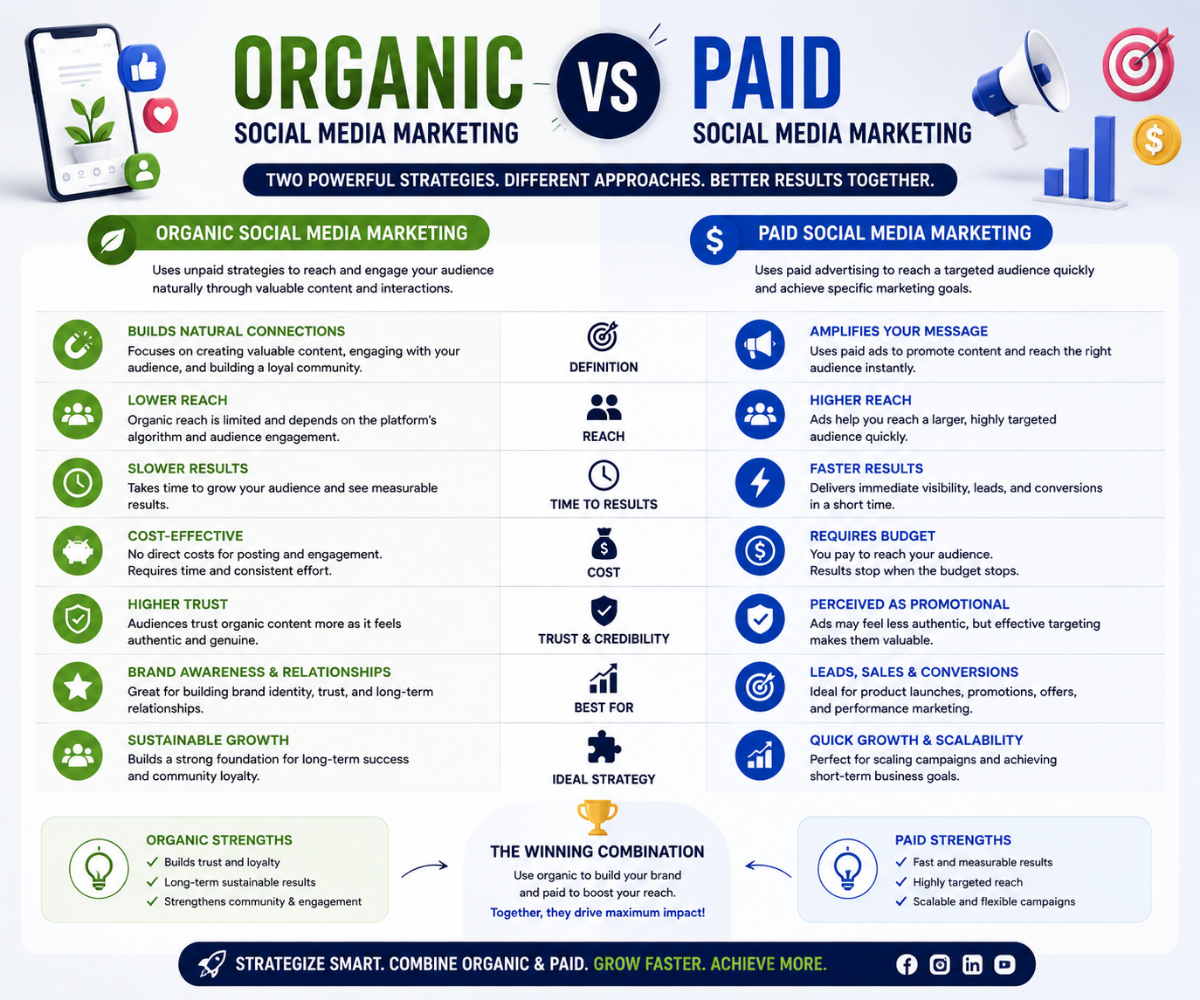
The biggest difference is how content reaches the audience.
Organic social media depends on natural distribution, followers, shares, engagement, and community interactions. Paid social media uses advertising budgets to reach selected audiences beyond the brand’s existing followers.
Organic marketing generally focuses on long-term audience relationships, while paid marketing can provide faster and more controlled reach.
Both approaches can work together and should not necessarily be treated as competing strategies. Current social-media guidance similarly emphasizes that organic and paid social can serve different roles while working together as part of one strategy.
For students attending digital marketing classes, understanding this distinction is important because businesses rarely need to choose between organic and paid marketing completely. Instead, marketers need to determine how much effort and budget should be allocated to each approach.
Organic content can establish credibility and provide useful information, while paid campaigns can help amplify selected messages and reach new audiences.
Benefits of Organic Social Media Marketing
Organic social media provides several advantages for businesses.
Builds Long-Term Relationships
Regularly sharing valuable content allows businesses to develop relationships with their followers. Consistent interaction can help create a sense of community around the brand.
A business that consistently answers questions, shares educational information, responds to comments, and participates in conversations can gradually develop stronger audience relationships.
In digital marketing classes, learners can explore different engagement techniques that help brands maintain relationships with their social media communities.
Establishes Brand Credibility
Educational and informative content can demonstrate a brand’s knowledge and expertise. Over time, this can help establish trust with potential customers.
For example, an educational institute can share industry insights, career guidance, student achievements, and useful marketing tips. Such content can demonstrate expertise without making every post directly promotional.
Supports Brand Personality
Organic content gives brands an opportunity to show their personality through conversations, stories, videos, and community interactions.
Behind-the-scenes content, employee stories, customer experiences, and informal videos can make a business feel more approachable.
Students in digital marketing classes can learn how different content formats contribute to brand personality and audience engagement.
Cost-Effective for Consistent Content
Businesses do not need to pay for every organic post to be published. However, organic marketing still requires investment in content creation, design, strategy, and management.
Therefore, calling organic social media completely “free” can be misleading. Although there may be no direct media cost, businesses still invest time and resources into creating and managing content.
Limitations of Organic Social Media Marketing
Organic marketing also has some limitations.
One major challenge is that organic reach can be unpredictable. Not every follower will necessarily see every post.
Building a large audience can also take considerable time. Businesses need to consistently publish valuable content and actively engage with their audience.
Organic social media may therefore be more suitable for businesses looking to build long-term visibility and relationships rather than relying on immediate results.
This is an important point for students learning through digital marketing classes because social media growth does not always happen instantly. A strong organic strategy usually requires consistency, experimentation, patience, and regular performance analysis.
Another challenge is content competition. Businesses are competing with creators, influencers, other brands, and personal content for users’ attention. This makes content quality and relevance increasingly important.
Benefits of Paid Social Media Marketing
Paid social media provides businesses with greater control over audience targeting and campaign objectives.
Faster Audience Reach
Paid advertising can help businesses reach a large number of relevant users without waiting for organic content to gain visibility.
This can be particularly useful when a business launches a new product, announces an offer, promotes an event, or wants to generate leads within a specific period.
Precise Targeting
Advertisers can target specific audience groups based on different characteristics and behaviors.
Depending on the platform and campaign setup, marketers may be able to define audiences using demographic information, interests, behaviors, previous interactions, or other available targeting options.
Understanding targeting is an important part of practical digital marketing classes because selecting the right audience can influence the efficiency of an advertising campaign.
Supports Lead Generation
Paid campaigns can be designed specifically to generate enquiries, registrations, sign-ups, or other desired actions.
For example, a business can create an advertisement promoting a service and direct interested users to a landing page containing a lead form which can be learned from the digital marketing classes.
Easier Performance Measurement
Businesses can track metrics such as impressions, clicks, engagement, cost per click, leads, conversions, and return on advertising spend.
This allows marketers to evaluate campaigns and make data-driven decisions.
Students in digital marketing classes can use these metrics to understand whether an advertising campaign is generating the desired results.
Limitations of Paid Social Media Marketing
Paid social media requires a marketing budget. Once advertising spending stops, the additional paid reach generated by those campaigns generally stops as well.
Poor targeting or weak advertising creative can also result in wasted spending.
Businesses need to continuously test audiences, creatives, offers, and campaign objectives to improve advertising performance.
Another challenge is ad fatigue. When audiences repeatedly see the same advertisement, their attention can decrease. This means marketers need to refresh creatives and monitor campaign performance.
Practical digital marketing classes should therefore teach students that paid advertising is not simply about putting money behind a post. It involves planning, testing, monitoring, optimization, and measurement.
Organic vs Paid: Which One Should Businesses Choose?
The answer depends on the business’s objectives, budget, audience, and marketing strategy.
Organic social media is useful for building a long-term presence, developing trust, educating audiences, and creating a community.
Paid social media is useful when businesses want faster reach, targeted exposure, lead generation, or measurable campaign outcomes.
For many businesses, the most effective approach is to combine both which can be learned from the digital marketing classes.
The decision should also depend on the stage of the business. A new business may need to establish its brand identity and content presence before investing heavily in paid campaigns. A business with an established audience may use paid campaigns to promote successful content or specific offers.
This strategic decision-making is one of the most useful concepts students can learn through digital marketing classes.
How Organic and Paid Social Media Can Work Together
Organic and paid marketing can support each other in several ways.
For example, a business may publish several organic posts to understand which topics receive the most engagement. The strongest-performing content can then be used as inspiration for paid advertising.
Similarly, paid campaigns can introduce new users to a brand, while organic content gives those users more reasons to follow and engage with the business.
This creates a journey where paid marketing helps attract attention and organic marketing helps build the relationship.
A hybrid approach can therefore allow marketers to use organic content for learning and relationship-building while using paid advertising to expand distribution.
In practical digital marketing classes, students can learn this process by creating an organic content plan and then identifying which pieces of content could potentially be promoted through paid campaigns.
For example:
Step 1: Create educational organic content.
Step 2: Monitor engagement.
Step 3: Identify high-performing content.
Step 4: Develop paid creative based on successful messages.
Step 5: Target relevant audiences.
Step 6: Monitor advertising results.
Step 7: Use the data to improve future content.
This creates a continuous learning cycle between organic and paid marketing.
When Should You Use Organic Social Media?
Organic social media can be particularly useful when the goal is to:
● Build a community
● Increase brand trust
● Educate an audience
● Share company updates
● Develop brand personality
● Engage existing followers
● Encourage conversations
Organic content is especially valuable for businesses that want to create a recognizable and trustworthy brand over time.
For students in digital marketing classes, these objectives demonstrate why social media should not always be measured only through sales. Engagement, conversations, audience growth, and brand familiarity can also be important outcomes.
Organic social media can also help businesses test ideas before spending money on advertising. If a particular topic consistently performs well organically, it may provide useful insight for future campaigns from the digital marketing classes.
When Should You Use Paid Social Media?
Paid social media can be useful when the goal is to:
● Generate leads
● Promote an offer
● Increase website traffic
● Launch a product
● Reach a new audience
● Drive registrations
● Increase sales
● Retarget previous visitors
Paid campaigns can provide businesses with additional reach and more control over who sees their advertisements.
For example, an educational institute may use paid social media to promote a course registration offer to a relevant audience. An e-commerce company may use paid campaigns to promote products to potential customers.
Learning when to use paid campaigns is an important part of digital marketing classes, because marketers need to connect campaign objectives with appropriate advertising strategies.
Important Metrics to Track
The metrics you monitor should depend on whether your campaign is organic or paid.
For organic social media, marketers can track:
● Reach
● Engagement
● Comments
● Shares
● Saves
● Follower growth
● Profile visits
● Website clicks
For paid social media, marketers can track:
● Impressions
● Click-through rate
● Cost per click
● Cost per lead
● Conversion rate
● Leads generated
● Advertising spend
● Return on advertising spend
Tracking these metrics helps marketers understand whether their social media activity is contributing to their overall marketing goals.
Students attending digital marketing classes should learn that metrics should always be connected to objectives. For example, a brand-awareness campaign may focus on reach and impressions, while a lead-generation campaign may focus more heavily on leads and cost per lead.
Looking at one metric in isolation can sometimes lead to incorrect conclusions. Marketers should consider multiple metrics together and compare performance over time.
Common Social Media Marketing Mistakes
One common mistake is relying entirely on organic reach and expecting rapid growth. Organic marketing usually requires consistency and patience.
Another mistake is running paid campaigns without clearly defining the target audience or campaign objective.
Businesses can also make the mistake of using the same content and strategy across every platform without considering the differences between audiences and formats.
Finally, failing to analyze performance can prevent marketers from understanding what works and what needs improvement.
These mistakes are commonly addressed in practical digital marketing classes, where students can learn how to develop social media strategies based on business objectives rather than simply posting content.
Another mistake is focusing too much on follower count. A large following does not automatically mean that a business is generating valuable engagement or conversions.
Businesses should instead focus on relevant audiences and meaningful outcomes.
Best Practices for Organic and Paid Social Media
A strong social media strategy should combine creativity with data.
Businesses should create valuable organic content consistently, understand their audience, maintain a recognizable brand identity, and encourage genuine engagement.
For paid campaigns, marketers should define clear objectives, select relevant audiences, create compelling advertisements, optimize landing pages, test different creatives, and monitor campaign performance.
The key is to make both organic and paid activities work toward the same overall business objectives.
For learners attending digital marketing classes, one useful way to understand this approach is to think of organic and paid marketing as two connected parts of the same social media strategy.
Organic content can answer:
What does our audience care about?
Paid advertising can answer:
How can we reach more of the right audience with this message?
Together, these approaches can help businesses build awareness, engagement, and conversions from the digital marketing classes.
How to Create a Balanced Social Media Strategy
A balanced social media strategy starts with clearly defining the business objective.
If the primary objective is brand awareness, marketers may focus on educational organic content, engaging videos, community interactions, and selected paid awareness campaigns.
If the objective is lead generation, businesses may combine informative organic content with targeted paid campaigns that direct users toward lead forms or landing pages.
If the objective is sales, marketers may combine product-focused organic content, customer testimonials, promotional posts, retargeting, and conversion-focused advertising.
Students in digital marketing classes can practice creating different strategies based on different objectives. This helps them understand that there is no single social media strategy that works for every business.
Budget should also be considered. A business with limited resources may initially rely more heavily on organic content while testing small paid campaigns. A business with a larger advertising budget may use paid campaigns more aggressively while maintaining a strong organic presence.
Role of Content in Organic and Paid Marketing
Content is the foundation of both organic and paid social media.
Organic marketing depends on content to attract and engage followers. Paid advertising also requires strong creative assets to capture attention and encourage users to take action.
A poorly designed advertisement may not perform well even with precise targeting. Similarly, an organic profile with repetitive or irrelevant content may struggle to retain followers.
This is why digital marketing classes should not teach social media advertising separately from content marketing. Marketers need to understand how headlines, visuals, videos, captions, offers, and calls-to-action influence audience response.
Different platforms also require different content approaches. A short video may work well in one environment, while an educational carousel or professional post may be more suitable for another.
Role of Analytics in Social Media Marketing
Analytics helps marketers understand what is working and what needs improvement.
Organic analytics can reveal which posts generate engagement, which content formats receive attention, and how audiences interact with the brand.
Paid analytics can help marketers evaluate advertising performance, including clicks, conversions, costs, and audience response.
For students attending digital marketing classes, learning analytics is important because social media decisions should not depend entirely on assumptions.
Marketers can use performance data to answer questions such as:
- Which content receives the most engagement?
- Which audience responds best to advertisements?
- Which campaign generates the most leads?
- Which creative produces better results?
- Which platform contributes most to business objectives?
- Where is the audience dropping off?
These insights can then be used to improve future campaigns.
Organic and Paid Social Media for Small Businesses
Small businesses can benefit from both organic and paid marketing, but their approach may differ from that of larger organizations.
Organic social media can help small businesses establish a local presence, communicate directly with customers, share behind-the-scenes content, and build relationships.
Paid advertising can then be used selectively to promote important offers, events, products, or services.
For students taking digital marketing classes, small-business examples can provide useful insight into how marketing strategies need to adapt to available resources.
A small business does not necessarily need a large advertising budget to begin testing paid campaigns but can start their journey with the digital marketing classes. It can start with clearly defined objectives, a specific audience, suitable creative, and measurable outcomes.
Organic and Paid Social Media for Educational Brands
Educational institutes can use organic social media to share educational tips, student experiences, industry information, career guidance, course-related information, and achievements.
Paid social media can then be used to reach prospective students with specific course promotions, workshops, webinars, events, or enquiry campaigns.
This makes social media particularly relevant for education marketing.
Students learning through digital marketing classes can study educational brands as examples of how organic content can build credibility while paid campaigns can support lead generation.
Why Practical Training Matters
Understanding definitions is only the beginning. Marketers need to know how to apply organic and paid social media concepts to actual campaigns.
Practical digital marketing classes can help learners develop skills such as:
- Creating social media calendars
- Developing content ideas
- Writing captions
- Creating social media creatives
- Planning paid campaigns
- Selecting target audiences
- Setting campaign objectives
- Understanding advertising budgets
- Monitoring performance
- Interpreting campaign metrics
- Improving underperforming campaigns
Practical experience can help students understand the difference between simply knowing a concept and actually applying it.
For example, reading about paid advertising is different from creating an advertising campaign, selecting an audience, analyzing results, and making optimization decisions.
Future of Organic and Paid Social Media Marketing
Social media marketing will continue to evolve as platforms, technologies, content formats, and audience behavior change.
Artificial intelligence, automation, creator content, short-form video, personalization, and advanced analytics are influencing how marketers create and distribute content.
However, the fundamental principles remain important. Businesses still need to understand their audience, create valuable content, communicate effectively, and measure results.
This is why modern digital marketing classes should focus not only on today’s platforms but also on developing adaptable marketing skills.
A marketer who understands strategyfrom digital marketing classes can learn new platforms more easily because they already understand the principles behind audience targeting, content creation, engagement, advertising, and measurement.
Conclusion
Organic and paid social media marketing serve different purposes, but both can play an important role in a successful digital marketing strategy. Organic marketing helps businesses build relationships, trust, community, and long-term visibility, while paid marketing provides targeted reach, faster exposure, and measurable advertising opportunities.
For aspiring digital marketers, understanding how these approaches work together is an important practical skill. NIDM (National Institute of Digital Marketing) helps learners develop knowledge across key areas of digital marketing, including social media marketing, SEO, paid advertising, content marketing, analytics, and lead generation.
Through practical digital marketing classes, learners can understand how to plan organic content, develop paid campaigns, analyze performance, and connect social media activities with broader business objectives.
The best social media strategy is not necessarily about choosing organic or paid marketing. It is about understanding the strengths of both and using them strategically to achieve specific marketing goals.
Whether a business wants to build a community, increase brand awareness, generate leads, drive website traffic, or increase sales, the right combination of organic and paid social media can help support those objectives.
For aspiring professionals, digital marketing classes can provide the foundation needed to understand these strategies and apply them to different business situations. As social media platforms continue to change, marketers who combine creativity, strategy, analytics, and practical skills will be better prepared to adapt.
Ultimately, successful social media marketing is not about posting more or spending more. It is about understanding the audience, creating the right content, choosing the right distribution method, measuring performance, and continuously improving the strategy. That is the practical approach that makes digital marketing classes valuable for anyone looking to build skills and pursue opportunities in the digital marketing industry.