Online Best Digital Marketing Course: Role of AI Tools in Modern Digital Marketing
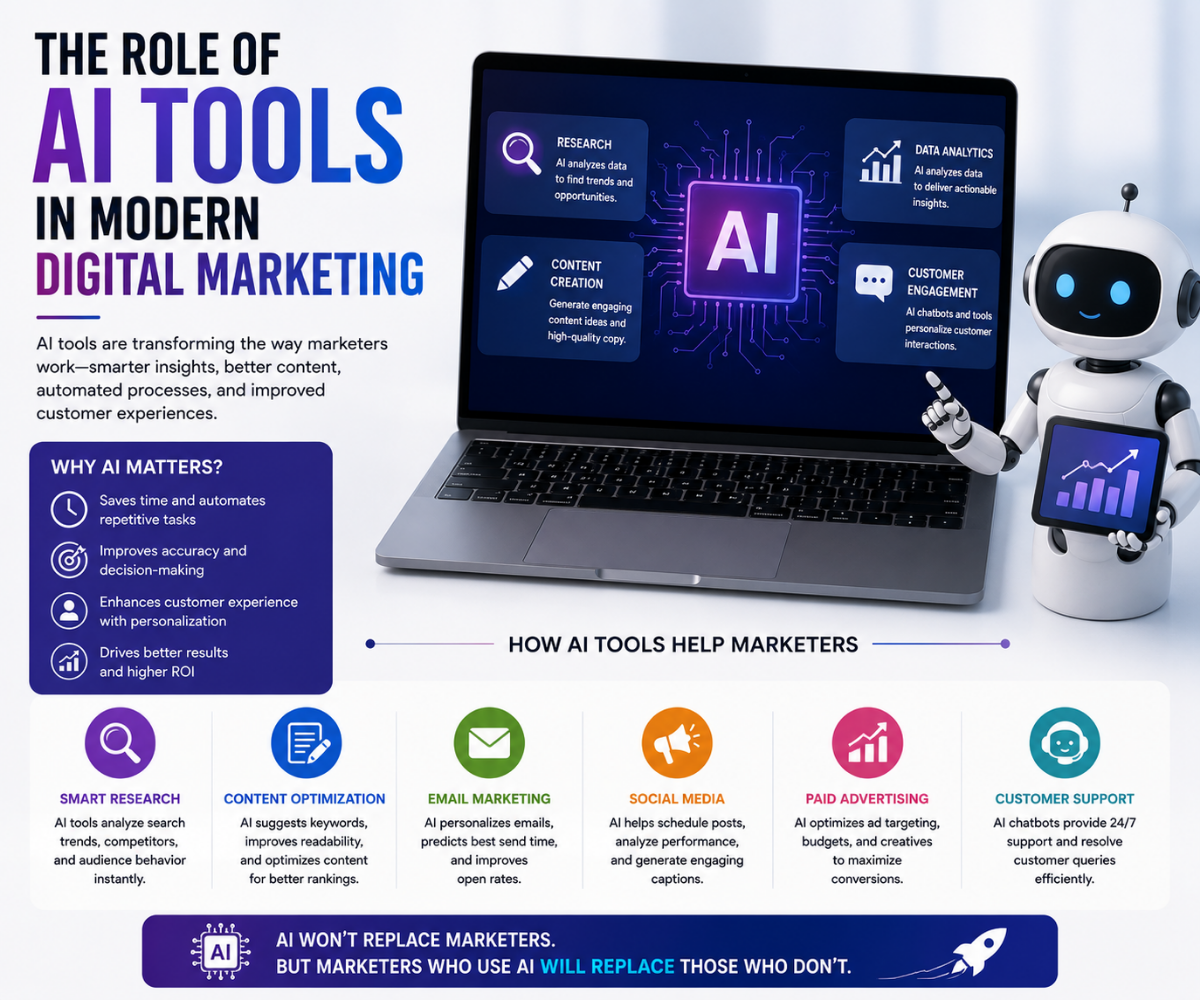
Artificial Intelligence (AI) has become one of the most important technologies shaping modern digital marketing. From content creation and customer research to advertising, SEO, analytics, and automation, AI tools are helping marketers complete tasks faster and make more informed decisions. As digital marketing continues to evolve, understanding how AI works and how marketers can use it has become an important professional skill.
For students searching for an online best digital marketing course, learning about AI tools can provide an advantage because modern marketing increasingly involves technology, automation, data analysis, and personalization. AI does not completely replace marketers. Instead, it can help marketers reduce repetitive work, analyze large amounts of information, generate ideas, and improve ca.commpaign efficiency.
The growth of AI has also changed the skills expected from digital marketing professionals. Earlier, marketers spent significant amounts of time manually researching keywords, creating content ideas, analyzing reports, and managing repetitive tasks. Today, AI-powered tools can assist with many of these activities.
For anyone considering an online best digital marketing course, understanding the practical role of AI in marketing can help build skills that are relevant across SEO, social media, content marketing, email marketing, paid advertising, and analytics.
What Are AI Tools in Digital Marketing?
AI tools are software applications that use artificial intelligence technologies to perform tasks that normally require human intelligence. These tasks can include understanding language, identifying patterns, generating content, making predictions, analyzing data, and automating decisions.
In digital marketing, AI tools can assist marketers in several areas, including:
- Content creation
- Keyword research
- Search engine optimization
- Social media marketing
- Email marketing
- Customer segmentation
- Advertising
- Data analysis
- Chatbots
- Marketing automation
- Competitor research
- Personalization
An online best digital marketing course can introduce learners to these applications and explain how AI fits into a wider marketing strategy.
The important point is that AI should be treated as a marketing assistant rather than a complete replacement for strategic thinking. Marketers still need to understand customers, business objectives, branding, positioning, and communication.
Why AI Has Become Important in Digital Marketing
Modern digital marketing produces enormous amounts of information. Businesses collect data from websites, social media platforms, search engines, advertising campaigns, email campaigns, and customer interactions.
Manually analyzing all this information can take considerable time. AI tools can process large datasets and identify patterns much faster.
For marketers, this can mean faster research, quicker reporting, more personalized communication, and improved workflow efficiency.
Students taking an online best digital marketing course can learn how AI can be incorporated into different stages of a marketing campaign rather than using it for only content generation.
AI is particularly useful when marketers need to perform repetitive tasks. Instead of spending hours creating initial drafts or organizing information, marketers can use AI to create a starting point and then apply human judgment to improve the final result.
AI Tools for Content Creation
Content marketing is one of the areas where AI tools have become particularly popular.
AI-powered writing tools can help marketers generate:
- Blog ideas
- Headlines
- Social media captions
- Email drafts
- Product descriptions
- Content outlines
- Video scripts
- Ad copy
- FAQs
For someone pursuing an online best digital marketing course, learning how to use AI for content creation can improve productivity.
However, AI-generated content should not simply be copied and published without review. Marketers need to check accuracy, tone, originality, brand voice, relevance, and usefulness.
AI can provide the initial draft, but human marketers are responsible for ensuring that the final content provides real value to the audience.
For example, a marketer could ask an AI tool to generate ten blog ideas about digital marketing. The marketer can then select the most relevant topics, conduct additional research, add examples, and create a stronger final article.
This approach combines AI efficiency with human creativity.
AI Tools for SEO
Search engine optimization is another area where AI tools can support marketers.
AI can assist with tasks such as:
- Keyword research
- Search intent analysis
- Content planning
- Topic clustering
- Competitor analysis
- Meta title ideas
- Meta descriptions
- Content optimization
- Internal linking suggestions
An online best digital marketing course that includes AI-powered SEO training can help learners understand how technology can support traditional SEO processes.
For example, marketers can use AI to brainstorm related keywords and topics around a primary keyword. They can then evaluate those suggestions using SEO tools and human judgment.
AI can also help marketers identify content gaps by analyzing existing information and suggesting topics that may be missing from a website.
However, SEO still requires strategic thinking. Search engines evaluate many factors, and simply generating large quantities of AI content does not automatically guarantee strong rankings.
AI for Social Media Marketing
Social media marketers are responsible for creating content, managing calendars, monitoring engagement, understanding audiences, and analyzing performance.
AI tools can help streamline many of these activities.
Marketers can use AI to generate:
- Caption ideas
- Content themes
- Post ideas
- Hashtag suggestions
- Short-form video concepts
- Content calendars
- Audience insights
- Engagement summaries
For learners enrolled in an online best digital marketing course, AI-powered social media workflows can demonstrate how marketers can save time while maintaining consistency.
AI can also help analyze which types of content receive stronger engagement. A marketer can use these insights to identify patterns and develop future content strategies.
However, social media still requires creativity and authenticity. Audiences may respond negatively to content that feels repetitive or overly automated. Therefore, AI should assist the social media manager rather than completely control the brand’s communication.
AI in Paid Advertising
Paid advertising involves creating campaigns, selecting audiences, developing advertisements, managing budgets, and analyzing performance.
AI can assist with several aspects of this process.
AI-powered advertising systems can help marketers optimize campaigns based on performance signals. AI tools can also help generate different variations of advertising copy and creative concepts.
For students taking an online best digital marketing course, understanding AI in paid advertising can help them learn how automation and machine learning are increasingly involved in campaign optimization.
For example, a marketer could create multiple versions of an advertisement and use campaign performance data to identify which version performs better.
AI can also help marketers identify patterns in customer behavior and improve audience targeting.
Nevertheless, marketers need to define clear campaign objectives and monitor results. Automation does not eliminate the need for human oversight.
AI for Customer Research
Understanding customers is one of the most important parts of marketing.
AI tools can help marketers analyze customer reviews, survey responses, comments, feedback, and other forms of customer communication.
This can help identify:
- Common customer problems
- Frequently asked questions
- Customer preferences
- Positive feedback
- Negative feedback
- Buying motivations
- Objections
- Common topics of discussion
An online best digital marketing course can teach students how customer research connects with content strategy, advertising, SEO, and brand positioning.
For example, if a company receives hundreds of customer reviews, manually analyzing every review may take significant time. AI can help summarize recurring themes, after which marketers can examine the findings and use them to improve campaigns.
AI for Personalization
Customers increasingly expect brands to provide relevant experiences.
AI can help businesses personalize marketing messages based on customer behavior and preferences.
Personalization can be applied to:
- Email campaigns
- Product recommendations
- Website experiences
- Advertising
- Content suggestions
- Customer communication
For someone completing an online best digital marketing course, understanding personalization can help explain why customer data and AI are becoming closely connected.
For example, an online store may recommend products based on a customer’s previous browsing or purchasing behavior.
Similarly, email marketers can use customer information to create more relevant communication.
Personalization can make marketing more useful, but businesses must also use customer data responsibly and respect privacy requirements.
AI Chatbots and Customer Support
AI-powered chatbots are increasingly used by businesses to answer common customer questions.
Chatbots can assist with:
- Frequently asked questions
- Product information
- Service details
- Appointment enquiries
- Basic troubleshooting
- Lead qualification
- Customer support
An online best digital marketing course can help learners understand how chatbots fit into marketing automation and lead-generation strategies.
For example, a business website can use a chatbot to answer basic questions and collect contact details from interested visitors.
This can reduce the workload on customer service teams and provide customers with immediate responses.
However, complex customer problems may still require human assistance. A good chatbot strategy should therefore provide a clear path to human support when necessary.
AI for Email Marketing
Email marketing can also benefit from AI.
AI tools can assist marketers with:
- Subject-line ideas
- Email copy
- Audience segmentation
- Personalization
- Send-time recommendations
- Campaign analysis
- A/B testing ideas
Students studying through an online best digital marketing course can use AI to understand how email marketing can become more personalized and data-driven.
For example, marketers can create different messages for new subscribers, existing customers, inactive users, and repeat buyers.
AI can help organize and analyze these segments, while marketers can decide which message and offer are appropriate for each audience.
AI for Marketing Analytics
Analytics is one of the most important applications of AI in digital marketing.
Marketing teams often have access to large amounts of data from multiple platforms. AI can help identify trends and patterns within this data.
AI can support marketers by helping them understand:
- Campaign performance
- Customer behavior
- Conversion trends
- Website activity
- Audience patterns
- Content performance
- Advertising results
For learners taking an online best digital marketing course, understanding AI analytics can help them move beyond simply collecting numbers.
The real value of analytics is using data to make decisions.
For example, if a campaign generates many clicks but very few conversions, marketers need to investigate why. The problem could be the landing page, offer, audience, messaging, or user experience.
AI can help identify patterns, but marketers still need to interpret the results and determine the appropriate action.
AI for Marketing Automation
Marketing automation allows businesses to automate repetitive marketing activities.
AI can make automation more intelligent by helping systems respond to customer behavior.
Examples include:
- Automated email sequences
- Lead scoring
- Customer segmentation
- Personalized recommendations
- Follow-up messages
- Chatbot responses
- Campaign reporting
An online best digital marketing course can help students understand how AI and automation can work together.
For example, when a visitor submits a lead form, an automated system can send an initial email, categorize the lead, and trigger follow-up communication.
This allows marketers to spend more time on strategy and creative work instead of repetitive administrative tasks.
AI for Competitor Research
Competitor analysis is another area where AI tools can assist marketers.
Marketers can use AI to organize information about competitors, identify recurring themes in their content, analyze messaging, and brainstorm potential opportunities.
For students pursuing an online best digital marketing course, competitor research using AI can demonstrate how technology can accelerate the research process.
However, marketers should not blindly accept AI-generated competitor insights. Information should be verified using reliable sources and actual competitor websites or campaigns.
The role of AI is to make research more efficient, not to eliminate research completely.
AI and Video Marketing
Video has become an important format across many digital platforms.
AI tools can assist video marketers with:
- Script ideas
- Video concepts
- Captions
- Transcriptions
- Editing assistance
- Content repurposing
- Short-form video ideas
An online best digital marketing course can help learners understand how AI can support the video production workflow.
For example, a long educational video can be converted into several short-form content ideas. AI can help identify potential sections, create initial scripts, or generate captions which can be learned from the online best digital marketing course.
Human creativity remains important because successful video content requires storytelling, relevance, emotion, and a clear understanding of the audience.
AI and Predictive Marketing
One of the more advanced applications of AI is predictive marketing.
Predictive systems use available data to identify patterns that may help marketers anticipate future customer behavior.
Businesses can potentially use predictive insights to understand:
- Which customers may be ready to purchase
- Which leads are more likely to convert
- Which customers may stop engaging
- Which products may receive greater interest
- Which campaigns may perform better
Students taking an online best digital marketing course can benefit from learning the basic concepts behind predictive marketing because data-driven decision-making is becoming increasingly important.
Predictive insights should still be treated as guidance rather than guaranteed outcomes. Customer behavior can change because of market conditions, competition, pricing, trends, and many other factors.
Advantages of Using AI Tools in Digital Marketing
AI provides several advantages to modern marketers.
Saves Time
AI can complete many repetitive tasks quickly, allowing marketers to focus on higher-value activities.
Improves Productivity
Marketers can use AI to generate initial ideas, summarize information, organize research, and assist with reporting.
Supports Data Analysis
AI can help process large amounts of information and identify patterns.
Enables Personalization
AI can help marketers create more relevant experiences for different customer groups.
Supports Faster Experimentation
Marketers can create multiple content or advertising variations more quickly and test different approaches.
An online best digital marketing course can help learners understand how to use these advantages while avoiding overdependence on automation.
Limitations of AI Tools in Digital Marketing
Although AI offers many benefits, it also has limitations.
AI-generated information can sometimes be inaccurate or incomplete. AI may also produce repetitive content or misunderstand the context of a specific business.
Another limitation is that AI cannot completely replace human creativity, empathy, strategic judgment, or understanding of brand identity.
For students enrolled in an online best digital marketing course, learning these limitations is just as important as learning the benefits.
Marketers should always review AI-generated content and verify important information before publishing it.
AI tools should support professional decision-making rather than replace it.
Human Creativity and AI Should Work Together
The most effective approach is not necessarily AI versus humans and can be learnt from the online best digital marketing course.
Instead, modern digital marketing can combine the strengths of both.
AI is good at:
- Processing information
- Identifying patterns
- Generating initial ideas
- Automating repetitive activities
- Organizing large datasets
Humans are good at:
- Strategic thinking
- Creativity
- Emotional understanding
- Brand storytelling
- Critical thinking
- Ethical decision-making
An online best digital marketing course should therefore teach learners how to combine AI capabilities with human marketing skills.
For example, AI may generate ten campaign ideas, but the marketer needs to determine which idea fits the brand, audience, budget, and objective.
This human-AI collaboration can produce stronger marketing outcomes than relying completely on either approach alone.
Skills Marketers Need in the AI Era
As AI becomes more common, digital marketers need to develop a combination of technical and creative skills.
Important skills include:
- AI tool usage
- Prompt writing
- Content strategy
- SEO
- Social media marketing
- Paid advertising
- Analytics
- Marketing automation
- Customer research
- Critical thinking
- Creativity
- Data interpretation
For anyone choosing an online best digital marketing course, it is useful to select training that covers both traditional digital marketing fundamentals and modern AI applications.
Learning only how to operate an AI tool is not enough. Marketers need to understand why and when a particular tool should be used.
How Beginners Can Start Using AI in Digital Marketing
Beginners do not need to start with complicated AI systems with online best digital marketing course.
They can begin with simple applications such as:
- Generating content ideas
- Creating blog outlines
- Brainstorming social media posts
- Summarizing research
- Creating email drafts
- Analyzing basic campaign data
- Developing customer personas
- Creating advertising variations
An online best digital marketing course can provide a structured environment where learners can practice these applications.
Once learners understand the fundamentals, they can gradually explore more advanced applications such as automation, predictive analytics, personalization, and AI-powered advertising.
Best Practices for Using AI Tools
Marketers should follow a few important practices when using AI.
Always Review AI Output
Never assume that AI-generated information is automatically accurate.
Maintain Brand Voice
AI-generated content should be edited to match the company’s tone and communication style.
Protect Sensitive Information
Marketers should be careful about entering confidential business or customer information into AI systems.
Use AI for Assistance
AI should support marketers rather than completely replace strategic decision-making.
Combine AI With Research
AI-generated ideas should be validated through appropriate research and reliable information.
Focus on Customer Value
The purpose of using AI should ultimately be to create better marketing experiences, not simply produce more content.
An online best digital marketing course can help learners understand these practices and develop responsible AI workflows.
Future of AI in Digital Marketing
The role of AI in digital marketing is likely to continue expanding.
More marketing platforms are incorporating AI into content creation, analytics, advertising, personalization, customer service, and automation.
This means digital marketers will increasingly need to understand how technology affects their work.
For students considering an online best digital marketing course, learning AI today can help them become more comfortable with the technologies shaping modern marketing.
However, the future of digital marketing will not be based on AI alone. Businesses will continue to need marketers who understand customers, brands, communication, strategy, and business objectives.
The most valuable professionals will likely be those who can combine marketing knowledge with effective AI usage with online best digital marketing course.
Conclusion
AI tools are transforming modern digital marketing by helping businesses automate repetitive activities, analyze data, personalize customer experiences, generate content ideas, improve advertising, support SEO, and understand audiences more effectively.
For aspiring marketers, learning how to use AI responsibly can provide an important advantage. An online best digital marketing course can help learners understand both the fundamentals of digital marketing and the role that AI can play across different marketing channels.
The goal should not be to use AI simply because it is available. Marketers need to identify where AI can genuinely improve efficiency, accuracy, creativity, customer experience, and decision-making.
NIDM (National Institute of Digital Marketing) helps learners build knowledge across important areas of digital marketing, including SEO, social media marketing, content marketing, paid advertising, analytics, and other practical marketing skills.
As AI continues to evolve, marketers who understand both marketing fundamentals and AI-powered tools can adapt more effectively to changes in the industry. Choosing an online best digital marketing course that combines practical digital marketing knowledge with modern AI applications can therefore be a useful step for learners who want to develop relevant skills for today’s digital environment.
Ultimately, AI is not replacing the need for good marketers. It is changing the way marketers work. Professionals who know how to use AI strategically while maintaining creativity, critical thinking, human judgment, and customer focus can use technology as a powerful marketing advantage.