Search engine optimization has evolved rapidly over the past decade. Gone are the days when websites could dominate search results simply by repeating the same keyword multiple times. Modern search engines have become smarter, more intuitive, and highly focused on user intent. This shift has introduced a major discussion in the digital marketing industry: Entity SEO vs Keyword SEO.
Today, businesses, bloggers, and marketers must understand how Google interprets content. Search engines no longer rely only on keywords. Instead, they analyze entities, context, relationships, and semantic meaning to deliver more accurate search results.
But does this mean keyword SEO is dead? Absolutely not.
Keywords still play a vital role in optimization, but entity SEO is changing how content is created and ranked. The real question is not whether one is better than the other. Instead, it’s about understanding how both strategies work together in modern SEO.
In this article, we’ll explore the complete difference between entity SEO and keyword SEO, their importance, benefits, future trends, and how to use both effectively for better rankings.
Understanding Keyword SEO
Keyword SEO is the traditional approach to search engine optimization. It focuses on optimizing web pages for specific words or phrases users type into search engines.
For years, keywords were the foundation of SEO strategies. Marketers researched high-volume search terms and inserted them strategically throughout their content.
How Keyword SEO Works
Keyword SEO involves identifying relevant phrases and placing them in important sections of a webpage, such as:
- Page titles
- Meta descriptions
- Headings
- URLs
- Image alt text
- Body content
- Internal links
For example, if a website wants to rank for “digital marketing course,” it would optimize content around that phrase.
Why Keywords Still Matter
Even though search engines are smarter today, keywords remain essential because users still search using words and phrases. Keywords help search engines understand the primary topic of a webpage.
Without proper keyword optimization:
- Pages may lose relevance
- Search engines may misunderstand content
- Rankings can decline
- Organic traffic may decrease
Advantages of Keyword SEO
Keyword SEO still offers several benefits:
- Easy content targeting
- Improved search visibility
- Better ranking opportunities for niche topics
- Effective PPC campaign support
- Clear optimization structure
However, relying only on keywords is no longer enough to compete in modern search results.
What Is Entity SEO?
Entity SEO is a more advanced and context-focused optimization strategy. Instead of concentrating only on keywords, entity SEO focuses on the meaning behind the content.
An entity is anything uniquely identifiable, such as:
- A person
- A company
- A location
- A product
- A concept
- An organization
- An event
Search engines use entities to understand relationships between topics and deliver more accurate search results.
How Entity SEO Works
Entity SEO helps search engines connect related concepts within content. Instead of focusing on repeating a single keyword, it builds semantic relevance.
For example, an article about SEO may naturally include related entities like:
- Search algorithms
- Backlinks
- Content marketing
- User intent
- Search Console
These related concepts help search engines understand the overall topic deeply.
Entity SEO and Semantic Search
Semantic search allows Google to interpret the meaning behind search queries rather than simply matching keywords.
This improves:
- Search accuracy
- User experience
- Content relevance
- Voice search performance
Entity SEO aligns perfectly with semantic search because it focuses on context and topic relationships.
The Evolution of Search Engines
To understand the importance of Entity SEO vs Keyword SEO, it’s necessary to look at how search engines evolved.
Early SEO Era
In the early days of SEO, search engines depended heavily on keyword matching. Websites could rank by stuffing keywords repeatedly into their pages.
Common tactics included:
- Excessive keyword repetition
- Hidden text
- Spammy backlinks
- Low-quality content
At that time, search engines lacked the intelligence to understand context.
Google’s Major Algorithm Updates
Google gradually improved its algorithms to prioritize quality and user experience.
Panda Update
Focused on eliminating thin and duplicate content.
Penguin Update
Targeted spammy and manipulative backlinks.
Hummingbird Update
Improved Google’s ability to understand search intent and context.
RankBrain
Introduced machine learning into search result analysis.
BERT and MUM
Enhanced natural language understanding and semantic interpretation.
These updates pushed SEO beyond simple keyword optimization.
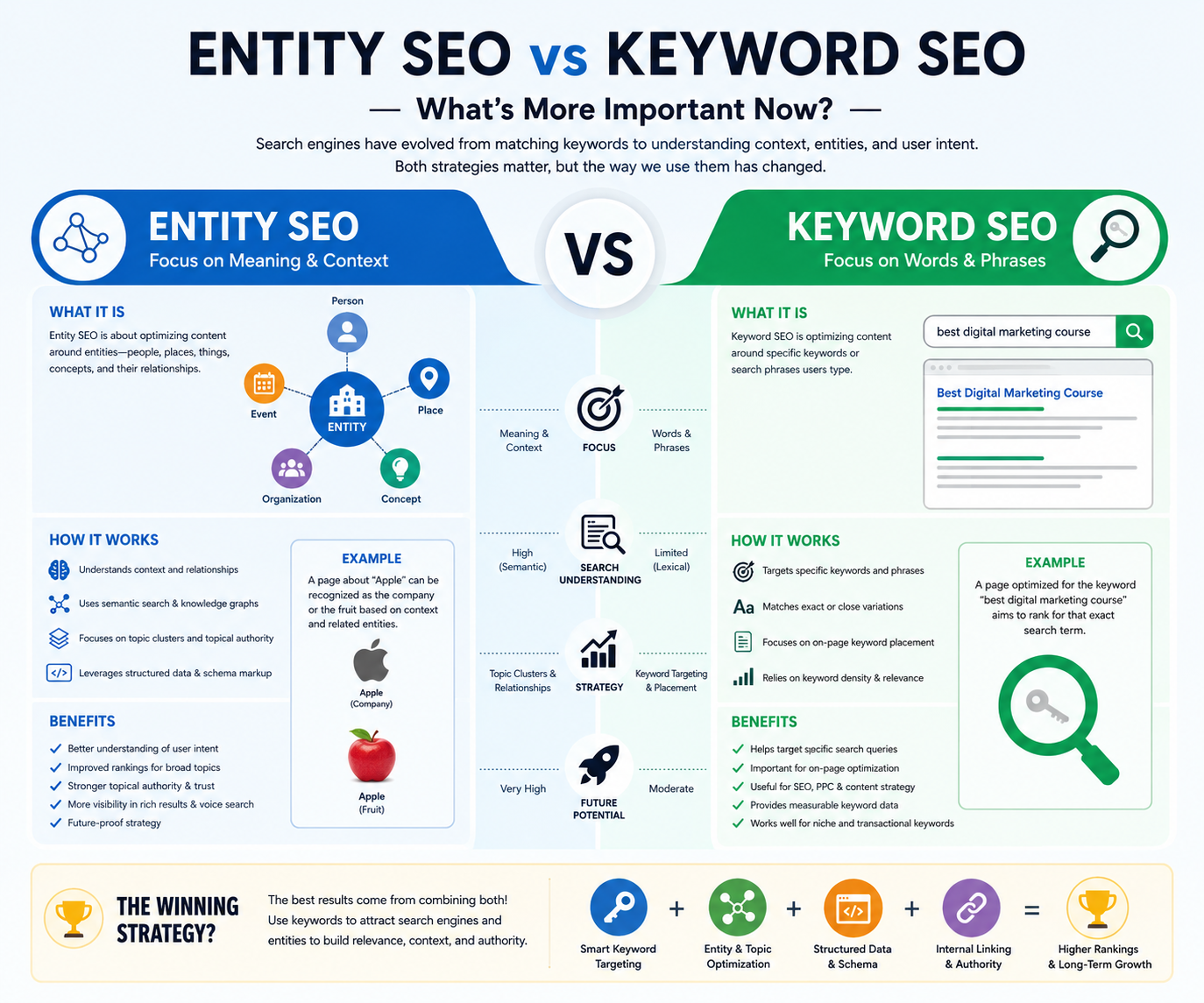
Key Differences Between Entity SEO and Keyword SEO
Although both strategies aim to improve rankings, they function differently.
| Feature | Keyword SEO | Entity SEO |
|---|---|---|
| Primary Focus | Keywords | Meaning and context |
| Optimization Style | Exact phrases | Semantic relationships |
| Search Intent Understanding | Limited | Advanced |
| Content Strategy | Keyword-centric | Topic-centric |
| Future Relevance | Moderate | Very High |
| Voice Search Support | Basic | Strong |
The biggest difference is that keyword SEO tells search engines what the content contains, while entity SEO helps search engines understand what the content means.
Why Entity SEO Is Becoming More Important
Modern search engines aim to deliver accurate and meaningful search results. Entity SEO supports this goal by improving contextual understanding.
Better Search Intent Matching
Users often search in conversational ways. Search engines now focus on understanding user intent rather than exact keywords.
For example:
- “Best places for coffee near me”
- “How to learn SEO fast”
- “Affordable laptops for students”
Entity SEO helps search engines interpret these queries more intelligently.
Improved Content Relevance
Entity-focused content naturally covers broader topic areas, making it more valuable to users.
Instead of targeting one keyword repeatedly, entity SEO creates depth and context.
Stronger Voice Search Optimization
Voice search queries are usually longer and more conversational.
Examples include:
- “What is the best SEO strategy for small businesses?”
- “How does entity SEO work?”
Entity SEO performs better because it aligns with natural language patterns.
Why Keyword SEO Still Matters
Despite the rise of semantic search, keyword SEO still remains essential.
Keywords Help Search Engines Categorize Pages
Keywords provide direct signals about page topics.
Without keywords, search engines may struggle to determine relevance quickly.
Important for On-Page Optimization
Keywords still influence critical SEO elements like:
- Title tags
- Headings
- URLs
- Meta descriptions
- Alt attributes
Useful for Content Planning
Keyword research helps marketers identify:
- Search demand
- User interests
- Competition levels
- Trending topics
This data remains extremely valuable for content strategy.
The Role of Google’s Knowledge Graph
Google’s Knowledge Graph is one of the biggest reasons entity SEO has gained importance.
What Is the Knowledge Graph?
The Knowledge Graph is Google’s database of entities and their relationships.
It stores information about:
- People
- Brands
- Places
- Movies
- Organizations
- Historical events
This allows Google to provide more accurate and context-aware search results.
How Knowledge Panels Work
When users search for famous entities, Google often displays a knowledge panel containing:
- Images
- Descriptions
- Related information
- Official websites
- Social profiles
This is powered by entity recognition.
How Structured Data Supports Entity SEO
Structured data helps search engines understand entities clearly.
What Is Schema Markup?
Schema markup is a form of structured data added to webpages to provide additional context.
Common schema types include:
- Article schema
- FAQ schema
- Product schema
- Organization schema
- Review schema
Benefits of Structured Data
Schema markup can improve:
- Rich snippets
- Search visibility
- Click-through rates
- Entity recognition
Structured data is a critical part of modern entity SEO strategies.
Topical Authority and Entity SEO
Topical authority has become a major ranking factor in SEO.
What Is Topical Authority?
Topical authority means covering a subject comprehensively enough for search engines to consider your website an expert source.
For example, a digital marketing website may publish detailed content about:
- SEO
- Content marketing
- Email marketing
- PPC advertising
- Social media marketing
This builds stronger semantic relevance.
Internal Linking and Semantic Relevance
Internal links help search engines understand topic relationships between pages.
A strong internal linking structure improves:
- Crawlability
- User navigation
- Contextual understanding
- Topical authority
Best Practices for Keyword SEO
Keyword optimization still requires careful execution.
Use Keywords Naturally
Avoid forcing keywords unnaturally into content.
Instead:
- Use synonyms
- Include variations
- Focus on readability
Optimize Important Areas
Include keywords strategically in:
- Titles
- Headings
- URLs
- Meta descriptions
- Image alt text
Match Search Intent
Understand what users expect when they search.
Create content that satisfies informational, navigational, or transactional intent.
Best Practices for Entity SEO
Entity SEO requires broader optimization techniques.
Build Comprehensive Content
Cover related subtopics naturally.
For example, an article about SEO should also discuss:
- Algorithms
- User intent
- Backlinks
- Technical SEO
- Content quality
Use Topic Clusters
Topic clusters organize content around a central subject.
This improves semantic connections across your website.
Strengthen Brand Signals
Consistent branding across platforms helps search engines recognize your business as an entity.
Entity SEO vs Keyword SEO for Content Marketing
Content marketing has shifted dramatically with semantic search.
Traditional Content Strategies
Older strategies focused heavily on exact-match keywords.
This often resulted in robotic and repetitive content.
Modern Content Strategies
Today’s content focuses on:
- User experience
- Contextual relevance
- Expertise
- Authority
- Engagement
Entity SEO encourages naturally informative and valuable content.
Common SEO Mistakes to Avoid
Many websites still use outdated SEO practices.
Keyword Stuffing
Overusing keywords hurts readability and user experience.
Ignoring Semantic Relationships
Content lacking contextual depth may struggle to rank competitively.
Weak Content Structure
Poor heading hierarchy reduces clarity for users and search engines.
Neglecting User Intent
Even optimized content may fail if it doesn’t solve user problems.
Which Strategy Is Better Today?
The real winner in the debate between Entity SEO vs Keyword SEO is balance.
Why Both Matter
Keyword SEO remains important for:
- Search targeting
- On-page optimization
- Content planning
Entity SEO is essential for:
- Semantic relevance
- Contextual understanding
- Voice search optimization
- Topical authority
The most successful SEO strategies combine both approaches effectively.
The Future of SEO
SEO will continue evolving toward contextual and AI-driven search experiences.
AI and Search Engines
Modern search engines use artificial intelligence to understand:
- User behavior
- Language patterns
- Search intent
- Topic relationships
This makes entity optimization increasingly valuable.
Voice Search and Conversational Queries
Voice assistants rely heavily on semantic understanding.
As voice search grows, entity SEO will become even more important.
Brand Authority Will Matter More
Strong brands with clear entity recognition may gain greater visibility across search features and AI-generated summaries.
How Businesses Can Adapt
Businesses should begin evolving their SEO strategies now.
Focus on Content Depth
Create comprehensive, valuable content rather than shallow keyword-focused articles.
Improve Website Structure
Use logical categories, topic clusters, and internal links.
Add Structured Data
Schema markup improves search engine understanding.
Build Brand Presence
Strong online mentions and consistent branding strengthen entity recognition.
Final Thought
The discussion around Entity SEO vs Keyword SEO reflects how modern search engines have evolved. Keyword SEO still plays a foundational role in helping search engines identify topics and match user queries. However, entity SEO has become increasingly important because search engines now prioritize context, relationships, and user intent.
Today, SEO success depends on more than simply inserting keywords into content. Websites must create meaningful, informative, and semantically connected content that genuinely helps users.
Businesses that combine keyword optimization with entity-focused strategies can build stronger topical authority, improve search visibility, and stay competitive in the future of search.
Rather than choosing one approach over the other, the smartest strategy is to integrate both. Keyword SEO helps search engines discover content, while entity SEO helps them truly understand it.