Digital Marketing With Placement: Content Marketing Strategies for Better Engagement
Best Digital marketing with placement programs can help aspiring marketers understand how businesses attract, engage, and convert their target audiences through different digital channels. One of the most effective ways to build meaningful connections with an audience is through content marketing and also helps to learn digital marketing with placement. Instead of focusing only on selling products or services, content marketing allows businesses to provide useful information, solve customer problems, answer questions, and build trust over time.
Content Marketing Strategies for Better Engagement
In today’s competitive digital landscape, simply creating content is not enough. Businesses need to create content that attracts attention, provides value, and encourages people to interact with their brand. This is where effective content marketing strategies play an important role. A well-planned content marketing approach can help businesses build trust, increase engagement, generate leads, and maintain long-term relationships with their audience.
Content Marketing Strategies for Better Engagement
Content marketing has become an essential part of digital marketing because it helps businesses attract, educate, and connect with their target audience. However, simply publishing content is not enough. Brands need a clear strategy to create valuable, relevant, and engaging content that encourages users to interact with them. Whether it is a business, educational institute, or Digital Marketing With Placement program, the right content marketing strategy can improve visibility, engagement, and conversions.
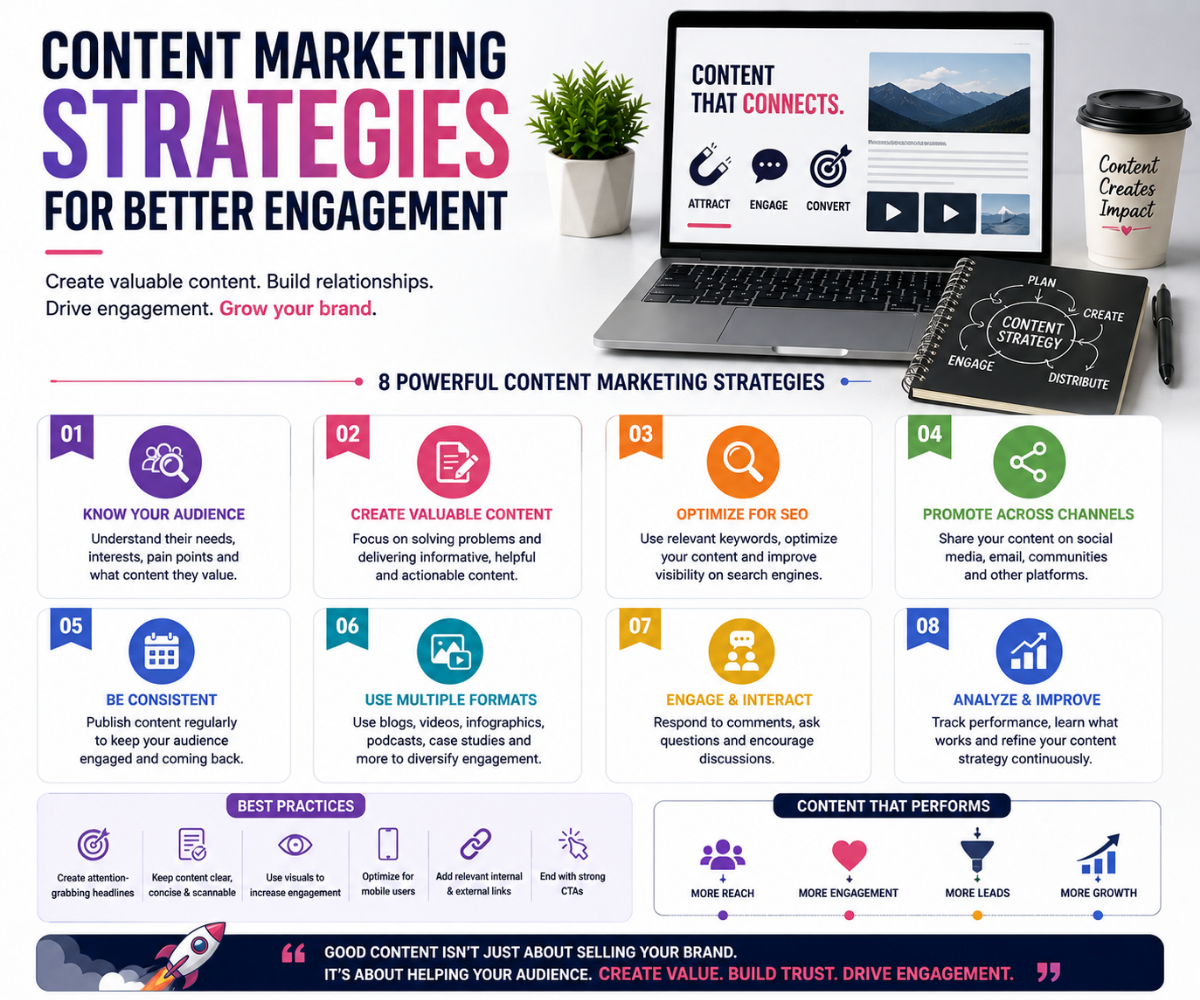
1. Understand Your Target Audience
The foundation of effective content marketing is knowing your audience. Before creating content, understand their interests, needs, challenges, and search behavior. A Digital Marketing With Placement program, for example, should understand what students want to know about digital marketing careers, course modules, practical training, and placement opportunities.
When content answers the audience’s actual questions, they are more likely to read, share, save, and engage with it.
2. Create Valuable and Relevant Content
Good content should provide genuine value instead of focusing only on promotion. Businesses can create blogs, guides, videos, infographics, case studies, and social media posts that solve problems or provide useful information.
For example, a Digital Marketing With Placement course provider can create content about SEO careers, social media marketing, Google Ads, content marketing, and digital marketing job opportunities. This type of informative content can attract students who are actively researching digital marketing as a career.
3. Use Multiple Content Formats
People consume information in different ways, so marketers should not depend on only one content format. Blogs can provide detailed information, while reels and short videos can deliver quick and engaging insights.
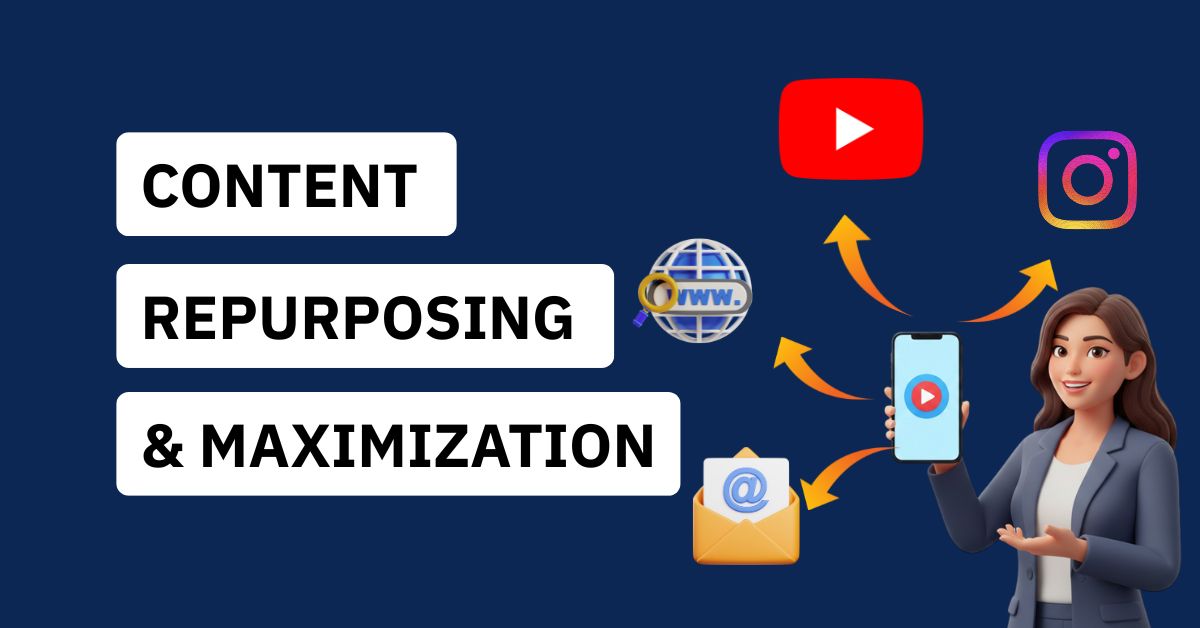
A Digital Marketing With Placement brand can turn one blog into an Instagram carousel, YouTube video, short reel, infographic, and email newsletter. Repurposing content helps maintain consistency across different platforms while reaching a wider audience.
4. Use Storytelling to Build Connections
Storytelling makes content more relatable and memorable. Instead of simply listing the features of a product, service, or course, brands can share real experiences, challenges, achievements, and success stories.
For a Digital Marketing With Placement program, student success stories can be particularly effective. Sharing how students learned practical digital marketing skills and progressed toward career opportunities can build trust and create an emotional connection with potential learners.
5. Encourage Audience Interaction
Engagement works best when content creates a two-way conversation. Marketers can ask questions, conduct polls, encourage comments, and invite users to share their opinions.
For example, a Digital Marketing With Placement institute can ask its audience which digital marketing skill they want to learn first or create a quiz about SEO and social media marketing. Interactive content encourages users to participate rather than simply consume information.
6. Optimize Content for SEO
SEO helps content reach people who are actively searching for information. Use relevant keywords naturally in the title, headings, paragraphs, image descriptions, and meta information.
For content targeting students, keywords such as Digital Marketing With Placement, digital marketing course, digital marketing career, and digital marketing training can help attract relevant search traffic when used appropriately.
7. Analyze Content Performance
Creating content is only one part of the process. Marketers should regularly track website traffic, engagement, shares, comments, clicks, leads, and conversions. These metrics reveal which topics and formats are performing well.
A Digital Marketing With Placement brand can use these insights to identify whether blogs, reels, videos, or student success stories generate the most engagement and then create more content around successful topics.
Conclusion
Effective content marketing is about creating meaningful connections with the audience. By understanding the target audience, producing valuable content, using multiple formats, incorporating storytelling, encouraging interaction, optimizing for SEO, and analyzing performance, brands can achieve better engagement. For businesses and educational brands promoting Digital Marketing With Placement, a consistent and audience-focused content strategy can also help build credibility, attract potential learners, and generate quality leads.
What Is Content Marketing?
Content marketing is a digital marketing approach that involves creating and distributing valuable, relevant, and consistent content for a specific target audience.
Content can take many forms, including:
- Blog posts
- Social media posts
- Videos
- Reels
- Infographics
- Podcasts
- E-books
- Case studies
- Email newsletters
- Guides
- Webinars
The main objective is to create content that provides value to the audience while supporting broader business and marketing goals.
Why Is Content Marketing Important for Engagement?
Creating content is not enough. Businesses need content that encourages people to interact with the brand.
Engaging content can help businesses:
- Build relationships with their audience
- Increase brand awareness
- Establish industry expertise
- Encourage conversations
- Generate website traffic
- Improve customer loyalty
- Generate leads
- Support conversions
When people consistently find useful information from a brand, they are more likely to remember and trust it.
Understand Your Target Audience
The foundation of an effective content strategy is understanding the people you want to reach and for Effective Digital Marketing With Placement.
Before creating content, marketers should identify:
- Who their target audience is
- What problems they face
- What questions they ask
- What topics interest them
- Which platforms they use
- What type of content they prefer
- What influences their purchasing decisions
- Also people who focus to get digital marketing with placements.
For example, a brand targeting college students may use short videos, simple educational content, trends, and interactive posts, while a B2B company may focus more on industry reports, case studies, LinkedIn content, and webinars.
The better you understand your audience, the easier it becomes to create content that connects with them.
Create Clear Content Goals
Every piece of content should have a purpose. Some content may be created to increase awareness, while other content may be designed to generate leads or encourage sales.
Common content marketing goals include:
Brand awareness: Introduce your brand to a larger audience.
Engagement: Encourage likes, comments, shares, saves, and conversations.
Education: Help users understand a topic or solve a problem.
Lead generation: Encourage users to provide their contact information.
Conversions: Encourage users to purchase, register, enquire, or take another desired action.
Having clear goals helps marketers determine what type of content they should create and how they should measure its performance.
Develop Content Pillars
Content pillars are the main topics that a brand consistently creates content around.
For example, a digital marketing institute and digital marketing with placements could use content pillars such as:
Digital Marketing Education: SEO tips, social media strategies, Google Ads, content marketing, and analytics and also digital marketing with placement.
Career Guidance: Digital marketing jobs, interview preparation, career paths, and required skills.
Student Stories: Testimonials, student experiences, achievements, and classroom activities.
Industry Updates: Marketing trends, platform changes, case studies, and industry news.
Promotional Content: Courses, workshops, events, and special offers.
Content pillars provide structure and make it easier to consistently generate relevant ideas.
Focus on Value-Driven Content
One of the most effective ways to increase engagement is to provide genuine value.
Instead of constantly promoting products or services, businesses should create content that helps users learn something, solve a problem, make a decision, or discover something useful.
For example, a digital marketing brand could publish a guide explaining common SEO mistakes rather than creating every post around its own services.
Value-driven content gives audiences a reason to follow, save, share, and return to a brand.
Use Storytelling
People often connect more strongly with stories than with straightforward promotional messages.
Storytelling can be used to communicate:
- Brand journeys
- Customer experiences
- Success stories
- Challenges and solutions
- Behind-the-scenes moments
- Founder stories
- Product development
A good story can make content more relatable and memorable.
Instead of simply saying that a product is useful, businesses can show how it helped solve a customer’s specific problem.
Use Different Content Formats
Audiences consume content in different ways. Therefore, marketers should experiment with multiple formats.
Blog Posts
Blogs can provide detailed information and help businesses answer common customer questions.
Short-Form Videos
Short videos can be used for quick tips, tutorials, educational content, product demonstrations, and entertaining content.
Carousel Posts
Carousels are useful for step-by-step guides, lists, comparisons, and educational topics.
Infographics
Infographics can simplify complex information and make data easier to understand.
Webinars
Webinars allow businesses to provide in-depth information while interacting directly with their audience.
Using multiple formats can help brands reach different audience preferences.
Create Interactive Content
Interactive content encourages users to participate instead of simply consuming information.
Examples include:
- Polls
- Quizzes
- Questions
- Surveys
- Challenges
- Interactive Stories
- Q&A sessions
For example, a social media brand could ask followers to vote on their preferred topic for the next educational video or content topic like how to learn digital marketing with placements for institutes.
This type of content can encourage participation and provide businesses with useful insights about their audiences.
Personalize Your Content
People are more likely to engage with content that feels relevant to them.
Content personalization can involve adapting messages based on:
- Customer interests
- Previous interactions
- Location
- Buying stage
- Industry
- Demographics
- Website behavior
For example, a business can provide different content to first-time visitors and existing customers based on their relationship with the brand.
Optimize Content for Each Platform
The same content does not always need to be published in exactly the same format everywhere.
A detailed blog post can be converted into a short LinkedIn post, Instagram carousel, Reel, infographic, or email newsletter.
This process is called content repurposing. It allows marketers to get more value from existing content while adapting it to different audiences and platforms and also to learn digital marketing with placement.
Use Strong Headlines
The headline is often the first element that determines whether someone will continue reading.
A strong headline should clearly communicate what the audience will gain from the content.
For example:
Instead of “SEO Tips”, use “7 SEO Tips to Improve Your Website Visibility.”
or to learn digital marketing with placement, specific headlines give users a clearer reason to engage with the content.
Add Effective Calls to Action
A call to action encourages users to take the next step after consuming content.
Depending on the objective, a CTA could ask users to:
- Comment
- Share
- Save
- Visit a website
- Download a guide
- Subscribe to a newsletter
- Register for a webinar
- Contact the business
- Make a purchase
The CTA should be relevant to the content and easy for the audience to understand.
Encourage User-Generated Content
User-generated content is content created by customers or followers rather than the brand itself.
Examples include:
- Customer reviews
- Testimonials
- Product photos
- Videos
- Social media mentions
- Customer stories
User-generated content can provide social proof and make the brand feel more authentic.
Businesses can encourage customers to share their experiences by creating campaigns, branded hashtags, contests, or simply asking satisfied customers to share their stories.
Maintain Consistency
Consistency is essential for building a strong content presence.
This does not necessarily mean posting every day. Instead, businesses should establish a realistic publishing schedule and maintain it and also to learn digital marketing with placement..
Consistency should also apply to:
- Brand voice
- Visual identity
- Content quality
- Messaging
- Topics
- Publishing frequency
A consistent content strategy makes it easier for audiences to recognize and remember a brand.
Use SEO to Increase Content Visibility
Content marketing and SEO work closely together.
Before creating content, marketers can research what their audience is searching for and identify relevant keywords.
SEO can be incorporated into:
- Blog posts
- Website pages
- Video descriptions
- Headings
- Meta titles
- Meta descriptions
- Image descriptions
However, content should be created primarily for the audience. Keywords should be used naturally rather than repeatedly inserted into every section.
Promote Your Content
Creating excellent content does not guarantee that people will find it.
Businesses should actively distribute and promote their content through relevant channels.
Content promotion can include:
- Social media
- Email marketing
- Search engines
- Online communities
- Paid advertising
- Influencer collaborations
- Industry partnerships
A good distribution strategy can increase the reach and engagement of valuable content.
Measure Content Performance
Content marketing should be measured regularly to understand what works.
Important metrics include:
Reach: How many people saw the content.
Engagement: How users interacted with the content.
Shares: How often users shared the content with others.
Saves: How frequently users saved the content for later.
Website traffic: How much traffic content generates.
Leads: How many potential customers were generated.
Conversions: How many users completed the desired action.
Analyzing these metrics helps marketers identify successful topics and formats and also to learn digital marketing with placement.
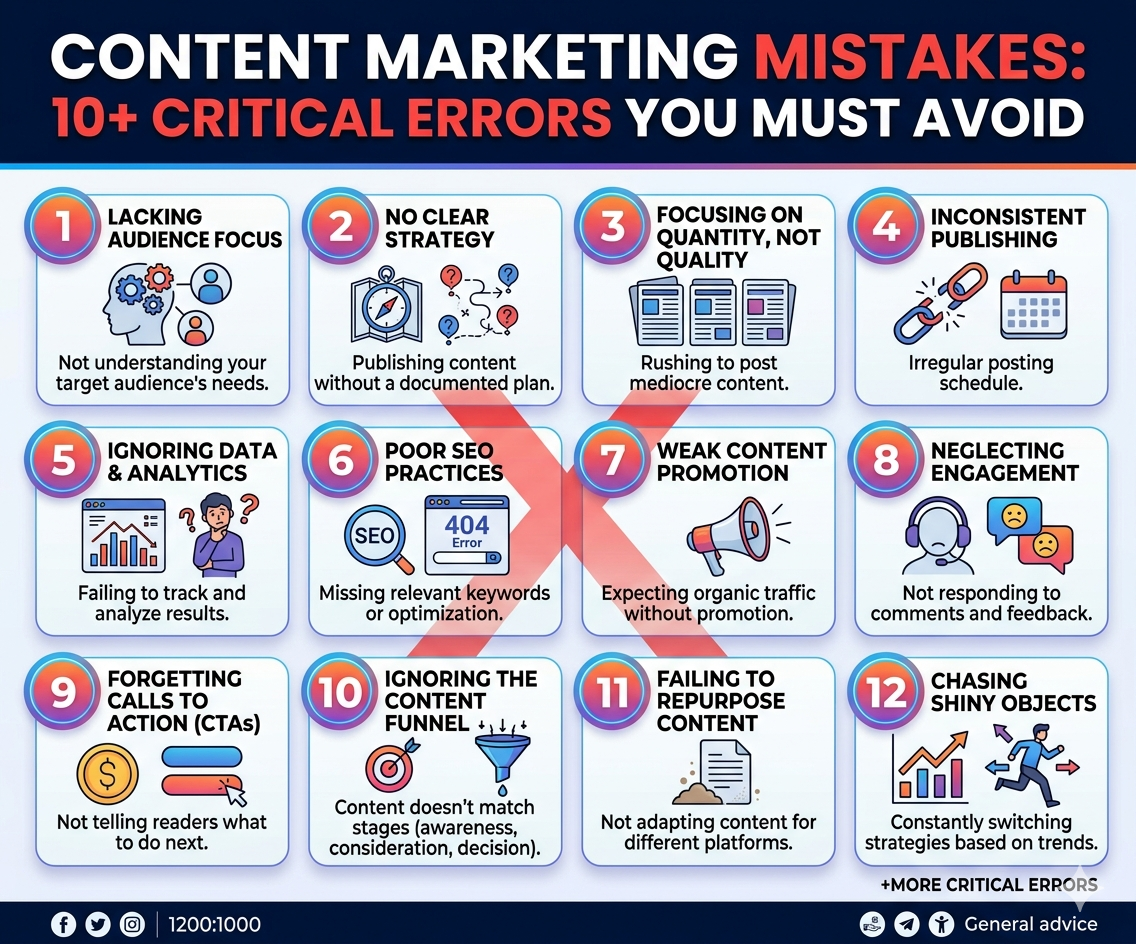
Common Content Marketing Mistakes
One major mistake is creating content without understanding the target audience. Content that is not relevant to the audience is unlikely to generate meaningful engagement and also helps to learn digital marketing with placements.
Another mistake is focusing entirely on promotional content. Audiences generally expect brands to provide value rather than constantly push sales messages.
Other common mistakes include:
- Inconsistent publishing
- Poor-quality content
- Weak headlines
- Ignoring SEO
- Not promoting content
- Using the same format repeatedly
- Ignoring audience comments
- Failing to analyze performance
Avoiding these mistakes can help businesses create a more effective content strategy to get digital marketing with placements.
Best Practices for Better Content Engagement
Businesses can improve engagement by focusing on relevance, consistency, and audience needs.
Some useful practices include:
- Know your audience
- Create clear content goals
- Develop content pillars
- Provide genuine value
- Use storytelling
- Experiment with different formats
- Create interactive content
- Personalize content where appropriate
- Optimize content for each platform
- Use strong CTAs
- Encourage user-generated content
- Promote valuable content
- Track performance regularly
- Improve the strategy based on data
The key is to focus on creating content that people actually want to consume rather than simply increasing the number of posts published and also to learn digital marketing with placement.
Why Marketers Should Learn Tools Along With Strategy
Tools are only as effective as the person using them. A marketer may know how to generate a report but still struggle to understand what the numbers actually mean.
For example, knowing how to access website traffic data is different from knowing why traffic increased and also to learn digital marketing with placements, which channel generated valuable visitors, and whether those visitors converted.
Similarly, using a keyword research tool is not enough. Marketers need to understand search intent, competition, relevance, and how keywords fit into a broader SEO strategy.
This is why practical digital marketing education should combine marketing fundamentals, strategy, tools, and real-world application.
Common Mistakes When Using Digital Marketing Tools
One common mistake is trying to use too many tools at the same time. This can create unnecessary complexity.
Another mistake is focusing on tool features instead of marketing objectives. Marketers should first define what they want to achieve and then select the appropriate tool and also to learn digital marketing with placements.
Ignoring data quality can also lead to incorrect conclusions. Marketers should understand where the data comes from and whether it accurately represents the situation.
Finally, marketers should avoid becoming completely dependent on automated recommendations. Human judgment remains important when interpreting data and making strategic decisions.
Conclusion
Content marketing is one of the most effective ways for businesses to build relationships with their audiences and encourage meaningful engagement. By understanding the target audience, creating valuable content, using different formats, developing content pillars, incorporating storytelling, encouraging interaction, and measuring performance, businesses can create a stronger and more consistent content strategy.
For aspiring digital marketers, Successful Digital Marketing With Placement, content marketing is an important skill to learn alongside SEO, social media marketing, paid advertising, email marketing, and analytics and to learn digital marketing with placements. NIDM (National Institute of Digital Marketing), The top Digital Marketing With Placements helps learners develop practical knowledge and also helps to get digital marketing with placement across these key areas and understand how different digital marketing channels work together.
Successful content marketing is not about creating the maximum amount of content. It is about creating relevant, useful, and engaging content that gives the audience a reason to pay attention, interact, and come back for more.