In today’s fast evolving digital landscape, businesses rely heavily on tools that can improve visibility, drive traffic, and optimize marketing performance. When discussing Adobe vs SEMrush, marketers often question whether Adobe marketing tools can match the effectiveness of SEMrush SEO tools. This SEO tools comparison helps clarify how both platforms contribute to digital success.
Adobe Role in the Marketing Ecosystem
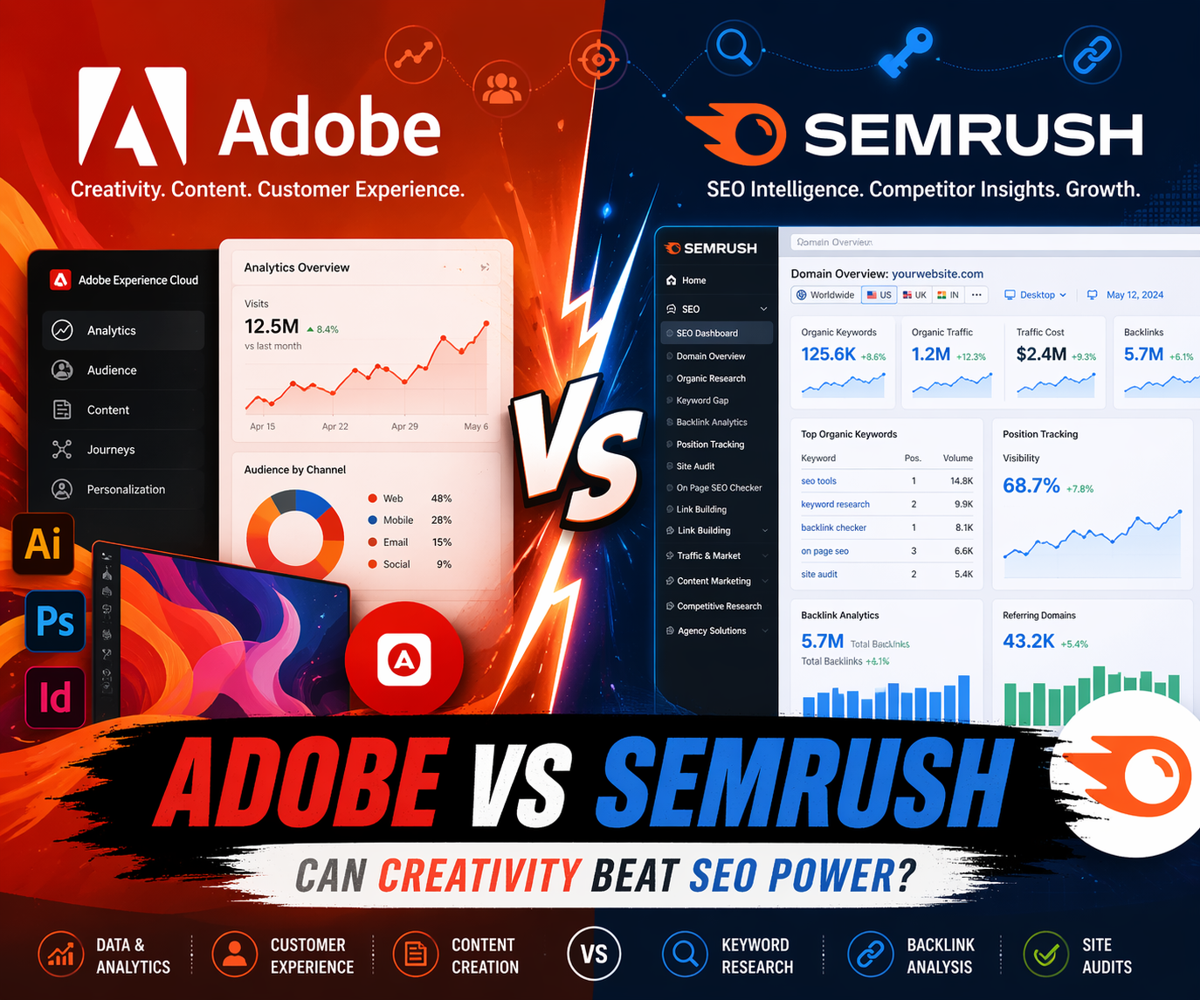
Adobe is known for its strong presence in creative design, content management, and customer experience solutions. Platforms like Adobe Experience Cloud enable businesses to manage campaigns, personalize user journeys, and analyze customer data at scale.Rather than focusing only on search engines, Adobe marketing tools focus on the entire customer lifecycle from content creation to conversion tracking. This makes Adobe a powerful solution for brand-driven strategies in this SEO tools comparison.
Adobe plays a crucial role in the modern marketing ecosystem by providing powerful tools for content creation, data analysis, and customer experience management. Through platforms like Adobe Experience Cloud, businesses can manage multi-channel campaigns, track user behavior, and deliver personalized experiences at scale. These capabilities help brands build stronger connections with their audience while optimizing marketing performance across digital platforms.
Beyond campaign management, Adobe focuses on the entire customer journey from content creation to conversion and retention. Its integrated ecosystem allows marketers to combine creative assets with real-time data insights, enabling more targeted and effective strategies. While Adobe is not a dedicated SEO platform, its strengths in design, analytics, and personalization significantly support overall digital marketing success.
SEMrush: A Specialist in SEO
In contrast, SEMrush is built specifically for search engine optimization and competitive intelligence. SEMrush SEO tools provide deep insights into keyword performance, search rankings, competitor strategies, backlink profiles, and technical SEO issues.
In any Adobe vs SEMrush discussion, SEMrush stands out as the preferred platform for improving search visibility and organic traffic.
SEMrush is widely recognized as a specialist in search engine optimization, offering a comprehensive suite of tools designed to improve online visibility and search rankings. It enables marketers to conduct in-depth keyword research, track rankings, analyze competitors, and identify high-performing opportunities. With its data-driven insights, SEMrush helps businesses understand what users are searching for and how to position their content effectively on search engines.
In addition to keyword analysis, SEMrush provides advanced features such as backlink audits, site health checks, and technical SEO recommendations. These tools allow marketers to fix issues that may impact website performance and ensure their site follows best SEO practices. Whether for agencies, businesses, or individual marketers, SEMrush plays a critical role in building strong SEO strategies that drive organic traffic and long-term growth.
Key Differences Between Adobe and SEMrush
- Adobe marketing tools emphasize experience, design, and analytics
- SEMrush SEO tools focus on search performance and optimization
Is Adobe Moving Toward SEO?
With advancements in AI and data analytics, Adobe is gradually evolving. Its predictive insights and customer data capabilities can support SEO strategies indirectly. However, Adobe marketing tools still lack core SEO functionalities such as keyword tracking, SERP analysis, and backlink monitoring areas where SEMrush SEO tools clearly lead
Adobe is gradually moving closer to the SEO space, but not in a traditional way. Instead of building a dedicated SEO tool, Adobe is enhancing its ecosystem with AI-driven optimization and performance features. For example, tools within Adobe Experience Manager and Experience Cloud now include capabilities like automated issue detection, content optimization suggestions, and performance monitoring—all of which indirectly support SEO. These innovations help improve website speed, user engagement, and content relevance, which are critical ranking factors.
Additionally, Adobe platforms already incorporate SEO best practices such as metadata management, sitemap support, and URL optimization, showing a clear alignment with search engine requirements. However, Adobe’s approach remains focused on experience optimization rather than pure SEO execution. While it is evolving with AI and automation, it still lacks core SEO functionalities like keyword tracking and backlink analysis. This indicates that Adobe is moving toward supporting SEO but as part of a broader digital experience strategy rather than becoming a direct SEO competitor.
Conclusion
In this Adobe vs SEMrush analysis, it’s clear that both platforms serve different purposes. SEMrush SEO tools dominate the SEO space, while Adobe marketing tools excel in creativity and analytics. For long-term success, businesses and learners at NIDM(National Institute of Digital Marketing) should integrate both tools to build a powerful, data driven marketing strategy that delivers visibility, engagement, and growth.