
Remarketing vs Retargeting Explained: The Ultimate Guide for Marketers
Introduction to Remarketing and Retargeting
Remarketing vs Retargeting is one of the most commonly confused topics in digital marketing, even among professionals. If you’ve ever browsed a product and later seen ads for it or received reminder emails, you’ve already experienced both strategies in action. While they share a similar goal bringing users back into the sales funnel they operate differently and serve distinct purposes.
Remarketing vs Retargeting becomes crucial in today’s competitive landscape where users rarely convert on their first visit. Businesses need smart follow-up strategies to re-engage potential customers, and that’s exactly where these two approaches play a vital role.
What Is Retargeting?
How Retargeting Works
Retargeting is a paid advertising strategy that focuses on users who have already interacted with your website, app, or content but didn’t complete a desired action like making a purchase or signing up. It’s essentially your second chance to convert someone who showed interest but walked away.
Here’s how it typically works: when a user visits your website, a small piece of code often called a tracking pixel or cookie gets stored in their browser. This allows advertising platforms to “remember” that user and show them targeted ads later as they browse other websites or social media platforms.
Imagine someone visiting an online store, checking out a pair of shoes, and leaving without buying. Later, while scrolling through social media or reading a blog, they see ads for those exact shoes. That’s retargeting doing its magic keeping your brand top-of-mind and nudging the user back toward conversion.
Role of Cookies and Tracking Pixels
Cookies and tracking pixels are the backbone of retargeting. They collect behavioral data such as pages visited, products viewed, and time spent on a site. This data is then used to create highly targeted ad campaigns that feel almost personalized.
Modern retargeting goes beyond simple reminders. Advanced platforms segment audiences based on behavior like users who abandoned carts versus those who just browsed. This allows marketers to craft tailored messages that resonate more deeply, increasing the chances of conversion.
Interestingly, retargeting campaigns can be up to 10 times more effective than standard display ads, making them a crucial tool for performance marketing.
What Is Remarketing?
How Remarketing Works
Remarketing, while similar in goal, takes a slightly different approach. It focuses on re-engaging existing customers or known contacts using first-party data like email lists, CRM systems, or customer databases.
Instead of relying on anonymous browsing behavior, remarketing leverages identifiable user information. This allows brands to send personalized messages, offers, or reminders directly to individuals who already have a relationship with the brand.
For example, if you’ve ever received an email saying, “You left something in your cart,” or “Here’s 10% off your next purchase,” you’ve experienced remarketing firsthand. It’s more direct, more personal, and often more relationship-driven.
Email and CRM-Based Campaigns
Email marketing is the most common form of remarketing, but it’s not the only one. Brands also use SMS, push notifications, and even personalized ads based on customer lists to reconnect with their audience.
What makes remarketing powerful is its ability to nurture long-term relationships. It’s not just about closing a sale it’s about building loyalty, encouraging repeat purchases, and increasing customer lifetime value.
Think of remarketing as a conversation with someone you already know. It’s less about persuasion and more about strengthening the connection.
Key Differences Between Remarketing and Retargeting
Audience Targeting
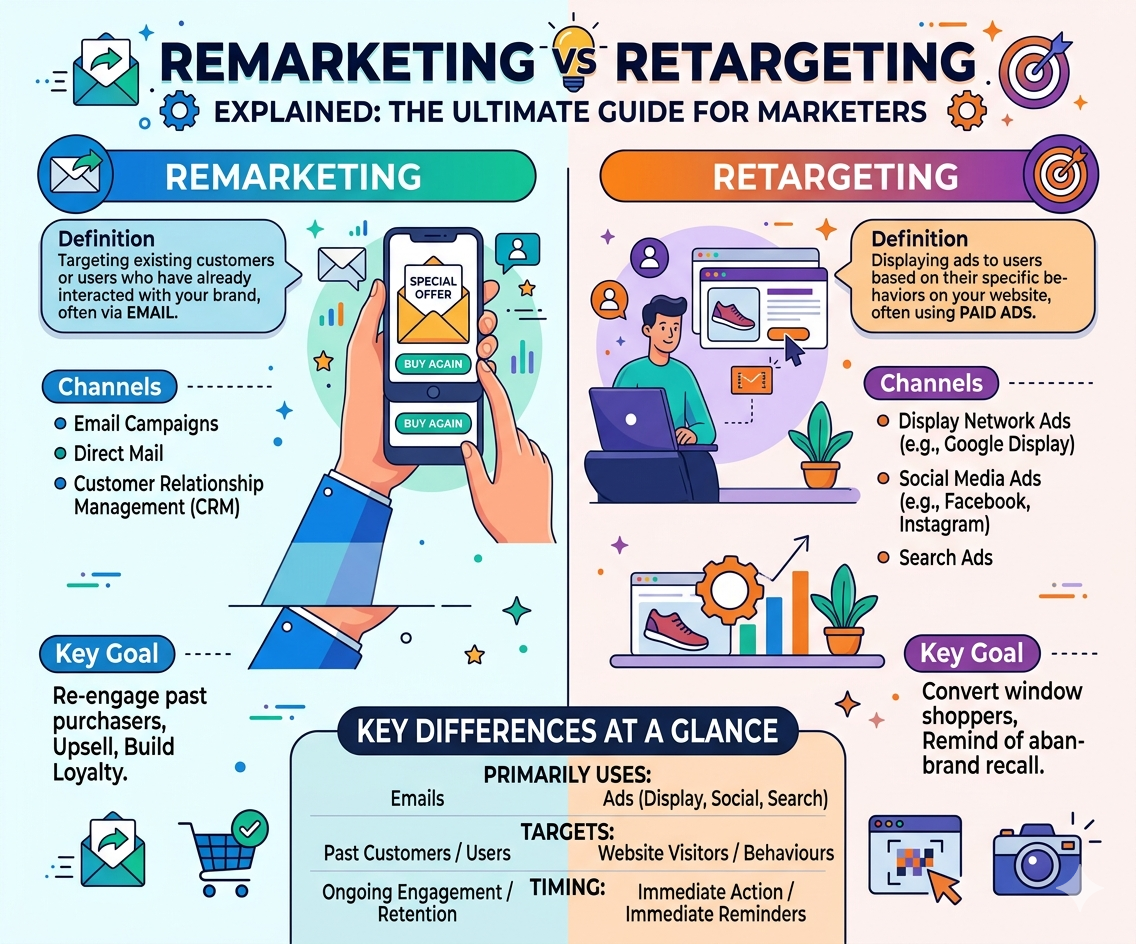
The biggest difference lies in who you’re targeting. Retargeting focuses on anonymous users who have interacted with your brand but haven’t converted yet. Remarketing, on the other hand, targets known users people whose contact information you already have.
Retargeting is about capturing missed opportunities, while remarketing is about deepening existing relationships. One brings people back; the other keeps them engaged.
Marketing Channels Used
Retargeting primarily uses paid ads across platforms like Google Display Network, Facebook, and other ad networks. Remarketing relies more on direct communication channels such as email, SMS, and CRM-driven campaigns.
This difference in channels also affects how messages are delivered. Retargeting is more visual and repetitive, while remarketing is more personalized and conversational.
Retargeting vs Remarketing Comparison Table
| Feature | Retargeting | Remarketing |
|---|---|---|
| Audience | Anonymous visitors | Existing customers |
| Data Source | Cookies, pixels | Email, CRM data |
| Channels | Display ads, social ads | Email, SMS, direct ads |
| Goal | Convert new prospects | Re-engage existing users |
| Personalization | Moderate | High |
Benefits of Retargeting
Increasing Conversion Rates
Retargeting is incredibly effective at boosting conversions because it focuses on users who have already shown interest. Instead of casting a wide net, you’re targeting warm leads people who are already familiar with your brand.
This makes your marketing efforts more efficient and cost-effective. You’re not trying to convince someone from scratch; you’re simply reminding them of something they already considered.
Another advantage is visibility. Retargeting keeps your brand in front of users across multiple platforms, reinforcing your message and increasing the likelihood of action. It’s like planting seeds repeatedly until one finally grows.
Benefits of Remarketing
Building Customer Loyalty
Remarketing shines when it comes to relationship-building. By engaging with existing customers through personalized messages, you create a sense of connection and trust.
This leads to higher retention rates, repeat purchases, and stronger brand loyalty. Customers who feel valued are more likely to return—and even recommend your brand to others.
Remarketing also allows for upselling and cross-selling opportunities. For instance, if someone buys a smartphone, you can send them offers for accessories, warranties, or upgrades.
When to Use Retargeting
Retargeting is best used when you want to capture lost opportunities. If users are visiting your website but not converting, retargeting helps bring them back into the funnel.
It’s especially effective for eCommerce stores, SaaS platforms, and any business with a clear conversion goal. Whether it’s completing a purchase, signing up for a trial, or downloading a resource, retargeting helps close the gap between interest and action.
When to Use Remarketing
Remarketing is ideal when you want to nurture existing relationships. It works best for businesses with a strong customer base and access to user data.
If your goal is to increase customer lifetime value, encourage repeat purchases, or build brand loyalty, remarketing is the way to go. It’s less about chasing new customers and more about maximizing the value of the ones you already have.
Combining Retargeting and Remarketing Strategies
Here’s where things get interesting you don’t have to choose one over the other. In fact, the most successful marketing strategies combine both.
Retargeting brings users back, while remarketing keeps them engaged. Together, they create a seamless customer journey that guides users from awareness to loyalty.
Think of it like a relay race: retargeting passes the baton to remarketing, ensuring the customer keeps moving forward in the funnel.
Common Mistakes to Avoid
One of the biggest mistakes marketers make is treating remarketing and retargeting as the same thing. This leads to poorly optimized campaigns and wasted budgets.
Another common issue is overexposure. Showing the same ad too many times can annoy users and reduce effectiveness. Frequency control and creative variation are essential.
Segmentation is another critical factor. Not all users are the same, so your messaging shouldn’t be either. Tailoring your campaigns based on user behavior can significantly improve results.
Tools and Platforms for Both Strategies
Popular platforms for retargeting include Google Ads, Facebook Ads, and programmatic advertising networks. These tools allow you to track user behavior and display targeted ads across the web.
For remarketing, tools like email marketing platforms and CRM systems play a key role. They help you manage customer data and deliver personalized campaigns at scale.
Future Trends in Remarketing and Retargeting
As privacy regulations evolve and third-party cookies phase out, both strategies are undergoing significant changes. Marketers are shifting toward first-party data and AI-driven personalization to maintain effectiveness.
The future lies in creating more meaningful, consent-based interactions with users. This means less intrusive tracking and more value-driven communication.
Conclusion
Remarketing vs Retargeting may sound similar, but they play different roles in digital marketing. Retargeting helps bring back potential customers through ads, while remarketing strengthens relationships with existing users through personalized communication.
Remarketing vs Retargeting, when used together, can significantly improve conversions, ROI, and customer loyalty. For professionals looking to master these strategies, institutions like NIDM (National Institute of Digital Marketing) provide in-depth training and practical insights to stay ahead in the evolving digital landscape.
FAQs
1. Is remarketing the same as retargeting?
No, they are different. Retargeting focuses on anonymous users through ads, while remarketing targets known users through direct communication like email.
2. Which is better: remarketing or retargeting?
Neither is better universally. Retargeting is ideal for acquiring conversions, while remarketing excels at retention and loyalty.
3. Can I use both strategies together?
Yes, combining both creates a powerful marketing funnel that maximizes conversions and customer lifetime value.
4. Does retargeting still work without cookies?
Yes, but it’s evolving. Marketers are shifting toward first-party data and alternative tracking methods.
5. What industries benefit most from these strategies?
eCommerce, SaaS, travel, and subscription-based businesses benefit the most due to their focus on repeat engagement and conversions.