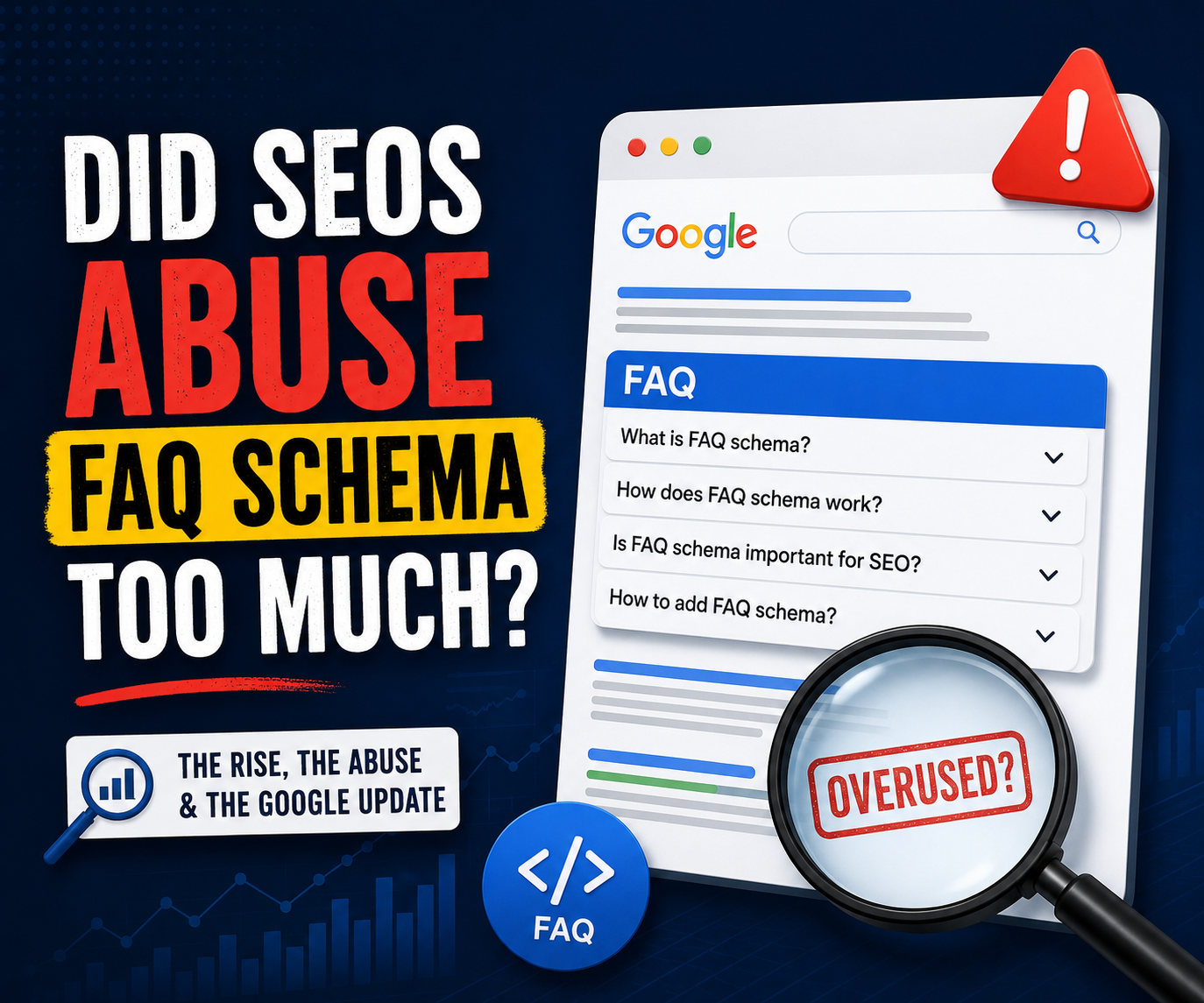
Search engine optimization has always evolved around one core goal: visibility. When FAQ rich results were first introduced by Google , they gave websites a new opportunity to occupy more space in search results and improve click-through rates. What started as a useful enhancement for users quickly became one of the most overused SEO tactics on the internet. Now that Google has significantly reduced FAQ rich results in Search, many marketers are asking the same question: did SEOs abuse FAQ schema too much?
Over the years, FAQ schema shifted from being a helpful feature into a competitive SEO tactic that many websites felt frced to adopt. Businesses added FAQ sections not because users needed them, but because competitors were gaining extra visibility in search results. As adoption increased, the quality of FAQ content steadily declined, turning search pages into crowded spaces filled with repetitive and low-value answers. This growing misuse eventually pushed Google to rethink how FAQ rich results should appear in Search and whether they were still improving the overall user experience.
The Original Purpose of FAQ Schema
FAQ schema was designed to help search engines better understand question-and-answer content on webpages. When implemented correctly, it allowed Google to display expandable FAQ sections directly in search results. The idea made sense. Users could quickly find answers without opening multiple pages, while websites gained additional visibility in search engine result pages (SERPs). In the early days, FAQ rich results improved the search experience because they were mostly used by government websites, health organizations, trusted educational resources, and customer support pages. The content was relevant, concise, and genuinely helpful.
At its core, FAQ schema was introduced to make search results more informative and user friendly. Instead of forcing users to open multiple webpages to find simple answers, search engines could display important information directly within the results page. This created a faster browsing experience while also helping websites highlight the most relevant parts of their content. Businesses, educational platforms, and even providers offering a digital marketing course began using FAQ schema to answer common user queries directly in search results, helping improve trust, visibility, and engagement without relying only on higher rankings.
When FAQ Schema Became an SEO Shortcut
As soon as marketers noticed that FAQ rich results increased screen space and click through rates, adoption exploded. Suddenly, almost every webpage on the internet had long FAQ sections filled with repetitive questions, keyword stuffed answers, and irrelevant schema mark up. Blog posts that never needed FAQs started adding them simply to gain extra visibility in search results. Product pages, landing pages, and even homepage banners became overloaded with artificial question-and-answer sections.
As competition in search rankings intensified, many websites began treating FAQ schema as a visibility hack rather than a usability feature. SEO teams realized that adding FAQ mark up could make their listings appear larger and more noticeable in search results, even when the questions themselves were unnecessary. This led to a wave of pages filled with artificial FAQs created mainly to capture attention, increase impressions, and push competitors further down the page. Over time, the tactic became so common that genuine FAQ content started losing its original value.
Why Google Reduced FAQ Rich Results
Google eventually announced that FAQ rich results would become far less common for most websites. Today, these rich results mainly appear for highly authoritative and government-related sources. This decision likely came from the growing abuse of structured data, declining content quality, overcrowded search results, and the rapid rise of AI generated content. Google wants search results to feel cleaner, simpler, and more useful. Too many FAQ dropdowns created visual noise and made search pages harder to navigate. At the same time, AI-powered search experiences are changing how information is presented. Instead of displaying multiple FAQ sections, Google increasingly prefers summarized answers and AI-generated overviews.
Another reason behind Google’s decision was the growing imbalance between helpful content and manipulated search enhancements. Many websites were using FAQ schema on pages where it added little real value, making search results feel repetitive and overcrowded. As Google continued focusing on cleaner and more user-focused experiences, limiting FAQ rich results became a way to reduce unnecessary clutter and highlight content that genuinely answers user intent. The rise of AI-powered search experiences also played a role, as Google increasingly prefers concise summaries over large expandable FAQ sections.
Did FAQ Schema Still Provide Value?
Despite the abuse, FAQ schema itself was never the real problem. Well-written FAQ sections still help users by answering common questions, improving usability, supporting voice search, and helping customers make decisions more quickly. The real issue was excessive and manipulative implementation. A useful FAQ section can still improve on-page experience even if it no longer generates rich results in Google Search. That means businesses should not remove FAQs entirely. Instead, they should focus on quality, relevance, and user intent.
The Future of Structured Data
Structured data is not dead. It still plays an important role in helping search engines understand content. Schemas related to products, reviews, recipes, events, organizations, and local businesses continue to provide value across different search experiences. However, the future of structured data will likely depend more on accuracy, trust, and usefulness rather than aggressive optimization strategies. Google is becoming increasingly selective about which enhanced results deserve visibility.
As search engines become more advanced, structured data will likely evolve from being a simple optimization tactic into a trust and context signal. Google is placing greater emphasis on accuracy, authority, and content relevance, which means schemas that genuinely help search engines understand information will continue to matter. Instead of rewarding excessive markup, future search experiences may prioritize websites that use structured data responsibly to improve clarity, credibility, and user experience.
Conclusion
FAQ schema was created to improve search experiences, but widespread over optimization weakened its usefulness. As more websites treated FAQs like an SEO trick instead of a user focused feature, the overall quality of search results declined. Google’s reduction of FAQ rich results is not just a technical update it is a signal about the future of SEO. Search engines are increasingly rewarding content that demonstrates real expertise, originality, and usefulness. Temporary SERP tactics may still appear from time to time, but sustainable SEO now depends more on trust and value than ever before. For marketers and publishers, the message is clear: optimize for people first, and algorithms second.