Cart Abandonment Emails That Recover Sales
Cart Abandonment Emails That Recover Sales have become one of the most powerful tools in modern ecommerce marketing. Imagine running an online store where seven out of ten shoppers walk away right before paying. Sounds painful, right? That is exactly what businesses experience every single day. Recent ecommerce studies show that the average global cart abandonment rate is around 70%, which means businesses lose billions in potential revenue annually. The good news is that abandoned carts are not completely lost opportunities. Smart recovery emails can bring customers back and turn hesitation into completed purchases.
Think of cart abandonment emails like a friendly shopkeeper who notices you forgot something at the counter and gently reminds you before you leave the store. A well-crafted email can remind customers about products they loved, answer hidden objections, and create urgency that pushes them toward checkout. Businesses today are using automation, personalization, AI-driven recommendations, and even SMS integration to recover significant amounts of lost sales. Ecommerce brands that implement optimized cart recovery strategies often recover between 10% and 20% of abandoned purchases.
The online shopping landscape is more competitive than ever, and customer attention spans are shrinking rapidly. Consumers compare products across multiple websites, get distracted by notifications, or simply postpone their buying decisions. That is why ecommerce brands cannot afford to ignore abandoned carts anymore. Recovery emails act like a second chance at making the sale, often at a fraction of the cost of acquiring a brand-new customer through paid advertising.
Understanding Why Customers Abandon Their Carts
The Real Cost of Cart Abandonment
Cart abandonment is not just a minor inconvenience for online businesses. It represents one of the largest revenue leaks in ecommerce. Studies from recent ecommerce reports indicate that global online stores lose trillions of dollars annually due to abandoned shopping carts. Every abandoned cart is a shopper who showed buying intent but stopped before completing the transaction. That means the customer was already interested, emotionally invested, and close to making a purchase decision. Losing them at the final stage feels like losing a race just inches before the finish line.
Businesses spend enormous budgets on advertising, SEO, influencer campaigns, and social media marketing to attract visitors. When those visitors abandon their carts, all that investment risks going to waste. Recovery emails help protect marketing ROI by bringing shoppers back without needing additional advertising spend. In many cases, recovering one abandoned cart costs far less than acquiring a new customer through paid campaigns.
Unexpected costs remain one of the biggest reasons customers abandon their carts. Research shows that additional shipping fees, taxes, and hidden charges are responsible for nearly half of abandoned checkouts. Slow delivery estimates, complicated checkout processes, mandatory account creation, and payment security concerns also push buyers away. Understanding these frustrations allows marketers to craft recovery emails that directly address customer doubts.
Common Reasons Customers Leave Without Buying
Customers abandon carts for many emotional and practical reasons. Sometimes they are simply browsing and comparing prices across multiple stores. Other times, distractions pull them away during checkout. Imagine someone shopping online while watching television, replying to messages, or traveling. One interruption is enough to stop the purchase completely.
Mobile shopping behavior also plays a huge role. Many users browse products on smartphones but delay purchases until later because typing payment information on smaller screens feels inconvenient. Mobile abandonment rates are significantly higher than desktop rates according to ecommerce research. Businesses that fail to optimize mobile checkout experiences naturally experience higher cart abandonment.
Trust issues also influence buying decisions. Shoppers often hesitate if a website lacks customer reviews, secure payment icons, clear return policies, or transparent shipping details. Recovery emails provide another opportunity to rebuild trust by showcasing testimonials, guarantees, and customer support options. A simple reminder paired with reassurance can make hesitant buyers feel confident enough to complete their orders.
Why Cart Abandonment Emails Matter in Ecommerce
How Recovery Emails Influence Buyer Decisions
Cart abandonment emails work because they reconnect businesses with customers at the perfect psychological moment. The shopper already demonstrated intent by adding products to the cart. They are not cold leads anymore. They are warm prospects standing right outside the checkout door. Recovery emails reopen the conversation and guide buyers back toward conversion.
Modern consumers receive hundreds of emails every week, so timing and personalization are critical. Successful cart recovery emails feel less like advertisements and more like helpful reminders. Instead of aggressively pushing a sale, the best emails focus on convenience, emotional connection, and value. They remind shoppers what they loved about the product and why it matters.
A strategically timed email sequence can dramatically improve conversion rates. Ecommerce research reveals that sending multiple recovery emails performs far better than sending only one. The first email usually acts as a reminder, while later emails introduce urgency, social proof, or discounts. This gradual approach mirrors real human decision-making instead of pressuring customers immediately.
Many successful brands now combine email recovery with behavioral targeting. AI tools track customer browsing habits, product preferences, and buying patterns to deliver hyper-personalized recommendations. This creates an experience that feels tailored instead of generic. Customers are far more likely to return when they feel understood rather than marketed to.
Statistics That Prove Cart Recovery Works
Recent ecommerce reports show that abandoned cart emails remain one of the highest-performing automated email campaigns. Automated emails generate a significant percentage of ecommerce sales despite representing only a small portion of total email volume. Businesses using optimized cart recovery workflows often achieve recovery rates between 5% and 20%, depending on timing and personalization strategies.
One interesting finding from recent research is that sending the first recovery email within 30 to 60 minutes after abandonment produces the best results. That short window captures customers while buying intent is still fresh. Delaying follow-ups for several hours often reduces effectiveness because shoppers mentally move on.
Community discussions among ecommerce marketers also reinforce the importance of timing and personalization.
Essential Elements of High-Converting Cart Abandonment Emails
Writing Subject Lines That Get Opened
The subject line is the digital equivalent of knocking on someone’s front door. If it fails to grab attention, the email never gets opened. High-performing subject lines are short, emotional, and curiosity-driven. They create urgency without sounding desperate or manipulative.
Subject lines like “You Left Something Behind,” “Still Thinking It Over?” or “Your Cart Is Waiting” work because they sound conversational and personal. Including the customer’s name or product name can improve open rates even more. Personalized subject lines immediately catch attention in crowded inboxes.
Marketers should avoid spammy language filled with excessive punctuation or all-capital letters. Customers today can detect aggressive marketing tactics instantly. Instead, the tone should feel natural and human. The goal is to continue the shopping experience smoothly rather than interrupt it with pushy sales messaging.
Creating Personalized Email Content
Personalization has become the backbone of successful ecommerce email marketing. Generic recovery emails rarely perform well because customers expect relevance. Businesses should include product images, pricing details, customer reviews, and personalized recommendations inside recovery emails. Seeing the abandoned product again helps reignite emotional attachment.
AI-driven personalization tools now allow businesses to customize email timing, content, and offers based on customer behavior. Some customers respond well to discounts, while others only need a gentle reminder. Intelligent automation prevents businesses from unnecessarily sacrificing profit margins with blanket discount offers.
The language inside the email should also sound human and conversational. Instead of robotic phrases like “Complete Your Purchase Immediately,” brands should write naturally. Something as simple as “Looks like you forgot something you loved” creates warmth and familiarity.
Using Urgency Without Sounding Pushy
Urgency works because humans naturally fear missing out. Limited stock alerts, expiring discounts, or shipping deadlines encourage faster decision-making. The challenge is using urgency ethically without damaging customer trust.
False scarcity tactics can hurt brand credibility. Customers quickly notice when products are supposedly “almost sold out” every single week. Honest urgency performs better over the long term because it builds trust and authenticity. If inventory is genuinely low or a promotion is ending soon, communicating that transparently can increase conversions dramatically.
Effective urgency also focuses on benefits instead of fear. For example, highlighting faster shipping before a holiday feels helpful rather than manipulative. Recovery emails should guide customers toward action while maintaining a positive shopping experience.
Best Timing Strategies for Cart Abandonment Emails
The Importance of the First Hour
Timing can make or break a recovery campaign. Ecommerce research consistently shows that the first hour after abandonment is the most valuable recovery window. Customers still remember the products they viewed, and buying intent remains strong.
Think about online shopping like a spark. Right after abandoning a cart, the spark is still glowing. Wait too long, and the excitement fades completely. That is why many successful brands trigger their first reminder email within 30 minutes. The goal is not aggressive selling. It is simply reconnecting with the customer while interest remains alive.
The first email should stay simple and helpful. Brands should avoid overwhelming customers with large blocks of promotional text. Instead, they should focus on reminding shoppers about the products they selected and making checkout easy to resume.
Multi-Email Sequences That Recover More Sales
Single reminder emails can work, but multi-email sequences consistently outperform them. Research indicates that businesses sending two or three recovery emails recover significantly more revenue compared to brands sending only one.
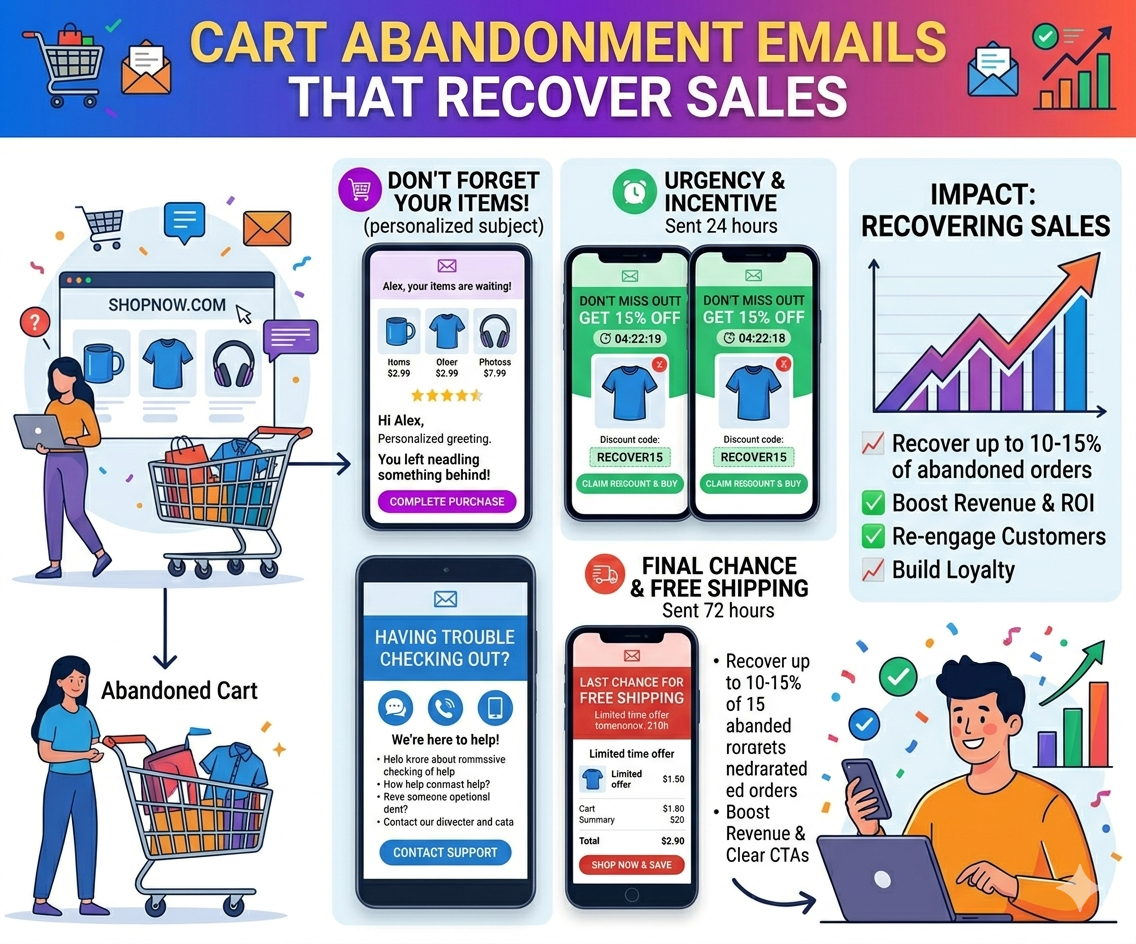
| Email Sequence | Timing | Main Purpose |
|---|---|---|
| Email 1 | 30 Minutes | Friendly reminder |
| Email 2 | 24 Hours | Address objections |
| Email 3 | 72 Hours | Create urgency or offer incentive |
The second email often performs well because customers have had time to reconsider their purchase. This message can answer common objections such as shipping concerns, return policies, or product quality doubts. Social proof, reviews, and testimonials work especially well here.
The final email usually introduces urgency or a small incentive. Discounts should not always be the first solution because they can train customers to abandon carts intentionally while waiting for coupons. Strategic incentives work best when used selectively.
Cart Abandonment Email Examples That Actually Convert
Reminder Emails
Reminder emails are the foundation of every recovery campaign. Their job is simple: remind shoppers about the products they left behind. These emails work best when they are visually clean, mobile-friendly, and emotionally engaging.
Successful reminder emails usually include product images, product names, pricing details, and a direct checkout button. Simplicity is key. Too many distractions reduce conversion rates. The customer should immediately understand what they abandoned and how to return to checkout.
Brands that use conversational copy tend to achieve better engagement. Instead of corporate language, many ecommerce businesses now write in a friendly tone that feels human and relatable.
Discount-Based Recovery Emails
Discounts can be highly effective, but they should be used strategically. Offering discounts too early can damage profitability and encourage unhealthy customer behavior. Some shoppers may intentionally abandon carts expecting coupons every time.
The best discount emails frame the offer as a limited-time opportunity. Phrases like “Complete your order today and enjoy 10% off” work because they combine urgency with reward. Time-sensitive incentives motivate hesitant buyers to take action.
Businesses should also analyze customer data before offering discounts. High-intent customers may return naturally without needing incentives. AI-driven tools now help marketers predict which customers genuinely require discounts to convert.
Social Proof and Review Emails
People trust other customers more than they trust advertising. That is why social proof plays such an important role in recovery campaigns. Customer reviews, testimonials, star ratings, and user-generated content reduce purchase anxiety and increase confidence.
Imagine hesitating before buying a new gadget online. Suddenly, you see hundreds of positive reviews from happy customers describing their experiences. That reassurance often removes doubt instantly. Social proof emails replicate that effect.
Brands can also include media mentions, influencer endorsements, or trust badges inside recovery emails. Every trust signal reduces friction and moves customers closer to purchase completion.
Mistakes That Destroy Cart Recovery Rates
Sending Too Many Emails
Aggressive email sequences can backfire quickly. Customers who feel overwhelmed by constant reminders may unsubscribe or develop negative feelings toward the brand. Balance is essential.
Most successful recovery flows use between two and four emails. Sending more than that often creates diminishing returns. The focus should always remain on relevance and customer experience rather than pure volume.
Ignoring Mobile Optimization
Mobile shoppers dominate ecommerce traffic today, yet many businesses still send poorly optimized emails. Tiny buttons, unreadable text, and slow-loading images frustrate mobile users instantly.
Recovery emails must load quickly and display perfectly on smartphones. Clear CTA buttons, responsive layouts, and concise messaging dramatically improve mobile conversions. Since many customers abandon carts on mobile devices, optimizing the recovery experience for smaller screens is absolutely critical.
Weak Call-to-Action Buttons
A recovery email without a strong CTA is like a road sign pointing nowhere. Customers need clear guidance about what action to take next. Generic phrases like “Click Here” lack motivation.
Strong CTAs use action-oriented language such as “Return to Cart,” “Complete My Order,” or “Secure My Items.” These phrases create momentum and reinforce customer intent.
Automation Tools for Cart Abandonment Email Campaigns
AI-Powered Email Personalization
Artificial intelligence is transforming ecommerce recovery strategies. AI systems analyze customer behavior patterns, purchase history, browsing activity, and engagement levels to deliver highly personalized recovery campaigns.
Modern tools can predict the best time to send emails, recommend complementary products, and determine whether discounts are necessary. This level of personalization increases conversions while protecting profit margins.
Businesses using AI-driven recovery systems are seeing stronger engagement and higher recovery rates compared to traditional one-size-fits-all campaigns.
Integrating SMS and Retargeting Ads
Email alone is no longer enough for many ecommerce brands. Combining recovery emails with SMS reminders and retargeting ads creates a stronger omnichannel experience. SMS messages achieve extremely high open rates because they reach customers instantly on mobile devices.
Retargeting ads also reinforce abandoned products across social media and search platforms. Customers repeatedly see the same products they considered earlier, which keeps the brand top of mind. When email, SMS, and retargeting work together, recovery rates improve dramatically.
Measuring the Success of Cart Abandonment Emails
Key Metrics Every Marketer Should Track
Tracking performance metrics helps businesses optimize recovery campaigns continuously. Open rates reveal whether subject lines attract attention. Click-through rates show how engaging the email content is. Conversion rates measure how many abandoned shoppers actually complete purchases.
Recovery revenue is another crucial metric. Businesses should monitor how much lost revenue recovery campaigns generate over time. Understanding customer lifetime value also helps marketers evaluate the long-term impact of successful recovery efforts.
A/B Testing for Better Conversion Rates
A/B testing allows marketers to compare different versions of emails and identify what works best. Testing subject lines, email timing, CTA buttons, images, and discount strategies can significantly improve performance.
Even small adjustments sometimes produce dramatic improvements. Changing one subject line or simplifying one CTA button can increase recovery rates noticeably. Successful ecommerce brands treat recovery optimization as an ongoing process instead of a one-time setup.
Conclusion
Cart Abandonment Emails That Recover Sales are no longer optional for ecommerce businesses that want sustainable growth. With global cart abandonment rates hovering around 70%, every abandoned cart represents potential revenue waiting to be recovered. Businesses that combine personalization, strategic timing, mobile optimization, and multichannel recovery strategies consistently outperform competitors.
The most successful recovery campaigns focus on customer psychology rather than aggressive selling. Shoppers want convenience, trust, transparency, and reassurance. Recovery emails work best when they feel like helpful reminders instead of relentless advertisements. AI-powered personalization, SMS integration, and behavioral targeting are shaping the future of cart recovery, helping businesses recover more sales than ever before.
For marketers, ecommerce entrepreneurs, and students learning advanced digital marketing strategies, mastering cart abandonment recovery is essential in today’s competitive online marketplace. Institutions like (NIDM) National Institute of Digital Marketing are helping future digital marketers understand how automation, email marketing, and customer behavior analysis drive ecommerce success in the modern digital economy.
FAQs
1. What is a cart abandonment email?
A cart abandonment email is an automated message sent to shoppers who add products to their online cart but leave without completing the purchase.
2. How many cart abandonment emails should businesses send?
Most ecommerce experts recommend sending between two and four recovery emails to maximize conversions without overwhelming customers.
3. What is the best time to send a cart abandonment email?
Studies suggest sending the first recovery email within 30 to 60 minutes after cart abandonment produces the highest engagement rates.
4. Do discounts always improve cart recovery rates?
Not always. Some customers return naturally without discounts. Strategic incentives work best when combined with personalization and urgency.
5. Can SMS improve cart recovery campaigns?
Yes. SMS messages often achieve higher open rates and faster engagement compared to email alone, especially when combined with automated recovery workflows.