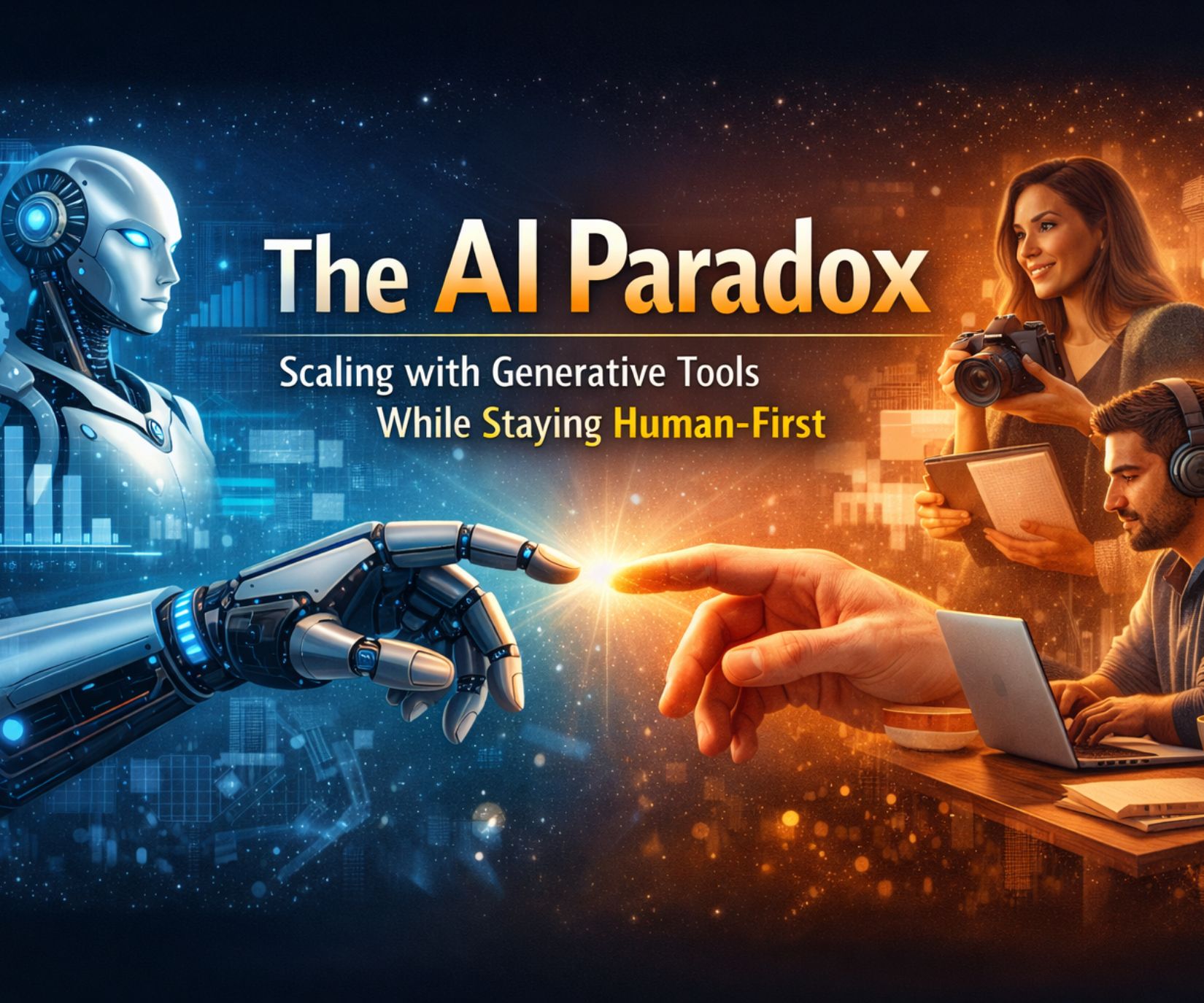
The AI Paradox is becoming one of the most talked about realities in modern digital marketing, content creation, and product development.
On one hand, artificial intelligence allows brands and individuals to create content, code, and campaigns at an unprecedented scale. On the other hand, audiences are increasingly rejecting content that feels automated, polished, and emotionally empty.
This contradiction, scaling faster with AI while needing to stay deeply human defines the AI Paradox. Understanding it is now essential for marketers, creators, developers, and anyone enrolling in digital marketing classes or working with generative tools.
In this article, we will break down The AI Paradox, explain why it matters, and show how to use AI responsibly while keeping trust, authenticity, and human storytelling at the center.
What is The AI Paradox
The AI paradox is simple to explain, yet complex to manage:
The more AI generated content floods the internet, the more valuable genuinely human content becomes.
AI helps you:
- Write faster
- Build quicker
- Publish at scale
- Reduce costs
But overuse or misuse leads to:
- Generic tone
- Repetitive ideas
- Loss of brand personality
- Declining trust
The paradox exists because efficiency and authenticity often pull in opposite directions. The challenge isn’t choosing one it’s learning how to balance both.
Why The AI Paradox Matters in Digital Marketing
Digital marketing thrives on connection. Algorithms may distribute content, but humans decide what they trust.
The AI Paradox matters because:
- Audiences can sense automation
- Generic content reduces engagement
- Trust drops when content feels deceptive
- Brands lose emotional relevance
This is why modern digital marketing classes now emphasize human-first strategy, not just AI tools.
The AI Paradox and the Shift to Human First Marketing
People don’t connect with perfection. They connect with stories, emotions, flaws, and honesty.
In a world where anyone can generate:
- Blog posts
- Ad copies
- Reels
- Websites
…in seconds, being human is the differentiator.
Human first content:
- Feels relatable
- Sounds natural
- Reflects lived experience
- Builds long-term trust
Algorithms may rank content, but humans decide loyalty.
Disclosure and Transparency as Trust Markers
One of the biggest mistakes brands make with AI is hiding its use.
Ironically, transparency builds more trust than secrecy.
Why Disclosure Works
When you openly say:
- “This content was assisted by AI”
- “We use AI tools to speed up research”
- “AI helped us prototype this idea”
You signal:
- Honesty
- Confidence
- Ethical intent
Audiences don’t hate AI. They hate deception.
Transparency in Practice
Here’s how you can be transparent without overexplaining:
- Mention AI use in your workflow page
- Add light disclaimers where relevant
- Explain how AI supports not replaces humans
This turns AI from a threat into a collaborative tool.
AI as a Co Creator, Not a Replacement
The healthiest mindset is simple:
AI should assist thinking, not replace it.
AI is excellent at:
- Structuring ideas
- Summarizing information
- Generating drafts
- Spotting patterns
Humans are irreplaceable at:
- Judgment
- Emotion
- Context
- Moral reasoning
- Storytelling
When AI handles the heavy lifting, humans can focus on meaning and creativity.
Vibe Coding: A Practical Example of The AI Paradox
One of the most exciting applications of generative AI is vibe coding.
Vibe Coding Explained
Vibe coding means:
- Describing what you feel a product should do
- Letting AI generate rough prototypes
- Iterating quickly without overengineering
Instead of writing perfect code, you focus on:
- Intent
- Flow
- Experience
AI translates that “vibe” into a working draft.
Why Vibe Coding Is Powerful
- Faster experimentation
- Lower entry barriers
- More creative freedom
- Less fear of “getting it wrong”
But here’s the key: vibe coding is for prototyping, not final judgment.
The Lesson of the AI Paradox Here
AI can generate stories. But it cannot live them.
Great storytelling comes from:
- Personal failure
- Cultural memory
- Emotional nuance
- Real conversations
AI lacks lived experience.
That’s why the best content today:
- Starts with human insight
- Uses AI for expansion
- Ends with human editing
Human storytelling is the soul. AI is the amplifier.
The AI Paradox and the Decline of Polished Content
For years, the internet pushed perfection:
- Studio lighting
- Scripted videos
- Over edited visuals
Today, that trend is collapsing.
Why Polished Content Is Losing Power
Audiences now associate polish with:
- Ads
- Corporate messaging
- Artificial intent
Instead, they prefer:
- Raw phone videos
- Natural lighting
- Unscripted speech
- Minor mistakes
This shift isn’t accidental, it’s a response to AI saturation.
The Rise of Lo-Fi Content as a Response to The AI Paradox
Lo-fi content feels human, and humans trust humans.
Why Lo-Fi Works
- Feels spontaneous
- Signals honesty
- Reduces psychological distance
- Encourages engagement
A shaky video with real insight often performs better than a perfect one with no soul.
AI can help:
- Generate captions
- Suggest hooks
- Optimize posting
But the face, voice, and emotion must remain human.
AI in Content Scaling Without Losing Identity
Scaling doesn’t have to mean cloning yourself into a thousand generic posts.
Here’s a human first scaling framework:
1: Define Your Voice Clearly
- Tone
- Values
- Beliefs
- Boundaries
2: Use AI for Repetition, Not Originality
- Repurposing
- Formatting
- Variations
3: Always Add a Human Pass
- Personal anecdotes
- Opinion
- Emotional framing
The goal is consistency, not sameness.
Trust Is the New Currency
In the AI era, attention is cheap, trust is expensive.
You earn trust by:
- Being transparent
- Sharing real experiences
- Avoiding exaggeration
- Respecting audience intelligence
AI-generated content without trust is noise.
Human-first content builds relationships, not just reach.
Ethics and Responsibility in The AI Paradox
Short-term growth through AI shortcuts may look attractive but it comes at a cost.
Brands that win long-term:
- Use AI responsibly
- Credit human contributors
- Avoid misleading automation
- Respect originality
Ethics is no longer optional. It’s a brand strategy.
Practical Examples of Human First AI Use
Here’s how modern creators are doing it right:
- Writers use AI for outlines, but write final drafts themselves
- Developers prototype with AI, then refactor manually
- Marketers use AI for ideas, not identity
- Educators use AI tools, but teach with lived examples
The pattern is clear: AI accelerates. Humans decide.
How to Avoid Sounding Like Everyone Else
To stand out in an AI-heavy world:
- Share personal stories
- Take clear positions
- Speak like you talk
- Accept imperfection
AI-generated sameness is everywhere. Original thought is rare.
The Future: Human Led, AI Assisted
The future is not AI vs humans.
It is:
- Humans with AI
- Creativity with computation
- Speed with soul
Those who understand this balance will not just survive, they will lead.
Winning the AI Paradox
The AI paradox isn’t a problem to solve it’s a balance to master.
Use AI to:
- Scale
- Experiment
- Prototype
- Optimize
But stay human by:
- Being transparent
- Telling real stories
- Embracing imperfection
- Prioritizing trust
In a world where machines can generate infinite content, your humanity becomes your strongest advantage. Ultimately, the winners in the AI era will not be those who automate everything. Instead, they will be those who protect their humanity while using technology wisely.