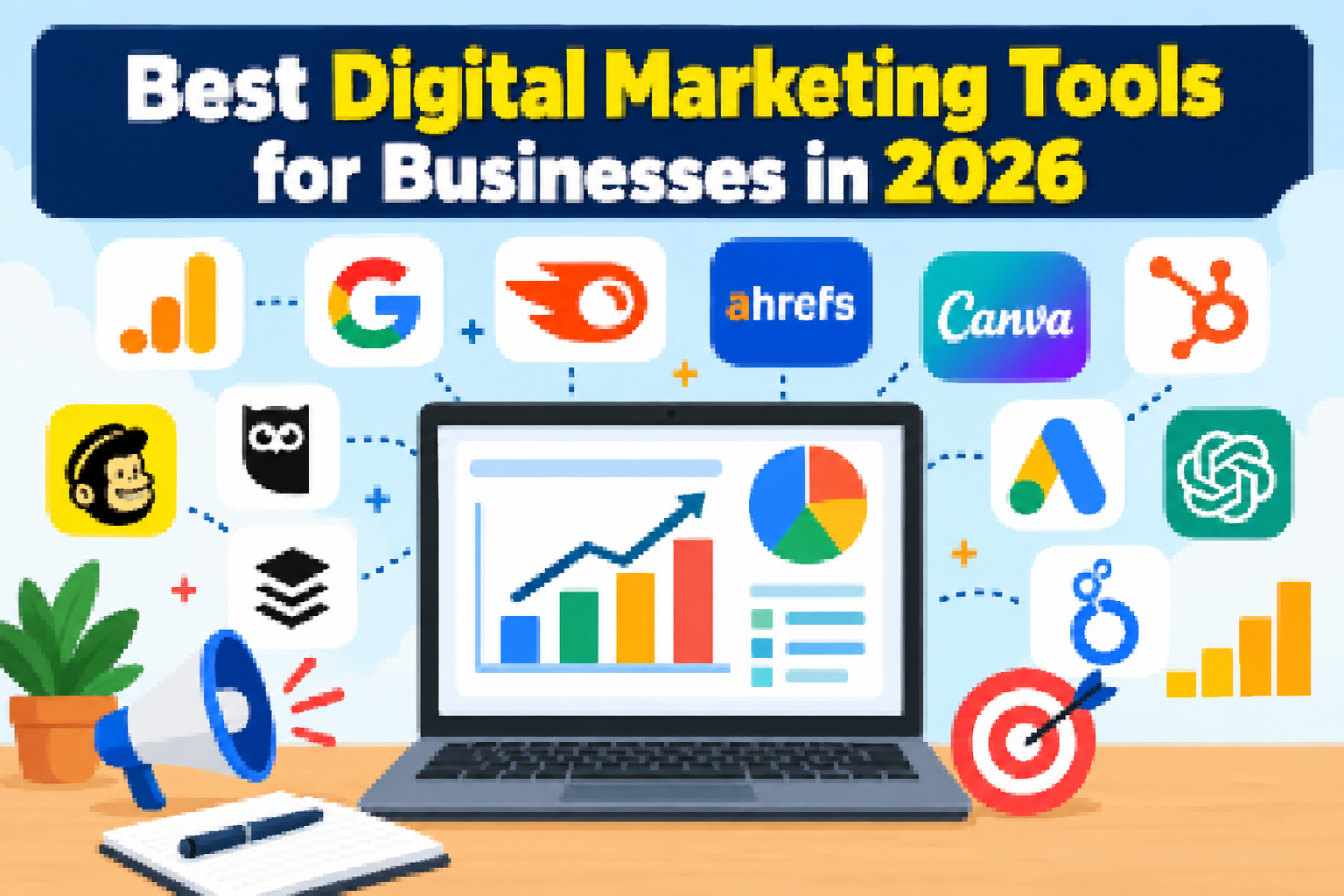
Best Digital Marketing Tools for Businesses in 2026
Introduction
Best Digital marketing tools has become essential for businesses looking to increase brand awareness, attract potential customers, and grow revenue online. However, managing SEO, social media, email campaigns, paid advertising, and content creation can be challenging without the right tools.
The best digital marketing tools for businesses in 2026 help simplify marketing activities, improve productivity, analyze campaign performance, and make data-driven decisions. Whether you run a startup, small business, e-commerce store, or digital marketing agency, choosing the right tools can help you achieve better results while managing your marketing budget .
In this guide, we explore the best digital marketing tools for businesses in 2026, their features, benefits, and how to choose the right solutions for your needs.
What Are Best Digital Marketing Tools 2026?
Digital marketing tools are software applications and online platforms that help businesses plan, execute, manage, and measure their online marketing activities.
These tools support various marketing functions, including search engine optimization (SEO), social media management, email marketing, content creation, paid advertising, analytics, and customer relationship management (CRM).
Using the right digital marketing tools can help businesses save time, understand customer behavior, improve campaign performance, and generate more qualified leads.
1. Google Analytics 4 – Best for Website Analytics
Google Analytics 4 (GA4) is one of the most useful digital marketing tools for understanding how visitors interact with your website or app.
It helps businesses measure traffic sources, user engagement, conversions, and important customer interactions.
Key features:
- Website and app performance tracking
- Traffic source analysis
- User engagement reports
- Conversion and event tracking
- Audience insights
Why businesses should use it:
GA4 helps businesses identify which marketing channels bring visitors and which activities contribute to conversions. This information supports better decisions about marketing budgets and campaign optimization.
Best for: Businesses, marketers, e-commerce stores, and website owners.
2. Google Search Console – Best for SEO Performance
Google Search Console is a free tool that helps website owners understand how their websites perform in Google Search.
It provides information about search queries, impressions, clicks, indexing, and certain technical SEO issues.
Key features:
- Search performance reports
- Keyword query insights
- Indexing and crawling reports
- Sitemap submission
- Mobile usability and website issue information where available
Why businesses should use it:
Search Console helps businesses identify opportunities to improve organic visibility and understand which pages receive search traffic. It is particularly valuable for monitoring SEO performance without paying for a premium SEO platform.
Best for: Bloggers, SEO professionals, website owners, and small businesses.
3. Semrush – Best for SEO and Competitor Research
Semrush is a digital marketing platform that supports SEO, keyword research, competitor analysis, content optimization, and paid search research.
Businesses can use it to discover relevant keywords, evaluate competing websites, identify content opportunities, and monitor SEO performance.
Key features:
- Keyword research
- Competitor analysis
- Backlink analysis
- Website SEO audits
- Rank tracking
- Content optimization tools
Why businesses should use it:
Semrush can help marketers build a more structured SEO strategy and discover opportunities to improve their websites’ visibility in search engines.
Best for: SEO agencies, growing businesses, content marketers, and established websites.
4. Ahrefs – Best for Backlink Analysis and SEO Research
Ahrefs is an SEO toolset known for backlink research, keyword discovery, competitor analysis, and website auditing.
It helps marketers understand how websites gain search visibility and identify opportunities to improve organic performance.
Key features:
- Backlink analysis
- Keyword research
- Competitor content research
- Site audits
- Rank tracking
- Content opportunity discovery
Why businesses should use it:
Ahrefs is useful for identifying relevant search topics, researching competing content, and evaluating backlink profiles as part of a broader SEO strategy.
Best for: SEO specialists, content marketing teams, and digital marketing agencies.
5. Canva – Best for Graphic Design and Marketing Creatives
Canva makes it easier to create marketing visuals without requiring advanced graphic design skills.
Businesses can use it to design social media posts, presentations, advertisements, infographics, banners, and other branded materials.
Key features:
- Ready-made design templates
- Social media graphics
- Brand kits and reusable assets
- Presentation design
- Video and visual content creation
- AI-assisted design features, depending on plan
Why businesses should use it:
Canva helps businesses create visually consistent marketing materials quickly. It is especially useful for small teams that need professional-looking designs without a dedicated designer for every task.
Best for: Startups, small businesses, social media managers, and content creators.
6. HubSpot – Best for CRM and Lead Management
HubSpot provides customer relationship management and marketing tools that help businesses organize leads, manage customer relationships, and automate parts of their marketing process.
Depending on the products and plan selected, it can support email marketing, landing pages, forms, lead nurturing, and campaign reporting.
Key features:
- Contact and lead management
- Email marketing
- Landing pages and forms
- Marketing automation
- Sales pipeline management
- Customer activity tracking
Why businesses should use it:
HubSpot helps marketing and sales teams maintain a clearer view of prospects and coordinate their activities. Businesses can use it to organize leads and develop more consistent follow-up processes.
Best for: B2B businesses, service providers, startups, and growing sales teams.
7. Mailchimp – Best for Email Marketing
Mailchimp is an email marketing platform that helps businesses communicate with subscribers, promote products, and nurture customer relationships.
It offers tools for creating email campaigns, managing audiences, and automating selected communications.
Key features:
- Email campaign creation
- Audience management
- Email templates
- Marketing automation
- Campaign performance reporting
- Signup forms and landing pages, depending on plan
Why businesses should use it:
Email marketing allows businesses to reach people who have chosen to receive their communications. Mailchimp can help organize campaigns and evaluate engagement through metrics such as clicks and conversions.
Best for: Small businesses, online stores, creators, and service providers.
8. Hootsuite – Best for Social Media Management
Hootsuite helps businesses manage social media activities from a centralized platform.
It supports social media scheduling, content planning, monitoring, and reporting for supported networks and plans.
Key features:
- Social media post scheduling
- Content calendar
- Social listening and monitoring features
- Performance analytics
- Team collaboration
- Multi-account management
Why businesses should use it:
Managing multiple social media accounts manually can consume significant time. Hootsuite helps teams organize publishing schedules and review performance more efficiently.
Best for: Marketing agencies, larger social media teams, and businesses managing multiple accounts.
9. Buffer – Best for Simple Social Media Scheduling
Buffer is a social media management tool designed to help individuals and businesses plan and publish content across supported social platforms.
It is useful for maintaining a consistent posting schedule without managing every post manually.
Key features:
- Post scheduling
- Content calendar
- Social media analytics
- Team collaboration features
- Publishing management across supported platforms
Why businesses should use it:
Buffer offers a straightforward way to organize social media publishing. It can be a practical option for small teams that want a simpler workflow.
Best for: Freelancers, small businesses, creators, and lean marketing teams.
10. Google Ads – Best for Paid Search Advertising
Google Ads helps businesses reach potential customers through paid advertising across Google’s supported advertising inventory.
Campaigns can target relevant search queries, audiences, locations, and other criteria depending on the campaign type.
Key features:
- Search advertising
- Display and video campaigns
- Audience targeting
- Conversion tracking
- Budget management
- Campaign performance reporting
Why businesses should use it:
Google Ads can help businesses reach people who are actively searching for relevant products or services. Successful campaigns require appropriate targeting, effective landing pages, and regular performance optimization.
Best for: Local businesses, e-commerce companies, service providers, and lead-generation campaigns.
Website: https://ads.google.com/
11. ChatGPT – Best for Marketing Ideas and Content Assistance
ChatGPT can assist marketing teams with brainstorming, research planning, outlining, drafting, rewriting, and analyzing marketing information.
It can help speed up content workflows, although human review remains important for factual accuracy, originality, and brand voice.
Key features:
- Blog topic generation
- Content outlines and first drafts
- Advertising copy ideas
- Social media captions
- Email draft creation
- Content repurposing and brainstorming
Why businesses should use it:
ChatGPT can reduce the time spent on repetitive writing and ideation tasks. Marketers can use it to develop content plans, explore messaging options, and adapt content for different audiences.
Best for: Content marketers, small businesses, marketing agencies, and entrepreneurs.
12. Looker Studio – Best for Marketing Reports and Dashboards
Looker Studio helps businesses create visual reports and dashboards using supported data sources.
Marketing teams can use it to bring selected performance metrics together in a format that is easier to understand and share.
Key features:
- Custom dashboards
- Interactive charts and tables
- Marketing performance reports
- Data visualization
- Report sharing and collaboration
- Connections to supported data sources
Why businesses should use it:
Looker Studio can make reporting more efficient by presenting important metrics in one dashboard. It is particularly useful for businesses that need to communicate campaign results to managers or clients.
Best for: Digital marketing agencies, analysts, and businesses that regularly report campaign performance.
Comparison of the Best Digital Marketing Tools in 2026
Best Digital Marketing Tools for Businesses in 2026
1. Google Analytics 4
- Main Purpose: Website analytics
- Best Suited For: Measuring website traffic, user engagement, and conversions.
2. Google Search Console
- Main Purpose: SEO monitoring
- Best Suited For: Tracking organic search performance, monitoring indexing issues, and understanding how users find your website through Google Search.
3. Semrush
- Main Purpose: SEO and competitor research
- Best Suited For: Advanced SEO campaigns, keyword research, competitor analysis, and website audits.
4. Ahrefs
- Main Purpose: Backlink and keyword research
- Best Suited For: SEO research, backlink analysis, competitor content analysis, and identifying new keyword opportunities.
5. Canva
- Main Purpose: Graphic design
- Best Suited For: Creating social media posts, marketing banners, infographics, presentations, and other promotional creatives.
6. HubSpot
- Main Purpose: Customer relationship management (CRM) and lead management
- Best Suited For: Generating leads, managing customer relationships, automating marketing activities, and nurturing potential customers.
7. Mailchimp
- Main Purpose: Email marketing
- Best Suited For: Creating email campaigns, managing subscriber lists, sending newsletters, and maintaining customer engagement.
8. Hootsuite
- Main Purpose: Social media management
- Best Suited For: Managing multiple social media accounts, scheduling posts, monitoring engagement, and analyzing social media performance.
9. Buffer
- Main Purpose: Social media scheduling
- Best Suited For: Planning content calendars, scheduling social media posts, and maintaining a consistent publishing schedule.
10. Google Ads
- Main Purpose: Paid advertising
- Best Suited For: Generating leads, increasing website traffic, promoting products and services, and driving sales through paid advertising campaigns.
11. ChatGPT
- Main Purpose: Content assistance
- Best Suited For: Generating blog ideas, creating content outlines, drafting social media captions, developing marketing copy, and brainstorming campaign ideas.
12. Looker Studio
- Main Purpose: Reporting and dashboards
- Best Suited For: Creating marketing performance dashboards, visualizing campaign data, tracking key performance indicators (KPIs), and preparing reports for clients or business teams.
Note: Features, free-plan limits, integrations, and prices can change. Check each provider’s official website for current plan details.
How to Choose the Best Digital Marketing Tools for Your Business
Choosing the right marketing software depends on your goals, budget, team size, and existing technology.
1. Define Your Marketing Goals
Decide whether your priority is increasing website traffic, generating leads, improving conversions, growing social media engagement, or retaining customers.
2. Consider Your Budget
Start with tools that address your most important needs. Free tools such as Google Analytics 4 and Google Search Console can provide valuable insights before you invest in premium platforms.
3. Check Ease of Use
Choose software that your team can use comfortably. A tool with advanced features may not be the best option if it creates unnecessary complexity.
4. Review Integrations
Check whether your tools work with your website platform, CRM, advertising accounts, email software, and reporting systems.
5. Measure Results
Track relevant performance indicators, including qualified leads, conversion rates, customer acquisition cost, and return on advertising spend.
Review your results regularly and replace tools that do not provide sufficient value.
Best Digital Marketing Tools for Small Businesses
Small businesses do not need to purchase every marketing tool available. A focused toolkit can be enough to establish and improve their online presence.
A practical starting combination includes:
- Google Analytics 4: Measure website activity.
- Google Search Console: Monitor search performance.
- Canva: Create marketing visuals.
- ChatGPT: Brainstorm and draft content.
- Buffer: Plan social media posts.
- Mailchimp: Manage email campaigns.
- Google Ads: Test paid campaigns when the budget allows.
Businesses can add premium SEO tools or a CRM as their needs become more complex.
Benefits of Using Digital Marketing Tools
The right tools can help businesses improve their marketing operations in several ways.
Time savings: Automate repetitive activities and simplify workflows.
Better decision-making: Use campaign data to identify opportunities and weaknesses.
Improved targeting: Reach more relevant audiences with appropriate messaging.
Consistent content publishing: Plan and organize marketing campaigns in advance.
Performance measurement: Track important metrics and assess whether marketing investments are delivering results.
Scalability: Build repeatable processes as the business and marketing team grow.
Frequently Asked Questions (FAQs)
1. What are the best digital marketing tools in 2026?
Some useful options include Google Analytics 4, Google Search Console, Semrush, Ahrefs, Canva, HubSpot, Mailchimp, Buffer, Google Ads, ChatGPT, and Looker Studio. The best choice depends on your business objectives and budget.
2. Which digital marketing tools are free?
Google Analytics 4, Google Search Console, and Looker Studio offer free access to core capabilities. Canva, Buffer, and other platforms also offer free or limited-access options at times. Check their official websites for current restrictions.
3. What are the best digital marketing tools for small businesses?
Google Analytics 4, Google Search Console, Canva, ChatGPT, and Buffer are practical starting points. Businesses can add email marketing, paid advertising, and CRM software as their needs develop.
4. Which tools are best for SEO?
Google Search Console is useful for monitoring Google Search performance, while Semrush and Ahrefs offer broader keyword research and competitor analysis capabilities.
5. Can digital marketing tools increase sales?
They can help businesses attract relevant visitors, improve lead management, measure conversions, and optimize campaigns. However, results depend on the quality of the strategy, audience targeting, offer, website experience, and execution.
6. How many digital marketing tools does a business need?
There is no fixed number. Start with a small set that covers your essential activities, then add tools when a clear business need justifies the additional cost and complexity.
Conclusion
The best digital marketing tools for businesses in 2026 can help streamline marketing activities, improve campaign performance, and support long-term business growth. From SEO and analytics to social media management, email marketing, and AI-powered content creation, each tool plays an important role in building a strong online presence.
However, using the right tools is only one part of a successful digital marketing strategy. Businesses also need practical knowledge, creativity, analytical skills, and the ability to adapt to changing digital trends.
For individuals who want to build a career in this growing field, the National Institute of Digital Marketing (NIDM) can be a valuable option to explore for digital marketing education and practical skill development. Learning how to use industry-relevant tools and apply effective marketing strategies can help aspiring professionals prepare for opportunities in the digital marketing industry.
Whether you are a business owner looking to grow your brand or a beginner planning to enter the industry, investing in the right tools and developing your digital marketing skills can help you move toward your goals in 2026 and beyond.
Start exploring the right digital marketing tools, strengthen your skills, and take the next step toward digital growth with NIDM.