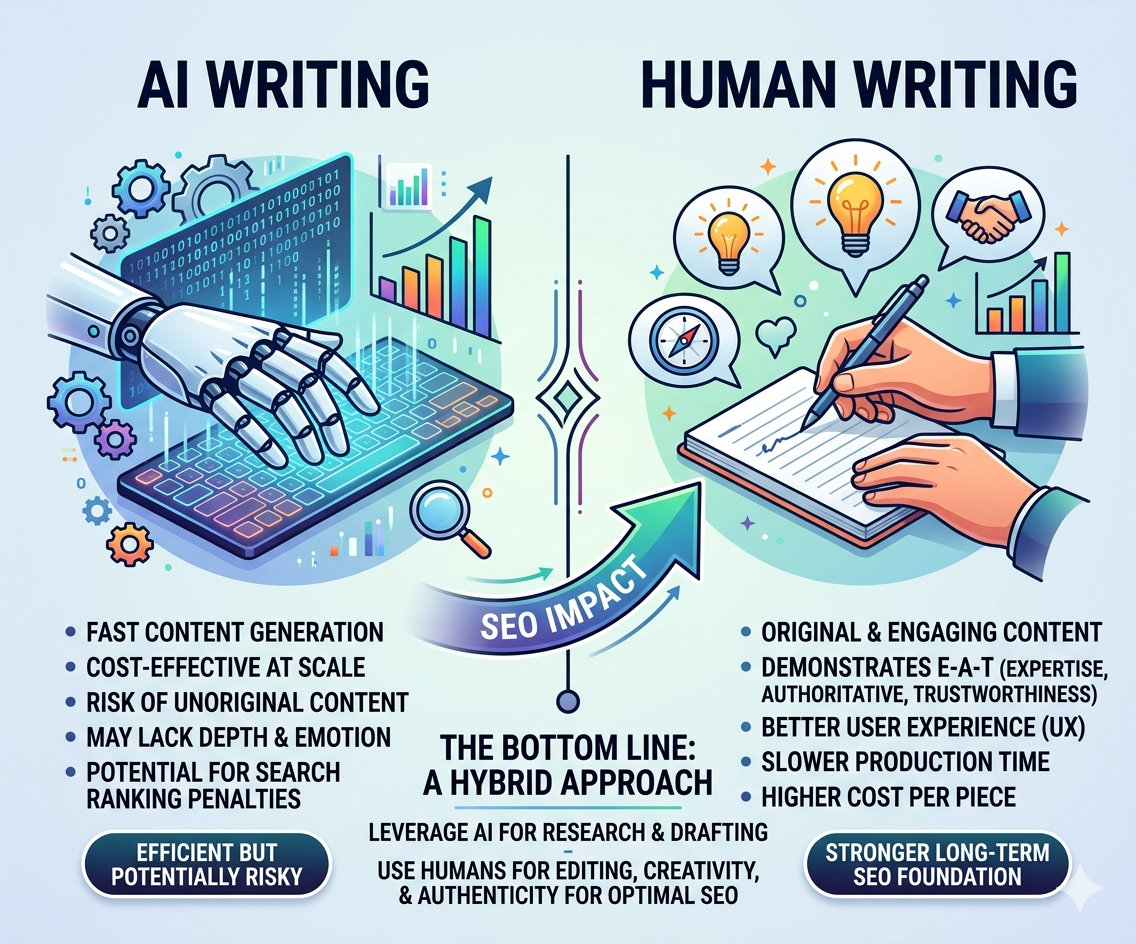
AI vs Human Writing: SEO Impact
Introduction
AI vs Human Writing: SEO Impact has become one of the most discussed topics in digital marketing and content creation. With AI writing tools rapidly evolving, businesses and marketers are questioning whether AI-generated content can truly compete with human-written content in search engine rankings. While AI offers speed and efficiency, human writers bring creativity, emotional intelligence, and authenticity. Understanding how both approaches affect SEO can help businesses create content strategies that improve visibility, engagement, and conversions.
Understanding AI Writing in SEO
AI writing tools use machine learning and natural language processing to generate content quickly. These tools can create blog posts, product descriptions, social media captions, and even long-form articles within minutes. AI-powered content generation has become popular among marketers because it reduces workload and increases productivity.
One major advantage of AI writing is consistency. AI tools can produce optimized content with targeted keywords, proper structure, and readable formatting. This helps businesses publish content regularly, which is an important factor in SEO performance. AI can also analyze data and suggest trending keywords that improve search engine visibility.
However, AI-generated content often lacks originality and emotional connection. Search engines like Google prioritize helpful, people-first content. If AI content becomes repetitive, generic, or overly optimized, it may struggle to rank well in competitive search results.
AI vs Human Writing: SEO Impact on Content Quality
AI vs Human Writing: SEO Impact is strongly connected to content quality. Search engines evaluate content based on relevance, expertise, user experience, and originality. Human writers naturally understand audience emotions, storytelling techniques, and contextual nuances that AI may miss.
Human-written content often feels more authentic and engaging. Writers can share personal experiences, opinions, and creative insights that build trust with readers. This improves user engagement metrics such as time on page, lower bounce rates, and higher social shares, all of which can positively influence SEO.
AI-generated content, on the other hand, excels at producing structured and keyword-rich articles quickly. It can support SEO campaigns by generating outlines, topic ideas, and first drafts. When combined with human editing, AI can become a valuable assistant rather than a replacement for human creativity.
Benefits of AI Writing for SEO
Faster Content Production
AI tools allow marketers to create large amounts of content in less time. Businesses managing multiple websites or blogs can maintain publishing consistency without requiring extensive manual effort.
Keyword Optimization
AI writing platforms analyze search trends and include relevant keywords naturally within the content. This helps improve on-page SEO and increases the chances of ranking for target search queries.
Cost Efficiency
For startups and small businesses, AI writing can reduce content creation costs. Instead of hiring multiple writers, companies can use AI tools to generate basic content and have editors refine it.
Content Scalability
AI makes it easier to scale content marketing efforts. Businesses can quickly create location-based pages, FAQs, product descriptions, and informational articles for broader keyword coverage.
Limitations of AI Writing in SEO
Lack of Emotional Intelligence
AI-generated content may sound robotic or repetitive. Readers often connect better with content that reflects human experiences and emotions.
Risk of Duplicate or Generic Content
Some AI-generated articles may resemble existing online content. This can reduce uniqueness and negatively impact SEO performance if not properly edited.
Limited Creativity
AI struggles with storytelling, humor, cultural understanding, and brand voice consistency. Human writers are better at creating memorable and persuasive content.
Potential Accuracy Issues
AI tools can occasionally generate misleading or inaccurate information. Fact-checking is essential before publishing AI-generated content online.
Human Writing and Its SEO Advantages
Human writers create content that resonates deeply with audiences. They understand how to adapt tone, style, and messaging according to reader intent. This ability improves user satisfaction and encourages repeat website visits.
Human-created content also supports brand authority. Thought leadership articles, case studies, expert opinions, and emotional storytelling often perform better in search rankings because they provide unique value.
Search engines increasingly prioritize Experience, Expertise, Authoritativeness, and Trustworthiness (E-E-A-T). Human-written content is more likely to demonstrate these qualities effectively compared to fully automated AI-generated articles.
AI vs Human Writing: SEO Impact on User Engagement
AI vs Human Writing: SEO Impact can also be measured through user engagement. SEO is no longer only about keywords; search engines evaluate how users interact with content.
Human-written articles often encourage comments, shares, and discussions because they feel relatable and authentic. Readers are more likely to trust brands that provide genuine insights and useful experiences.
AI-generated content may perform well for informational searches but sometimes fails to maintain reader attention for long periods. Without human refinement, AI articles may appear mechanical and lack depth.
The best-performing SEO content often combines AI efficiency with human creativity. AI can assist with research and optimization, while human writers ensure clarity, originality, and emotional connection.
Best Practices for Combining AI and Human Writing
Use AI for Research and Drafting
AI tools are highly effective for generating topic ideas, outlines, and initial drafts. This saves time during the content creation process.
Add Human Editing
Human editors should review AI-generated content to improve tone, readability, accuracy, and originality.
Focus on User Intent
Content should answer user questions clearly and provide valuable insights rather than simply targeting keywords.
Maintain Brand Voice
Human writers ensure consistency in brand messaging and communication style across all content platforms.
Prioritize Quality Over Quantity
Publishing fewer high-quality articles is more effective than mass-producing low-value content.
Future of AI and Human Writing in SEO
The future of content marketing will likely involve collaboration between AI and human writers. AI technology will continue improving, but human creativity and emotional intelligence remain irreplaceable.
Businesses that successfully combine AI efficiency with human expertise can create content that ranks well and builds meaningful audience relationships. Instead of viewing AI as competition, marketers should use it as a supportive tool for enhancing productivity and SEO performance.
Conclusion
AI vs Human Writing: SEO Impact shows that both AI and human writers have unique strengths. AI offers speed, scalability, and optimization, while human writers provide creativity, authenticity, and emotional depth. Search engines increasingly reward content that delivers real value to users, making human involvement essential for long-term SEO success.
For businesses and aspiring marketers looking to master SEO, content strategy, and AI-powered digital marketing, National Institute of Digital Marketing (NIDM) provides professional training and industry-focused learning opportunities to stay ahead in the evolving digital landscape.