
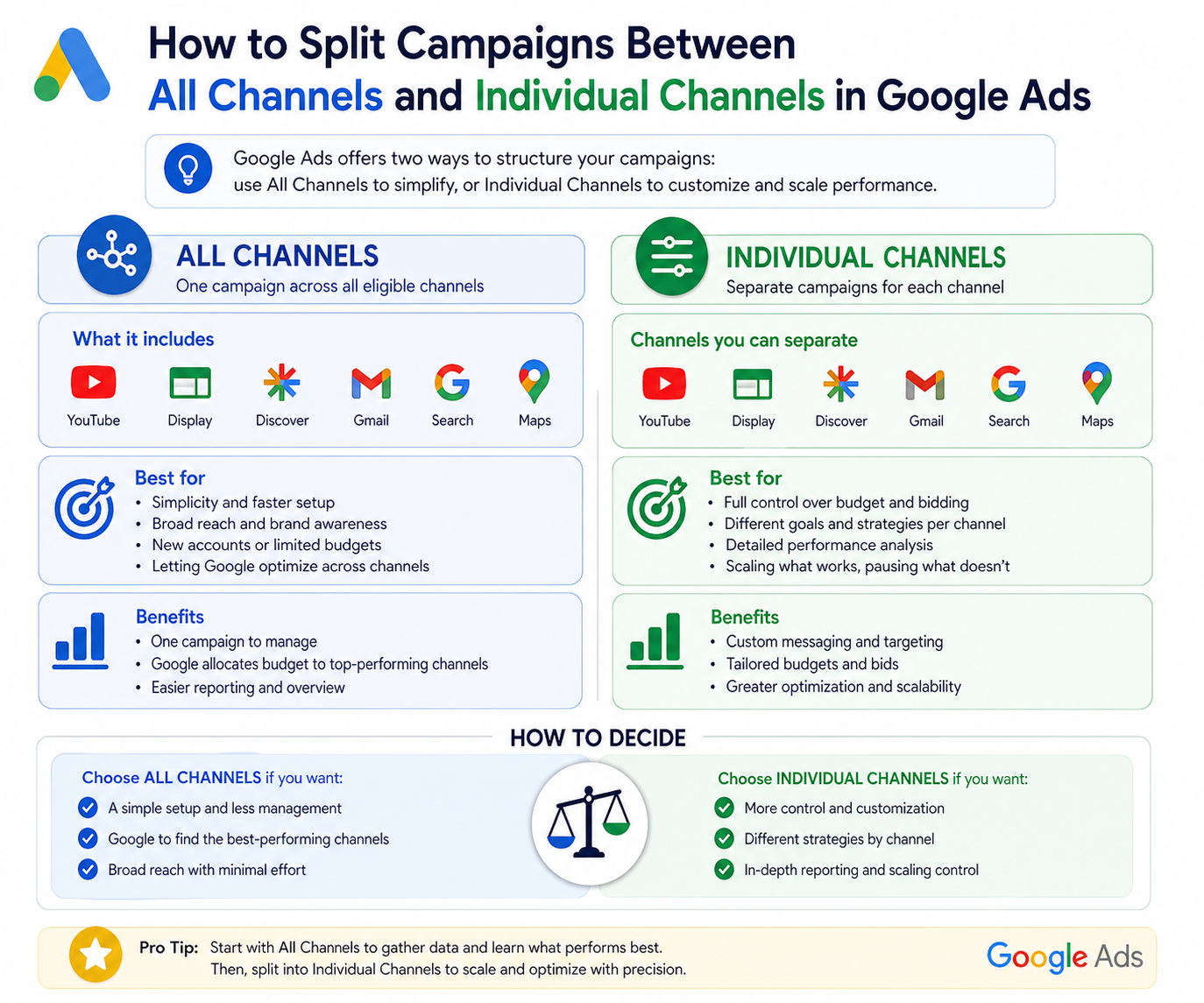
With the latest updates in Google Ads, advertisers are no longer limited to a single campaign approach. Instead, they must decide how to effectively combine All Channels campaigns, which rely on automation and broad reach, with Individual Channels campaigns that offer more precise control. This shift has made campaign structure more strategic than ever, as the way you split your campaigns can directly influence performance, cost efficiency, and scalability.
Splitting campaigns between All Channels and Individual Channels in Google Ads requires a balanced approach that combines automation with control. All Channels campaigns are ideal for reaching a broader audience across multiple platforms like Search, Display, and YouTube, using machine learning to optimize performance and uncover new opportunities. These campaigns are especially useful for scaling quickly, launching new products, or gathering initial data about audience behaviour. In contrast, Individual Channels campaigns allow advertisers to focus on specific platforms with greater precision, enabling better control over targeting, creatives, and bidding strategies to maximize results from high-performing segments.
An effective strategy involves using All Channels campaigns to generate insights and drive volume, while leveraging Individual Channels campaigns to refine and optimize performance based on that data. By aligning campaigns with different stages of the marketing funnel, advertisers can use automation for awareness and discovery, and manual campaigns for high-intent conversions. Regular monitoring and budget adjustments are essential to maintain efficiency, ensuring that high-performing campaigns receive more investment while underperforming ones are optimized or paused. This combination helps businesses achieve both scalability and precision, leading to improved ROI and more effective overall campaign performance.
What Are All Channels and Individual Channels?
All Channels campaigns are designed to simplify advertising by allowing businesses to run ads across multiple platforms such as Search, Display, YouTube, and Discover within one campaign. These campaigns use machine learning to automatically optimize targeting, bidding, and placements based on user behaviour and conversion signals. In contrast, Individual Channels campaigns focus on a single platform, giving advertisers full control over how ads are delivered, what creatives are used, and how budgets are allocated. This distinction makes Individual Channels more suitable for detailed optimization and performance tracking. To effectively understand and apply these strategies, enrolling in a digital marketing course can be highly beneficial, as it provides structured knowledge on campaign management, platform-specific techniques, analytics, and the use of automation tools to maximize advertising performance.
All Channels campaigns in Google Ads are designed to simplify advertising by allowing businesses to run ads across multiple platforms such as Search, Display, YouTube, and Discover within a single campaign. These campaigns rely heavily on automation and machine learning to optimize targeting, bidding, and placements in real time. By analyzing user behaviour and conversion data, All Channels campaigns aim to deliver the best possible results with minimal manual effort, making them ideal for advertisers who want to scale quickly and reach a wider audience.
Why Splitting Campaigns Matters
A well-planned campaign split helps advertisers avoid the limitations of relying entirely on one method. All Channels campaigns can drive scale and uncover new opportunities, but they often lack transparency in channel-level performance. Individual Channels campaigns provide clarity and control, but they may require more effort and limit reach if used alone. By combining both approaches, advertisers can create a more balanced strategy that captures the benefits of automation while maintaining the ability to fine-tune performance where it matters most.
Splitting campaigns between All Channels and Individual Channels in Google Ads is important because relying on only one approach can limit overall performance. All Channels campaigns offer scale and automation but often reduce visibility into which platforms are driving results, while Individual Channels campaigns provide detailed control but may restrict reach and slow down growth. By combining both, advertisers can balance efficiency and precision—using automation to discover new opportunities and manual control to optimize high-performing areas—ultimately leading to better budget utilization, improved targeting, and higher return on investment.
When to Use All Channels Campaigns
All Channels campaigns are most effective when the goal is to reach a wider audience and generate results without extensive manual management. They are particularly useful for new campaigns, product launches, or businesses that are still exploring their target audience. Since these campaigns rely on automated systems, they can quickly identify patterns and optimize performance across multiple platforms. This makes them ideal for advertisers who want to scale faster and gather insights without spending too much time on daily adjustments.
All Channels campaigns in Google Ads are most effective when you want to reach a broad audience and generate results without spending too much time on manual optimization. They are particularly useful during the early stages of a campaign, such as launching a new product or entering a new market, where gathering data and identifying potential customers is important. Since these campaigns use automation and machine learning to manage targeting and bidding, they help advertisers scale faster, discover new opportunities, and improve performance even with limited hands-on management.
When to Use Individual Channels Campaigns
Individual Channels campaigns are better suited for situations where accuracy and customization are essential. When advertisers already have data on what works, they can use this approach to focus on high-performing channels and refine their strategy. This is especially valuable for targeting users with strong intent, where tailored messaging and precise bidding can significantly improve conversion rates. Businesses with larger budgets or specific campaign goals often benefit from this level of control, as it allows them to optimize each channel independently.
How to Split Campaigns Effectively
Splitting campaigns effectively starts with aligning your strategy to your marketing objectives. All Channels campaigns can be used to drive awareness and attract new users, while Individual Channels campaigns can focus on converting those users into customers. Budget distribution should reflect this balance, with a larger share allocated to automated campaigns for reach and a smaller portion reserved for controlled experiments and optimizations.
Another important aspect of splitting campaigns is using All Channels campaigns as a learning tool. These campaigns generate valuable data about audience behaviour, platform performance, and creative effectiveness. Advertisers can use these insights to build more targeted Individual Channels campaigns that deliver better results. At the same time, it is important to ensure that campaigns do not compete with each other. Proper audience segmentation and funnel-based targeting can help prevent overlap and improve overall efficiency.
Creative execution also plays a key role in campaign success. While All Channels campaigns automate creative combinations, Individual Channels campaigns allow for tailored messaging that aligns with user intent on specific platforms. Regular monitoring and performance analysis are essential to maintaining the right balance, as they enable advertisers to shift budgets, refine strategies, and respond to changing trends
Common Mistakes to Avoid
Many advertisers make the mistake of depending too much on automation without analyzing the results in detail. This can lead to inefficiencies and missed optimization opportunities. Another common issue is running similar campaigns across both All Channels and Individual Channels without clear differentiation, which can cause internal competition and reduce effectiveness. Failing to use insights from automated campaigns or neglecting testing in manual campaigns can also limit overall performance.
Best Practices for Long-Term Success
Long-term success requires a flexible and data-driven approach. Advertisers should begin with a broader strategy and gradually refine it as more data becomes available. Combining automated insights with manual adjustments ensures that campaigns remain both scalable and efficient. Continuous testing, creative improvements, and alignment with the customer journey are essential for maintaining strong performance over time.
Learn Digital Marketing to Improve Campaign Strategy
To effectively manage and optimize modern advertising strategies, building expertise in Digital Marketing is highly valuable. A well-structured learning approach can help advertisers understand how to use tools like Google Ads more effectively, interpret campaign data, and apply advanced optimization techniques. Developing these skills not only improves campaign performance but also enables marketers to adapt quickly to platform updates and industry changes.
Conclusion
Splitting campaigns between All Channels and Individual Channels in Google Ads is about creating a balanced and adaptable strategy. While automation helps scale campaigns and discover new opportunities, manual control allows for precision and deeper optimization. By combining both approaches thoughtfully, advertisers can achieve better performance, improved return on investment, and long-term growth in an increasingly competitive digital environment.