A Google core update can dramatically affect your website’s search rankings, organic traffic, and online visibility. Many website owners experience sudden drops in traffic after a major update and immediately assume their site has been penalized. In reality, Google core updates are designed to improve the quality of search results by rewarding websites that provide the most relevant, trustworthy, and helpful content for users. If your rankings declined after a core update, the best solution is not to panic or make random SEO changes. Instead, you should perform a detailed website audit to identify weaknesses and improve your site according to Google’s quality standards. Enrolling in a digital marketing course can also help website owners and marketers understand the latest SEO trends, Google algorithm updates, content optimization strategies, and effective techniques to recover and improve rankings after a core update.
Auditing your website after a core update helps you understand what areas need improvement, whether it is content quality, technical SEO, user experience, or search intent optimization. A proper audit allows you to create a long-term recovery strategy rather than relying on temporary ranking tricks.
Understand the Impact of the Core Update
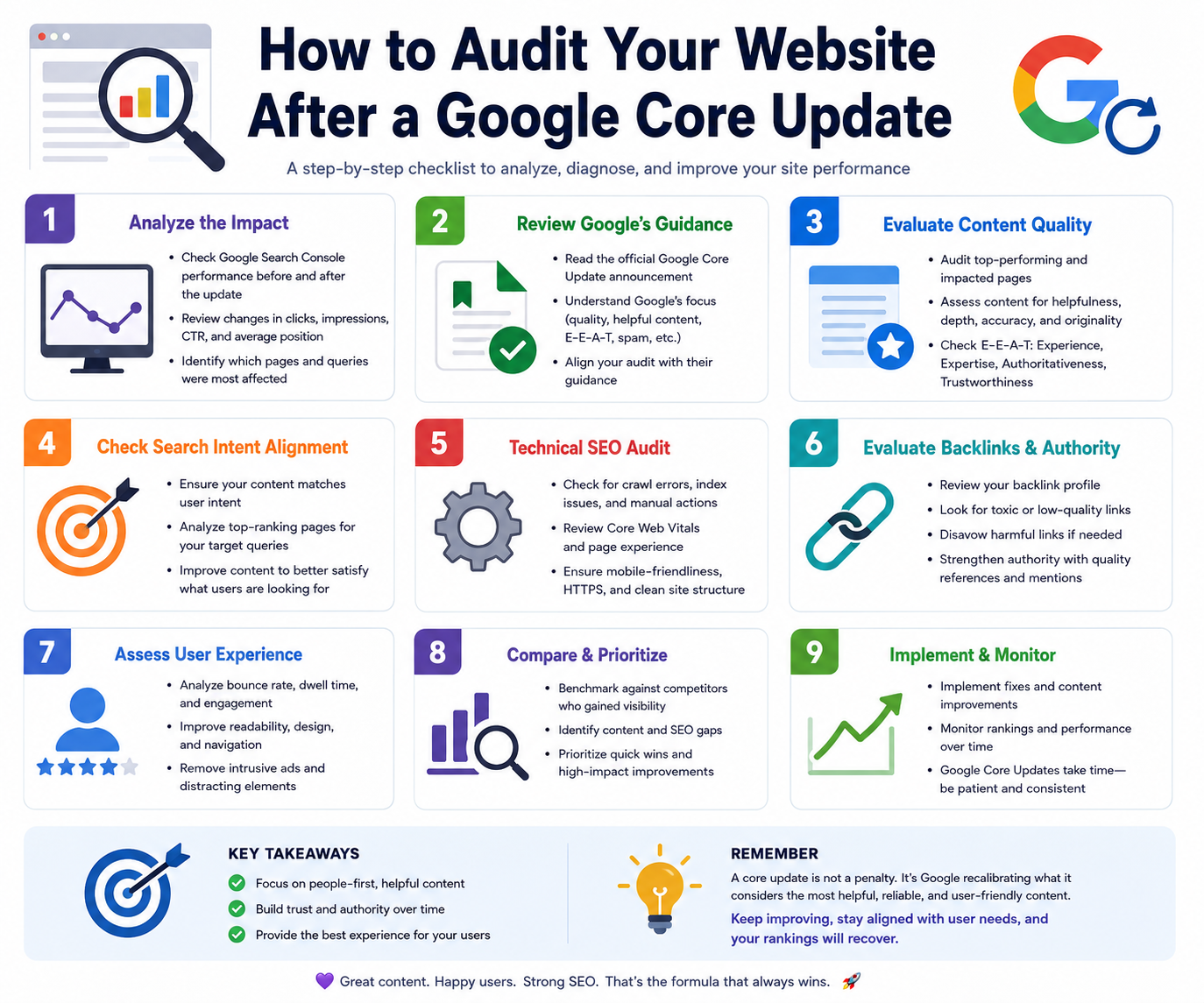
Before making any changes, it is important to understand how the Google core update affected your website. Start by analyzing your traffic and ranking data using tools like Google Analytics and Google Search Console. Compare your website’s performance before and after the update rollout to identify which pages lost traffic, impressions, or keyword rankings.
Sometimes only specific sections of a website are affected, while other times the entire domain experiences ranking fluctuations. Understanding the exact impact helps you avoid unnecessary changes to pages that are still performing well. It also helps you focus your efforts on the pages that need immediate improvement. You should also observe whether competitors gained rankings for keywords you lost. This often reveals the type of content Google now prefers after the update.
Analyze Search Intent Carefully
Search intent has become one of the most important ranking factors in modern SEO. Google wants to rank pages that best satisfy what users are actually searching for. If your content does not fully answer the user’s query, it may lose rankings even if it was previously performing well. During your audit, search your target keywords and carefully study the top-ranking pages. Look at the type of content Google is rewarding. Are the results more informational, transactional, comparison-based, or experience-focused? Compare those pages with your own content and identify gaps.
For example, if users searching for “best laptops for students” are seeing detailed comparison articles with buying guides and real-life usage examples, a short generic article may no longer be competitive. Improving search intent alignment often has a major impact on ranking recovery after a core update.
Evaluate Content Quality and Depth
Content quality is one of the biggest factors affected during Google core updates. Google continuously improves its ability to identify content that genuinely helps users. Thin articles, outdated blog posts, keyword stuffed pages, and low value AI generated content often struggle after updates. When auditing your content, ask yourself whether the article provides real value to readers. Does it answer questions clearly? Does it offer unique insights, examples, expert opinions, or practical solutions? Is the information updated and accurate?
High-quality content should be comprehensive without being unnecessarily lengthy. It should be easy to read, properly structured, and written for humans rather than search engines. Adding statistics, case studies, visuals, FAQs, and real-world examples can significantly improve content quality and engagement. Refreshing outdated articles is equally important. Old information can reduce trustworthiness, especially in industries where trends and data change frequently.
Strengthen EEAT Signals
Google strongly emphasizes EEAT, which stands for Experience, Expertise, Authoritativeness, and Trustworthiness. Websites that demonstrate strong EEAT signals are more likely to perform well after core updates. Experience means showing that the content creator has real-world knowledge or first hand experience with the topic. Expertise involves demonstrating deep understanding and accuracy. Authoritativeness reflects your reputation within your industry, while trustworthiness focuses on transparency and reliability.
To improve EEAT, include detailed author bios, display contact information, mention credentials where relevant, and cite reliable sources. If possible, showcase real experiences, customer testimonials, expert opinions, or original research. Building high-quality backlinks from authoritative websites also strengthens your authority in Google’s eyes. Google wants users to trust the websites it ranks, especially for topics related to health, finance, technology, or important life decisions.
Audit Technical SEO Performance
Even the best content can struggle to rank if technical SEO problems exist on your website. A technical audit helps ensure that Google can crawl, index, and understand your pages efficiently. Start by checking for crawl errors, broken links, redirect issues, duplicate pages, and indexing problems using Google Search Console. Evaluate your website’s loading speed and Core Web Vitals because slow websites often create poor user experiences.
Mobile usability is also critical since Google primarily uses mobile-first indexing. Your website should load properly across all devices and screen sizes. Poor navigation, intrusive pop-ups, or unresponsive layouts can negatively impact user satisfaction and rankings. A technically optimized website creates a strong foundation for long-term SEO success.
Improve User Experience
Google increasingly prioritizes websites that offer excellent user experiences. If users quickly leave your website because of poor design, slow loading speed, or confusing navigation, your rankings may decline over time.
During your audit, evaluate how users interact with your website. Make sure your pages are visually clean, easy to navigate, and free from excessive advertisements or distractions. Improve readability by using shorter paragraphs, proper headings, relevant images, and clear formatting. User engagement signals such as time spent on page, bounce rate, and interaction levels can indirectly influence SEO performance. A website that keeps visitors engaged usually performs better in search results.
Review Internal Linking Structure
Internal linking helps Google understand your website structure and identify your most important pages. Strong internal links also improve user navigation and distribute authority throughout your website.
During your audit, identify pages with few or no internal links. Important articles should receive links from related content across your website. Use descriptive anchor text that clearly explains the linked page topic. A well-structured internal linking strategy can improve crawlability, increase page authority, and help users discover additional valuable content.
Remove or Improve Low-Quality Pages
Large numbers of low-quality pages can weaken your overall website quality. Google evaluates websites as a whole, not just individual pages. Thin content, duplicate pages, outdated articles, and low-engagement pages may negatively affect overall site performance.
Review older pages carefully and decide whether they should be updated, merged, redirected, or removed. Instead of publishing large quantities of weak content, focus on maintaining fewer but higher-quality pages that provide genuine value. Quality is far more important than quantity after modern Google core updates.
Monitor Results and Stay Consistent
Recovering from a Google core update takes time. Google may need several weeks or months to fully reassess your website after major improvements are implemented. This is why consistency is important.
Continue monitoring keyword rankings, organic traffic, impressions, and user engagement metrics regularly. Avoid making aggressive SEO changes every few days because it becomes difficult to identify what is actually improving performance. SEO recovery is usually gradual. Websites that consistently improve content quality, user experience, and trust signals are more likely to regain rankings over time.
Conclusion
A Google core update should be viewed as an opportunity to improve your website rather than a reason to panic. Google’s goal is to reward websites that provide the best possible experience and the most valuable information for users. By carefully auditing your content quality, search intent alignment, EEAT signals, technical SEO, and user experience, you can build a stronger and more reliable website that performs better in future updates. Instead of chasing shortcuts or outdated SEO tricks, focus on creating helpful, trustworthy, and user-focused content. Websites that consistently prioritize quality and user satisfaction are the ones that achieve long-term SEO success in an ever-changing search landscape.