Introduction to Email Marketing Tools
Why Email Marketing Still Dominates in 2026
Email marketing tools aren’t just alive they’re thriving, evolving, and outperforming many flashy digital trends that come and go. You might wonder, in a world of TikTok ads and AI chatbots, does email still matter? The answer is a resounding yes. Email remains one of the highest ROI channels in digital marketing, consistently delivering strong engagement and conversion rates. Businesses rely on it because it provides direct access to customers without depending on unpredictable algorithms or rising ad costs.
Key Criteria for Choosing the Right Tool
Before diving into comparisons, it’s crucial to understand what actually matters when selecting an email marketing platform. Too many businesses get distracted by shiny features instead of focusing on what drives results. The real question isn’t “Which tool is best?” but rather “Which tool is best for your specific needs?”
There are several critical factors to consider. First, ease of use especially if you’re just starting out. A complicated interface can slow down your marketing efforts and create unnecessary frustration. Second, automation capabilities modern email marketing relies heavily on workflows like welcome sequences, abandoned cart reminders, and behavioral triggers. Third, segmentation and personalization, which determine how effectively you can target your audience.
Pricing also plays a huge role, especially as your subscriber list grows. Some tools start cheap but become expensive quickly, while others offer scalable pricing models. Integration capabilities are equally important whether you’re connecting to Shopify, WordPress, or CRM systems.
Ultimately, choosing between Mailchimp, ConvertKit, and Klaviyo comes down to your business model. Are you a creator, a small business owner, or an ecommerce brand? Each platform is designed with a different user in mind, and that’s where the real differences begin to emerge.
Overview of Mailchimp
Core Features and Capabilities
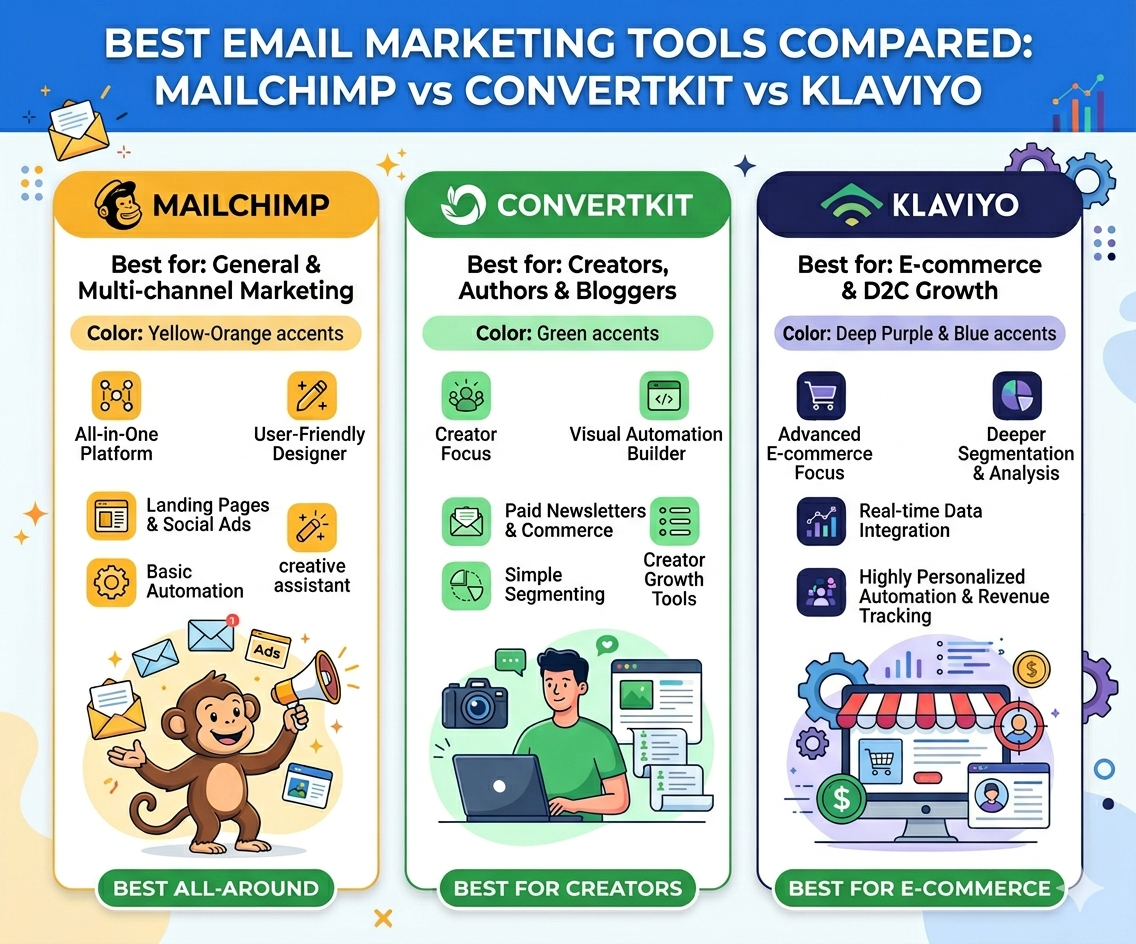
Mailchimp is often the first name that comes to mind when people think about email marketing and for good reason. It’s one of the oldest and most widely used platforms in the industry, evolving from a simple newsletter tool into a comprehensive marketing suite. Today, it offers everything from email campaigns and landing pages to CRM features and social media ads.
One of Mailchimp’s biggest strengths is its all-in-one approach. Instead of juggling multiple tools, you can manage your entire marketing ecosystem within a single platform. The drag-and-drop email builder is particularly user-friendly, making it easy for beginners to create professional-looking campaigns without any coding skills. Additionally, Mailchimp provides advanced analytics, A/B testing, and audience insights that help marketers optimize their campaigns over time.
In recent years, Mailchimp has heavily invested in AI-driven features. Tools like predictive segmentation, send-time optimization, and content suggestions allow users to automate decision-making processes. These features make it easier to deliver the right message to the right audience at the right time, which is essentially the holy grail of email marketing.
However, while Mailchimp offers a broad range of features, it’s sometimes criticized for lacking depth in certain areas, especially when compared to more specialized platforms like Klaviyo.
Pricing Structure and Limitations
Mailchimp’s pricing model has undergone significant changes, particularly in 2026. The free plan, once a major attraction, now supports only 250 contacts and 500 emails per month, which is a sharp reduction compared to previous limits . This shift reflects a broader trend toward monetization and premium features.
Paid plans start at around $13 per month and scale based on the number of contacts and features required. While this may seem affordable initially, costs can rise quickly as your audience grows. For example, larger lists can push pricing into hundreds of dollars per month, making it less attractive for scaling businesses.
Another limitation is that some advanced features like automation workflows are restricted to higher-tier plans. This means that businesses relying on automation may need to upgrade sooner than expected.
Despite these drawbacks, Mailchimp remains a solid choice for small to medium-sized businesses looking for a versatile, easy-to-use marketing platform.
Overview of ConvertKit
Creator-Focused Features
ConvertKit, now rebranded as Kit, takes a completely different approach compared to Mailchimp. Instead of trying to be everything for everyone, it focuses specifically on creators bloggers, podcasters, authors, and online educators. This specialization is what makes ConvertKit stand out.
At its core, ConvertKit is designed to help creators build and monetize their audience. It uses a tag-based system rather than traditional lists, allowing for more flexible and intuitive subscriber management. This means you can segment your audience based on behavior, interests, and engagement without duplicating contacts.
One of the platform’s most appealing features is its simplicity. The interface is clean, minimalistic, and easy to navigate, making it ideal for users who don’t want to deal with complex setups. ConvertKit also offers built-in tools for selling digital products, creating landing pages, and running email sequences.
This focus on creators is not accidental. According to recent comparisons, ConvertKit is specifically built for bloggers and digital entrepreneurs who rely heavily on email lists for revenue . It’s less about flashy features and more about delivering exactly what creators need.
Pricing and Ease of Use
ConvertKit offers a free plan for up to 1,000 subscribers, which is more generous than Mailchimp’s current free tier. Paid plans scale based on subscriber count, similar to other platforms, but the pricing structure is generally straightforward and transparent.
One of the biggest advantages of ConvertKit is its ease of use. You don’t need to be a tech expert to set up automation workflows or manage your audience. The platform’s visual automation builder is intuitive, allowing users to create complex sequences without feeling overwhelmed.
However, simplicity comes with trade-offs. ConvertKit lacks some of the advanced features found in Mailchimp and Klaviyo, particularly in areas like ecommerce integrations and detailed analytics. It’s not the best choice for businesses that require deep data insights or multi-channel marketing capabilities.
Still, for creators who prioritize simplicity and audience engagement, ConvertKit is hard to beat.
Overview of Klaviyo
Ecommerce-Centric Capabilities
Klaviyo is the powerhouse of ecommerce email marketing. Unlike Mailchimp and ConvertKit, which cater to broader audiences, Klaviyo is built specifically for online stores. If you’re running a Shopify or WooCommerce business, this platform is designed with you in mind.
What sets Klaviyo apart is its ability to leverage customer data. It tracks every interaction clicks, purchases, browsing behavior and uses this data to create highly personalized campaigns. This level of detail allows businesses to send targeted messages that drive conversions and increase revenue.
Klaviyo also excels in automation. From abandoned cart emails to post-purchase follow-ups, the platform offers pre-built workflows that are optimized for ecommerce. These workflows can be customized based on real-time data, making them more effective than traditional batch-based campaigns.
According to recent comparisons, Klaviyo’s segmentation and automation capabilities are significantly more advanced than Mailchimp’s, particularly for ecommerce use cases .
Pricing and Advanced Analytics
Klaviyo’s advanced features come at a cost. It is generally more expensive than Mailchimp, with pricing increasing significantly as your subscriber list grows. For example, at 50,000 contacts, Klaviyo can cost over 100% more than Mailchimp, highlighting the premium nature of the platform .
However, many businesses justify this cost because of the platform’s ability to generate revenue. Klaviyo provides detailed analytics, including customer lifetime value, churn risk, and predictive insights. These metrics allow businesses to make data-driven decisions and optimize their marketing strategies.
In essence, Klaviyo is not just an email marketing tool it’s a revenue engine for ecommerce brands.
Feature Comparison Table
Automation, Segmentation, and Integrations
| Feature | Mailchimp | ConvertKit | Klaviyo |
|---|---|---|---|
| Automation | Moderate | Simple & intuitive | Advanced & real-time |
| Segmentation | Good | Tag-based system | Highly advanced |
| Integrations | Extensive | Moderate | 350+ integrations |
| Ecommerce Focus | متوسط | Limited | Strong |
Ease of Use and User Experience
| Platform | Ease of Use | Learning Curve | Best For |
|---|---|---|---|
| Mailchimp | High | Low | Small businesses |
| ConvertKit | Very High | Very Low | Creators |
| Klaviyo | متوسط | High | Ecommerce brands |
Pricing Comparison Breakdown
Free Plans vs Paid Plans
Mailchimp’s free plan is now quite limited, while ConvertKit offers more flexibility for beginners. Klaviyo, on the other hand, focuses less on free users and more on delivering value through paid plans.
Cost Scalability with Growth
As your subscriber list grows, pricing becomes a critical factor. Mailchimp and ConvertKit scale moderately, but Klaviyo can become significantly more expensive. However, its ROI often justifies the cost for ecommerce businesses.
Automation and AI Capabilities
Workflow Automation Comparison
Automation is where these platforms truly differentiate themselves. Mailchimp offers solid automation features, but they are often limited compared to Klaviyo’s real-time triggers. ConvertKit focuses on simplicity, making it easy to create basic workflows without complexity.
AI Features and Predictive Analytics
Mailchimp has introduced AI tools like predictive segmentation and content optimization, while Klaviyo takes it further with predictive analytics and customer insights. ConvertKit, on the other hand, keeps things simple and doesn’t heavily rely on AI.
Best Tool by Use Case
Best for Beginners
Mailchimp is ideal for beginners due to its user-friendly interface and all-in-one features.
Best for Creators
ConvertKit is the go-to choice for creators who want simplicity and audience engagement tools.
Best for Ecommerce Businesses
Klaviyo is the clear winner for ecommerce, offering advanced automation and data-driven insights.
Pros and Cons of Each Platform
Mailchimp Pros & Cons
Mailchimp’s biggest advantage is its versatility. It’s like a Swiss Army knife packed with features that cover a wide range of marketing needs. However, this versatility can also be a drawback. Because it tries to do everything, it doesn’t always excel in specialized areas. Users often find that while Mailchimp is great for basic campaigns and small business needs, it can feel limiting when you need advanced automation or deep segmentation. Another issue is pricing. While it starts affordable, costs can escalate quickly as your list grows, making it less appealing for scaling businesses.
ConvertKit Pros & Cons
ConvertKit shines in simplicity and focus. It’s designed specifically for creators, which means it eliminates unnecessary complexity. The tag-based system is intuitive and powerful for audience segmentation, and the clean interface makes it easy to use even for beginners. However, this simplicity comes at a cost. ConvertKit lacks advanced features like detailed analytics and deep ecommerce integrations. It’s not the best choice for businesses that need sophisticated marketing automation or multi-channel campaigns.
Klaviyo Pros & Cons
Klaviyo is a powerhouse for ecommerce, offering unmatched segmentation, automation, and analytics. It’s built to drive revenue, and it does that exceptionally well. However, this power comes with a steep learning curve and higher costs. Businesses that don’t need advanced ecommerce features may find it overwhelming and unnecessarily expensive. It’s a tool designed for growth, but it requires investment—both in terms of money and time.
Final Verdict: Which Tool Should You Choose?
Choosing between Mailchimp, ConvertKit, and Klaviyo isn’t about finding the “best” tool it’s about finding the right fit for your business. If you’re a small business or beginner, Mailchimp offers a balanced mix of features and ease of use. If you’re a creator, ConvertKit provides simplicity and focus that aligns perfectly with your needs. And if you’re running an ecommerce business, Klaviyo delivers the advanced capabilities required to scale and maximize revenue.
Conclusion
Email Marketing Tools remain one of the most powerful assets in digital marketing, and selecting the right platform can significantly impact your results. Whether you prioritize ease of use, creator-focused features, or advanced ecommerce automation, each tool offers unique advantages. To master these tools and build a successful career in digital marketing, learning from experts like NIDM (National Institute of Digital Marketing) can provide the practical skills and industry knowledge needed to stay ahead.
FAQs
1. Which email marketing tool is best for beginners?
Mailchimp is generally the best option for beginners due to its user-friendly interface and all-in-one features.
2. Is ConvertKit better than Mailchimp?
It depends on your needs. ConvertKit is better for creators, while Mailchimp is more versatile for general marketing.
3. Why is Klaviyo more expensive?
Klaviyo offers advanced ecommerce features and predictive analytics, which justify its higher pricing.
4. Can I switch between these tools easily?
Yes, most platforms offer migration tools, but the process can vary depending on your data and integrations.
5. Which tool offers the best ROI?
For ecommerce businesses, Klaviyo often provides the best ROI due to its advanced targeting and automation capabilities.