Branding vs Performance Ads: Which Strategy is Better for Your Business?
If you’ve ever run ads or thought about growing a business online, you’ve probably stumbled into the classic debate: branding vs performance ads. It’s like choosing between planting a tree and picking fruit one takes time, the other gives instant results. But here’s the catch: most marketers get stuck thinking they must choose one over the other. That’s where things go wrong.
Marketing today isn’t what it used to be. With rising ad costs, shorter attention spans, and smarter consumers, businesses are under pressure to deliver results fast while still building something meaningful. In fact, global marketing spend is projected to reach nearly $1.87 trillion in 2025, which means competition is fiercer than ever.
So what’s the real difference between branding and performance ads? And more importantly how do you use them together without wasting money?
Let’s break it down in plain English.
What is Branding in Marketing?
Core Purpose of Branding
Branding is all about how people feel about your business. It’s not just your logo, colors, or tagline it’s the emotional connection you build with your audience over time. Think of branding as your reputation in the market. It answers questions like: Why should someone trust you? Why should they choose you over competitors?
Unlike performance ads, branding doesn’t aim for immediate clicks or sales. Instead, it focuses on long-term growth building awareness, trust, and loyalty. Companies that invest in strong branding often see up to 23% higher revenue, simply because people recognize and trust them more.
Branding works quietly in the background. It shapes perception, influences decisions, and creates familiarity. When someone remembers your brand without seeing an ad—that’s branding doing its job.
Key Elements of Branding
Branding isn’t one single activity it’s a combination of several moving parts that work together. These include your visual identity (logo, colors), your voice (how you communicate), and your messaging (what you stand for).
But here’s the interesting part: branding also includes customer experience. The way you respond to emails, the tone of your social media, even how your website feels—all of this contributes to your brand.
Good branding creates consistency. And consistency builds trust. Over time, this trust turns into loyalty, and loyal customers are far more valuable—they’re more likely to buy again and recommend you to others.
What Are Performance Ads?
Core Objective of Performance Marketing
Performance ads are the opposite side of the coin. They focus on immediate, measurable results. You’re not paying for exposure you’re paying for outcomes like clicks, leads, or sales.
This model is incredibly popular because it’s easy to track. You can see exactly how much you spent and what you got in return. That’s why performance marketing has become a dominant strategy, with around 70% of marketers increasing investment in performance-driven campaigns.
In simple terms, performance ads are about action. You run a campaign, track conversions, and optimize for better results. It’s fast, data-driven, and highly scalable.
Common Channels Used in Performance Ads
Performance ads typically run on platforms where tracking is easy and precise. These include:
- Google Ads (search and display)
- Social media ads (Meta, Instagram, LinkedIn)
- Affiliate marketing
- Retargeting campaigns
Each of these channels allows advertisers to measure metrics like cost per click (CPC), cost per lead (CPL), and return on ad spend (ROAS). This level of detail makes performance marketing extremely attractive for businesses that want quick wins.
Key Differences Between Branding and Performance Ads
Goals and Objectives
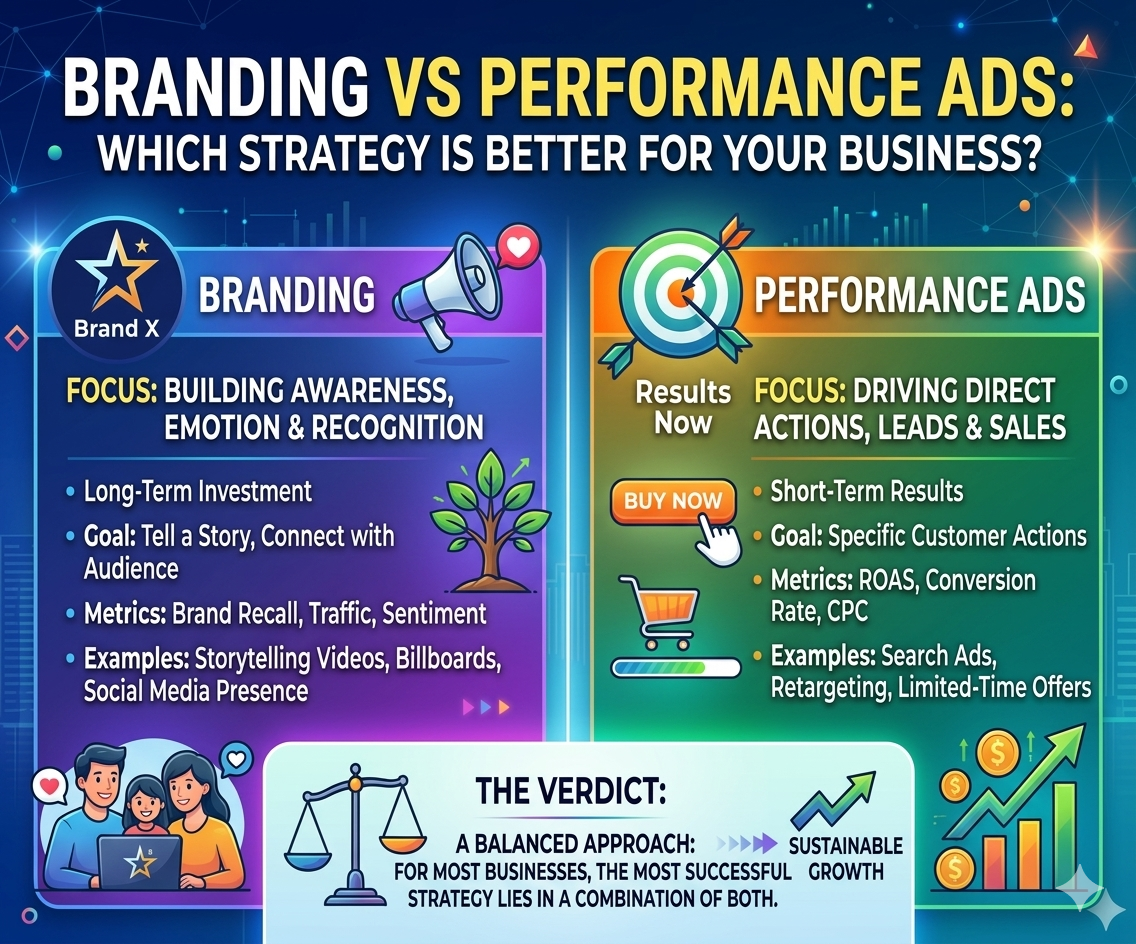
Branding and performance ads differ fundamentally in what they aim to achieve. Branding focuses on building awareness, trust, and emotional connection, while performance ads are designed to drive immediate actions like clicks and purchases.
Think of branding as creating demand and performance ads as capturing it.
Timeframe and Results
Branding is a long game. It can take months or even years to see its full impact. Performance ads, on the other hand, can deliver results within hours or days.
This difference often tempts businesses to prioritize performance ads, especially when they need quick revenue. But relying only on short-term gains can backfire in the long run.
Measurement Metrics
One of the biggest differences lies in how success is measured. Branding relies on indirect metrics like:
- Brand recall
- Customer sentiment
- Share of voice
Performance ads use direct metrics such as:
- Conversions
- Click-through rate (CTR)
- Return on ad spend (ROAS)
Because performance metrics are easier to track, many companies lean heavily toward them—even when branding might be more beneficial.
Budget and ROI
Performance ads offer clear ROI—you know exactly what you’re getting. Branding, however, is harder to measure but often delivers compounding returns over time, including lower acquisition costs and higher customer lifetime value.
Interestingly, strong brands can reduce customer acquisition costs by 30–50%, making performance campaigns more efficient.
Pros and Cons of Branding
Branding is powerful, but it’s not without challenges. The biggest advantage is its ability to create long-term value. When people trust your brand, they don’t just buy once—they keep coming back.
Another benefit is pricing power. Strong brands can charge more because customers perceive them as more valuable.
However, branding requires patience. It doesn’t deliver instant results, and measuring its impact can be tricky. Businesses often struggle to justify branding budgets because the ROI isn’t immediately visible.
Pros and Cons of Performance Ads
Performance ads shine when you need quick results. They’re measurable, scalable, and easy to optimize. You can test different creatives, audiences, and strategies to improve performance almost instantly.
But there’s a downside. Performance ads can become expensive over time, especially if your brand isn’t strong. Without brand recognition, every click costs more because customers don’t trust you yet.
Another limitation is dependency. The moment you stop spending on ads, results drop. It’s like turning off a tap—no budget, no traffic.
When Should You Focus on Branding?
Branding makes the most sense when you’re playing the long game. If your goal is to build a recognizable business that people trust, branding should be a priority.
It’s especially important in competitive markets where differentiation matters. When products are similar, branding becomes the deciding factor.
Startups often overlook branding because they’re chasing quick wins. But investing in branding early can set the foundation for sustainable growth.
When Should You Use Performance Ads?
Performance ads are ideal when you need immediate results. Launching a new product? Running a limited-time offer? Trying to generate leads quickly? Performance ads are your best friend.
They’re also useful for testing ideas. You can quickly validate whether a product or message resonates with your audience before investing heavily in branding.
Real-World Examples of Branding vs Performance
Imagine two businesses selling the same product. One invests heavily in branding—telling stories, building a community, creating emotional connections. The other focuses only on ads, driving traffic and conversions.
In the short term, the second business might win. But over time, the first business builds loyalty, reduces costs, and gains a competitive edge.
That’s why companies with strong brand awareness often see 2.5x higher conversion rates compared to unknown competitors.
Why You Should Combine Both Strategies
The truth is, this isn’t a battle—it’s a partnership. Branding and performance ads work best when they’re combined.
Branding creates demand. Performance ads capture it.
Full Funnel Marketing Explained
A full-funnel strategy uses branding at the top (awareness), nurturing in the middle (consideration), and performance ads at the bottom (conversion).
This approach ensures you’re not just chasing clicks—you’re building a sustainable business.
Latest Trends in Branding and Performance Marketing (2025–2026)
Marketing is evolving fast. Today’s consumers are more selective, and traditional ads are losing effectiveness. That’s why businesses are shifting toward integrated strategies that combine storytelling with data-driven optimization.
Another trend is the rise of AI-driven personalization. Performance campaigns are becoming smarter, while branding is becoming more human and authentic.
Common Mistakes Businesses Make
One of the biggest mistakes is choosing one strategy over the other. Businesses either focus too much on performance and burn out their audience or invest in branding without a clear path to revenue.
Another mistake is expecting instant results from branding. It doesn’t work that way. Branding is like compound interest it grows over time.
How to Balance Branding and Performance Ads
Balancing both strategies requires a clear understanding of your goals. A common approach is the 60/40 rule 60% of your budget on branding and 40% on performance.
This balance ensures you’re building long-term value while still driving short-term results.
Tools to Measure Branding vs Performance
For performance ads, tools like Google Analytics and ad dashboards provide clear data.
For branding, measurement is more nuanced. You might track brand searches, direct traffic, or customer surveys to understand brand perception.
Expert Insights and Statistics
Experts agree that combining branding and performance delivers the best results. Businesses that integrate both strategies not only grow faster but also achieve better efficiency in their marketing spend.
The data backs this up—strong brands don’t just attract customers; they make every marketing effort more effective.
Conclusion
Branding vs performance ads is not a choice but a strategy that works best when combined. Branding builds trust and long-term value, while performance ads drive immediate results and conversions.
Branding vs performance ads ultimately creates a powerful marketing system where businesses attract and convert customers efficiently. For marketers looking to master both strategies, institutions like NIDM (National Institute of Digital Marketing) provide valuable training and practical insights to stay ahead in the competitive digital landscape.
FAQs
1. What is the main difference between branding and performance ads?
Branding focuses on long-term awareness and trust, while performance ads aim for immediate, measurable results like clicks and sales.
2. Which is better: branding or performance marketing?
Neither is better on its own. The most effective strategy combines both for sustainable growth.
3. Can small businesses afford branding?
Yes, branding doesn’t always require huge budgets. Consistency and storytelling can go a long way.
4. How long does branding take to show results?
Branding is a long-term strategy and can take several months to years to deliver significant results.
5. Do performance ads work without branding?
They can work, but they’re less efficient. Strong branding improves conversion rates and reduces costs.