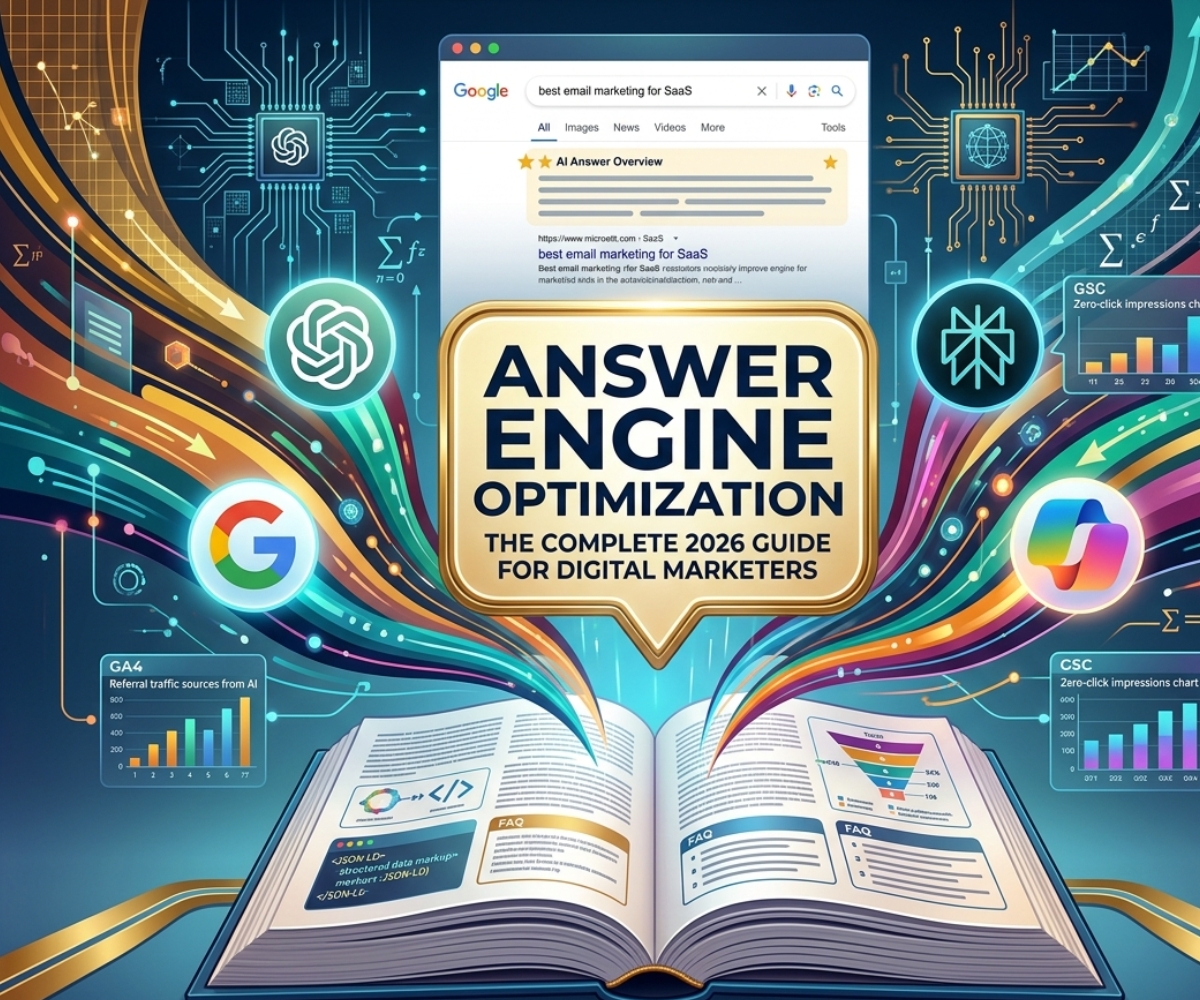
Answer Engine Optimization (AEO) is the practice of structuring your content so that AI-powered platforms like ChatGPT, Google AI Overviews, Perplexity, and Microsoft Copilot extract it and deliver it as a direct, cited response to user queries. In other words, you’re not just trying to rank anymore. You’re trying to be the answer.
Every week, over 800 million people use ChatGPT or similar AI tools to get information. Google AI Overviews now appear in nearly 55% of all searches. The brands winning these citations are building trust, authority, and conversions at a speed that traditional SEO simply can’t match — and those who ignore this shift are quietly becoming invisible.
If your content isn’t being cited by AI answer engines, you’re missing the fastest-growing source of high-intent traffic in 2026.
What Is Answer Engine Optimization — And Why Does It Matter?
Traditional SEO earns you a spot on a results page. Answer Engine Optimization earns you a spot inside the answer itself. It’s the difference between being listed and being quoted.
When someone asks ChatGPT ‘What’s the best email marketing tool for startups?’ and the AI responds citing your blog post — that’s AEO working. You didn’t need the user to click a link. Your brand became the authority before they ever visited your site.
AEO vs SEO vs GEO: How They Differ
| Strategy | Optimizes For | Success Metric |
| SEO | Search result rankings | Traffic & rankings |
| GEO | AI-generated overviews | AI impressions |
| AEO | Being the cited source | Citations & conversions |
AEO doesn’t replace SEO — it evolves it. Strong technical SEO is the foundation. AEO is the layer that ensures your content gets extracted and cited by AI platforms that your audience now relies on daily.
Why AI Answer Optimization Is Urgent Right Now
- ChatGPT handles over 2 billion queries daily
- Google AI Overviews appear in ~55% of all Google searches
- Gartner predicts traditional search volume will drop 25% by 2026 as users shift to AI assistants
- ~60% of Google searches now end without any click — the answer is served on the page
- Brands appearing in AI answers see up to 9x higher conversion rates vs standard search clicks
How AI Search Optimization Actually Works (The RAG Pipeline)
To optimize for answer engines, you first need to understand how they retrieve and select content. Most use a process called Retrieval-Augmented Generation (RAG), which runs in three stages:
Stage 1: Conversational Search Optimization Starts at Query Parsing
The AI interprets the user’s question — not just keywords, but intent, context, and entities. A query like ‘Is email marketing still worth it for SaaS in 2026?’ signals evaluative intent, and the system searches for content that directly compares, recommends, or supports a clear position.
Stage 2: Semantic Retrieval
The system searches its index for semantically relevant documents. A post titled ‘Email ROI for B2B Software Companies’ can surface for that query even without matching every word. Relevance is concept-based, not just keyword-based.
Stage 3: Your AI Citation Strategy Determines Who Gets Quoted
Retrieved documents are scored on relevance, authority, recency, and structural clarity. AI models favour content they can cleanly extract a well-formed answer from. Messy, poorly structured content rarely gets cited — even if it’s technically accurate.
AI models don’t reward who ranks #1. They reward who is easiest to trust, extract, and cite.
7 Answer-Based SEO Strategies to Implement Right Now
Here are seven proven tactics to make your content AI-citation ready:
1. Lead Every Section With a Direct Answer
Answer Engine Optimization rewards content that answers questions immediately. State your core answer in the first 40–60 words of every section — before the explanation and evidence. Think of each H2 as a question and the paragraph beneath it as the direct answer.
2. Structure Content Around Questions (Core AEO Technique)
Use H2 and H3 headings that mirror how users ask questions conversationally. Add a dedicated FAQ section with concise answers (under 50 words each). Use tools like ‘People Also Ask’, AnswerThePublic, and AlsoAsked to find real question formats your audience uses.
3. Implement Schema Markup
Structured data (JSON-LD schema) tells AI systems exactly what type of content is on your page. The most impactful schema types for AEO are:
- FAQPage — marks up question-and-answer pairs
- HowTo — for step-by-step instructional content
- Article / BlogPosting — with author and date metadata for E-E-A-T signals
- Speakable — marks sections ideal for voice assistant responses
4. Build Topical Authority Across Content Clusters
AI platforms evaluate your entire content ecosystem, not just individual pages. A comprehensive pillar page on Answer Engine Optimization supported by satellite articles (on schema, FAQs, voice search, etc.) signals genuine topical ownership — making you far more likely to be cited across a range of related queries.
5. Strengthen E-E-A-T Signals
Experience, Expertise, Authoritativeness, and Trustworthiness are critical AEO factors. Practical steps: add author bios with credentials, cite original data, earn third-party mentions, and keep content current. Studies show 85% of AI brand mentions originate from third-party sources — off-site authority is huge.
6. Voice Search Optimization for Spoken Queries
Voice queries are longer and more conversational than typed ones. Optimize for natural phrasing: ‘how do I…’, ‘what’s the best way to…’, ‘which tool is better for…’. Keep answers scannable — voice assistants read short paragraphs. With voice commerce projected to hit $80 billion annually, this is no longer optional.
7. Refresh Content on a Regular Cadence
Freshness is mandatory. AI engines actively deprioritize stale content. Update your key posts quarterly, add visible timestamps like ‘Last updated: March 2026’, and incorporate recent data. Brands leading in AI citations update content 3–4x per year minimum.
How to Measure AI Answer Optimization Success
AEO requires different metrics than traditional SEO. Here’s what to track:
- AI brand mentions & citations: Tools like Semrush, Profound, and Advanced Web Ranking now track where your brand appears across ChatGPT, Perplexity, Gemini, and Copilot.
- Zero-click impressions: In Google Search Console, watch for queries with high impressions but low CTR — a strong signal your content is appearing in AI Overviews.
- AI referral traffic: In GA4, create a custom segment to track sessions from perplexity.ai, chatgpt.com, and bing.com/chat.
- Assisted conversions: Track users who encounter your brand via AI and later convert directly. Attribution modelling is key here.
AEO may reduce direct click-through rates short-term — but the users who arrive after encountering your brand as a trusted AI citation are among the highest-converting visitors you’ll ever get.
Answer Engine Optimization in Action: Real Brand Results
AEO isn’t theoretical. Brands implementing it are already seeing measurable outcomes:
- NerdWallet saw a 35% revenue increase by becoming the expert answer source for financial queries — even as overall traffic dipped. Being the trusted answer proved more valuable than raw clicks.
- Local service businesses report significant increases in inbound calls after optimizing their Google Business Profiles with FAQ content formatted for voice search and AI extraction.
- B2B SaaS brands using AI citation strategies are now appearing directly in comparison answers, shortcutting the buyer’s research phase and driving higher-intent demo requests.
Start Your Answer Engine Optimization Strategy Today
The shift from ‘ranking for clicks’ to ‘being the answer’ is well underway. ChatGPT has 400+ million weekly users. Google AI Overviews reach nearly a billion searchers monthly. Perplexity processes millions of queries every day. These platforms are where your audience now makes decisions — and the brands being cited there are winning mindshare, trust, and revenue.
Answer Engine Optimization doesn’t replace your existing SEO — it supercharges it. Technical SEO remains the foundation. But without layering AEO strategies on top, you’re leaving the most valuable real estate in modern search completely uncontested.
Quick Win: Audit your top 10 blog posts. Add a direct answer in the opening paragraph, a 5-question FAQ section at the bottom, and FAQPage schema markup. That single move can start earning AI citations within weeks.
FAQs About Answer Engine Optimization
What is Answer Engine Optimization in simple terms?
Answer Engine Optimization (AEO) is the process of formatting and structuring your content so AI tools like ChatGPT, Google AI Overviews, and Perplexity select it as the source when answering user questions.
Is AEO different from SEO?
Yes. SEO focuses on ranking in search result pages. AEO focuses on being cited inside AI-generated answers. Both are important — AEO builds on a strong SEO foundation.
Which AI platforms does AEO target?
Primarily ChatGPT, Google AI Overviews, Perplexity, Microsoft Copilot, and Gemini. These collectively handle billions of queries daily and are where modern search behaviour is rapidly shifting.
How long does it take to see AEO results?
Some brands see AI citations within 2–4 weeks of implementing schema markup and FAQ sections on high-authority pages. Broader topical authority typically builds over 3–6 months.
Do I need a separate AEO strategy or can I combine it with SEO?
Combine them. Most AEO best practices (direct answers, structured data, E-E-A-T, freshness) also improve traditional SEO performance. Think of AEO as the evolution of SEO, not a replacement.
If you’re serious about mastering AEO, AI-driven search strategies, and the future of digital marketing, now is the time to upgrade your skills. Institutions like NIDM (National Institute of Digital Marketing) are already equipping marketers with practical training in AI-powered marketing, automation, and next-generation SEO techniques.