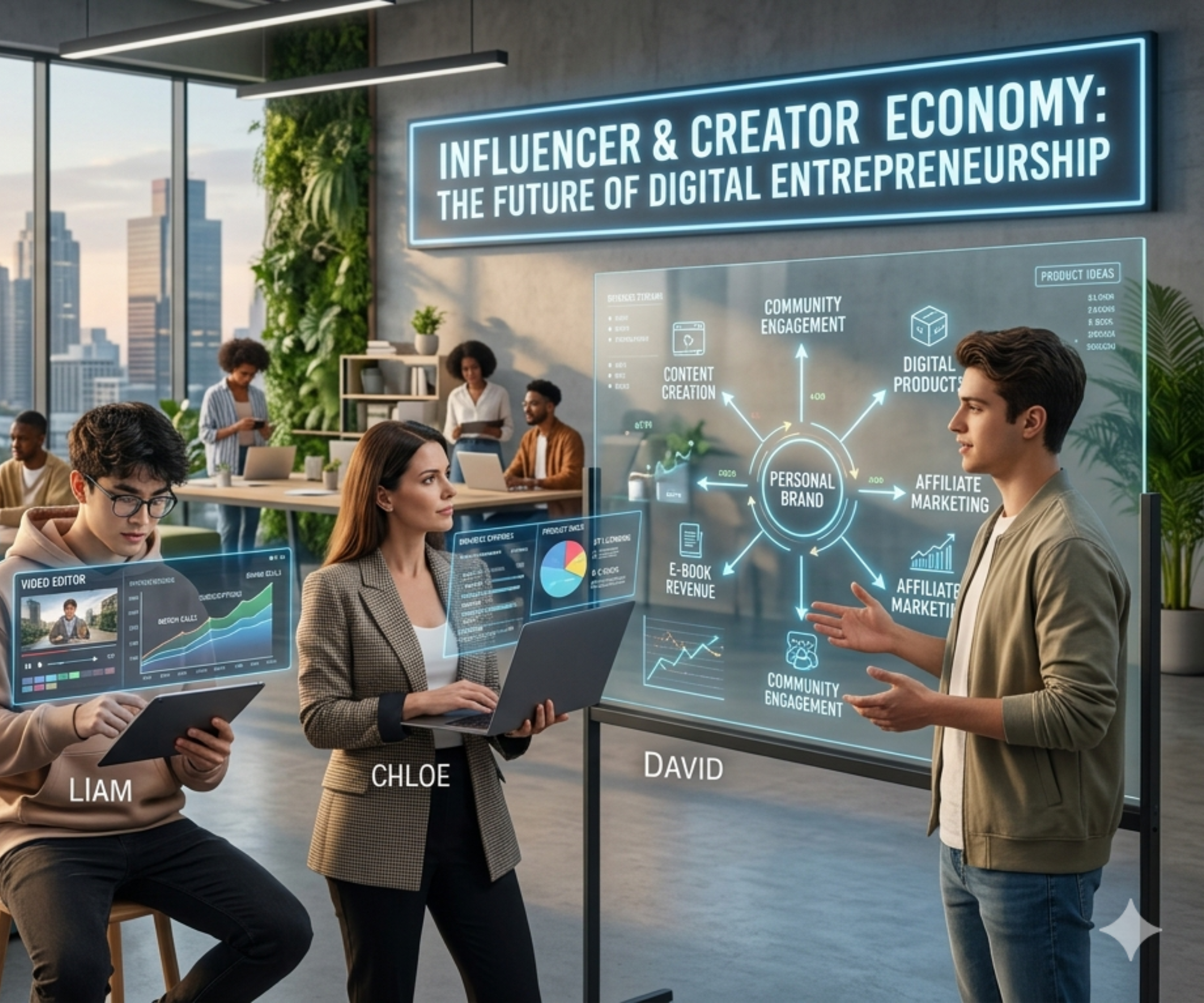
Influencer & Creator Economy: The Future of Digital Entrepreneurship
Introduction to the Influencer & Creator Economy
Influencer & Creator Economy has transformed the internet into a powerful platform for digital entrepreneurship where individuals can create, share, and monetize content online. Over the last decade, social media platforms have evolved from simple networking spaces into massive economic ecosystems where creators build audiences, influence purchasing decisions, and generate income through various monetization strategies. Today platforms such as YouTube, Instagram, TikTok, and podcast platforms allow millions of creators worldwide to establish personal brands and businesses. What once required expensive studios, media companies, and publishers can now be achieved using just a smartphone and creative storytelling.
What is the Creator Economy?
The creator economy refers to a digital ecosystem where independent creators produce and distribute content while earning income directly from their audiences. These creators include bloggers, YouTubers, podcasters, influencers, photographers, educators, and newsletter writers who leverage digital platforms to reach global audiences. Unlike traditional media industries controlled by publishing houses and television networks, creators now operate as independent media businesses. They produce content, build communities, analyze audience data, collaborate with brands, and monetize their influence through advertising, subscriptions, digital products, and partnerships.
Influencer vs Content Creator
Although the terms influencer and content creator are often used interchangeably, they represent slightly different roles within the creator economy. Content creators primarily focus on producing valuable, educational, or entertaining content for their audience, while influencers focus more on influencing audience decisions, especially purchasing behavior. A YouTube educator or blogger might prioritize teaching or storytelling, whereas an Instagram lifestyle influencer often collaborates with brands to promote products. In reality, many creators evolve into influencers as their audience grows and brands begin to recognize their influence over consumer behavior.
Growth of the Influencer & Creator Economy
The Influencer & Creator Economy has experienced extraordinary growth in recent years and is now considered one of the fastest-growing sectors in digital marketing. Industry estimates suggest that the global creator economy is valued at over $191 billion and could exceed $528 billion by 2030. Influencer marketing alone has expanded from approximately $1.7 billion in 2015 to over $32 billion in 2025, reflecting how brands are shifting advertising budgets toward creators who have strong relationships with their audiences. This shift occurs because modern consumers trust recommendations from creators far more than traditional advertisements.
Growth of the Creator Economy in India
India is emerging as one of the fastest-growing markets within the global creator economy. With affordable smartphones, inexpensive mobile data, and a population exceeding one billion people, digital content consumption has skyrocketed. By 2025, the Indian creator economy reached approximately ₹2,200 crore, growing rapidly from ₹640 crore only a few years earlier. The country now has thousands of active creators producing content across platforms like YouTube, Instagram, and regional social media networks. Interestingly, around 72% of consumed creator content in India is produced in regional languages, highlighting the importance of localized digital content.
Platforms Powering the Influencer & Creator Economy
Social media platforms form the foundation of the creator economy because they provide distribution channels for content and tools for audience engagement. Platforms such as YouTube, Instagram, TikTok, Facebook, LinkedIn, Twitch, and X (formerly Twitter) allow creators to build communities and share content globally. Each platform supports different formats, with YouTube focusing on long-form video content, TikTok specializing in short-form viral videos, and Instagram emphasizing visual storytelling. These platforms also compete for creators by introducing monetization tools such as ad revenue sharing, creator funds, and membership programs.
Monetization in the Influencer & Creator Economy
Monetization is a key component of the Influencer & Creator Economy, allowing creators to convert audience attention into income. One of the most common revenue streams is brand partnerships, where companies collaborate with creators to promote products through sponsored posts, product reviews, or ambassador programs. Influencers also generate income through affiliate marketing, advertising revenue, merchandise sales, online courses, and subscription communities. Successful creators often diversify their income sources to reduce dependence on a single platform or monetization strategy.
Benefits of the Creator Economy
Challenges in the Influencer & Creator Economy
Despite its opportunities, the creator economy also presents challenges for aspiring creators. One major issue is income inequality, where only a small percentage of creators earn significant revenue while many struggle to monetize their content effectively. Studies show that the top 10% of creators receive the majority of advertising payments. Another challenge is algorithm dependence, as creators rely heavily on social media platforms to distribute content. Changes in platform algorithms can dramatically affect visibility, audience reach, and revenue.
Emerging Trends in the Creator Economy
Several technological and cultural trends are shaping the future of the creator economy. Artificial intelligence is becoming increasingly important in content production, helping creators automate tasks such as video editing, script writing, thumbnail design, and audience analytics. Another emerging trend is the rise of micro and niche influencers who focus on specialized topics such as finance, technology, education, gaming, or fitness. These creators often have smaller audiences but achieve higher engagement and stronger trust among followers.
Future of the Influencer & Creator Economy
The future of the Influencer & Creator Economy looks extremely promising as digital consumption continues to grow worldwide. Experts predict that the industry could reach over $1 trillion in value within the next decade. Innovations such as AI-generated content, virtual influencers, creator-owned platforms, and community-based monetization models will likely shape the next phase of digital entrepreneurship. As creators increasingly operate like independent media companies, the boundaries between influencers, entrepreneurs, and media producers will continue to blur.
Conclusion
FAQs
What is the creator economy?
The creator economy is a digital ecosystem where individuals produce content online and generate income through advertising, brand partnerships, subscriptions, digital products, and community memberships.
How big is the creator economy?
The global creator economy is estimated to be worth more than $191 billion and could surpass $528 billion by 2030.
How do influencers earn money?
Influencers earn money through brand collaborations, affiliate marketing, advertising revenue, merchandise sales, and paid memberships.
Is the creator economy a good career?
Yes, content creation can be a rewarding career, but success requires consistency, strong branding, and diversified income streams.
Which platforms are best for creators?
Popular platforms include YouTube, Instagram, TikTok, LinkedIn, Twitch, and podcast platforms depending on the content format.