The digital marketing landscape has been transformed by AI. A well-defined ChatGPT marketing strategy is no longer optional — it is essential for brands that want to stay competitive. OpenAI’s suite of models, including ChatGPT, GPT-4o, and the broader API ecosystem, now gives marketers unprecedented tools to create content, personalise customer journeys, analyse audiences, and automate repetitive workflows. This guide walks you through everything you need to know to build, execute, and optimise your own ChatGPT marketing strategy from the ground up.
Why a ChatGPT Marketing Strategy Matters in 2025
The marketing world is moving faster than ever. Consumer expectations have risen sharply, content production demands have soared, and advertising costs continue to climb. ChatGPT and the OpenAI platform sit at the intersection of all three challenges, offering scalable, intelligent solutions that were simply not available even three years ago.
Brands that have adopted a structured ChatGPT marketing strategy report significant efficiency gains, including faster content turnaround, higher personalisation scores, and improved customer engagement rates. Meanwhile, those without a plan risk falling behind as AI-native competitors capture market share.
The Scale of the Opportunity
OpenAI’s ChatGPT reached 100 million users within two months of launch — the fastest product adoption in history. Today, hundreds of millions of people interact with ChatGPT regularly for research, shopping comparisons, and product discovery. This makes the platform not just a productivity tool but an emerging marketing channel in its own right.
How Marketers Are Already Using ChatGPT
Leading marketing teams are using ChatGPT for a wide variety of tasks, including:
- Drafting and optimising ad copy across multiple platforms
- Generating first drafts of blog posts, white papers, and case studies
- Personalising email sequences at scale
- Conducting rapid competitor and keyword research
- Building chatbot scripts and conversational marketing flows
- Analysing customer feedback and surface actionable insights
Building Your ChatGPT Marketing Strategy: A Step-by-Step Framework
A successful strategy requires more than prompting ChatGPT and copying the output. It demands intentional planning, brand alignment, and a feedback loop for continuous improvement. The following framework provides a structured approach.
Step 1 — Define Your Marketing Goals
Before opening any AI tool, be crystal clear on what you want to achieve. Are you trying to grow organic traffic, reduce content production costs, improve email open rates, or accelerate lead generation? Each goal will shape how you use ChatGPT and what you measure.
Step 2 — Establish Brand Voice Guidelines
ChatGPT is highly adaptable, but it needs direction. Create a concise brand voice document that captures your tone, values, audience personas, and style preferences. Include positive examples of on-brand content and negative examples of what to avoid. This document becomes part of your system prompt whenever you engage the model.
Step 3 — Identify High-Leverage Use Cases
Not all marketing tasks benefit equally from AI assistance. Start by mapping your existing workflows and identifying the most repetitive, time-intensive steps. Content ideation, first-draft creation, social media caption generation, and A/B test variant writing tend to offer the highest ROI for most teams.
Step 4 — Integrate ChatGPT into Your Tech Stack
The OpenAI API allows you to embed ChatGPT capabilities directly into your CRM, CMS, or marketing automation platform. This integration unlocks personalisation at scale — for example, dynamically generating personalised email subject lines or tailoring landing page copy based on traffic source.
Step 5 — Measure, Iterate, and Optimise
Track performance metrics for every AI-assisted initiative. Compare engagement rates, conversion rates, and production times against your baseline. Use these insights to refine your prompts, update your brand voice document, and expand your use cases over time.
Content Marketing with ChatGPT
Content remains the bedrock of digital marketing, and ChatGPT dramatically accelerates every stage of the content lifecycle — from ideation through to distribution.
Ideation and Topic Research
ChatGPT excels at generating content ideas tailored to specific audiences, seasons, or trends. By providing context about your target persona and competitive landscape, you can quickly generate a month’s worth of blog topics, video scripts, or podcast outlines in minutes rather than hours.
Drafting Long-Form Content
One of the highest-value applications of a ChatGPT marketing strategy is the acceleration of long-form content production. Using a clear brief with target keyword, intended audience, desired word count, and key points to cover, ChatGPT can produce a strong first draft that your team then edits, fact-checks, and refines. This hybrid human-AI workflow can reduce writing time by 50–70% without sacrificing quality.
SEO Optimisation and Meta Copy
ChatGPT is particularly effective for SEO copywriting tasks such as meta titles, meta descriptions, header tag suggestions, and internal linking anchor text. It can also analyse a page structure and recommend improvements for better search visibility.
Social Media Marketing with ChatGPT
Social media demands high-volume, platform-specific content that resonates with diverse audiences. ChatGPT is a natural fit for this challenge.
Platform-Specific Caption Writing
Each social channel has its own culture, formatting norms, and algorithmic preferences. ChatGPT can be prompted to write LinkedIn posts in a professional, thought-leadership tone; Instagram captions with an aspirational, emoji-friendly style; and X (formerly Twitter) threads that prioritise brevity and punch.
Community Management and Responses
Brands managing large communities often struggle to respond to every comment and message in a timely, personalised way. ChatGPT can generate draft responses to frequently asked questions, handle routine enquiries, and flag complex issues for human review — all while maintaining a consistent brand voice.
Social Listening and Sentiment Analysis
By feeding customer comments, reviews, and social mentions into ChatGPT, marketers can quickly surface themes, sentiment patterns, and emerging concerns that would take hours to analyse manually. This intelligence feeds directly into campaign strategy and product messaging.
Email Marketing and Personalisation with ChatGPT
Email marketing remains one of the highest-ROI channels available. ChatGPT enhances it further by enabling deeper personalisation without proportionally increasing workload.
Subject Line Testing
Subject lines are the single most important factor in email open rates. ChatGPT can generate dozens of subject line variants for any given email in seconds, giving your team more options to A/B test and optimise.
Personalised Email Sequences
When connected to your CRM via the OpenAI API, ChatGPT can generate personalised email body copy that references a contact’s industry, previous purchase behaviour, or specific pain points. This level of personalisation, previously only possible for enterprise teams with large budgets, is now accessible to businesses of all sizes.
Paid Advertising with ChatGPT
ChatGPT can substantially accelerate paid advertising workflows across search, display, and social channels.
Ad Copy Creation and Variants
Effective paid campaigns require constant creative refresh. ChatGPT can produce multiple ad copy variants — headlines, descriptions, CTAs — for any audience segment or campaign objective in a fraction of the time it would take a copywriter working alone. This makes it easier to maintain fresh creative and reduce ad fatigue.
Audience Research and Persona Development
A strong ChatGPT marketing strategy includes using the model to deepen audience research. By analysing customer reviews, forum discussions, and support transcripts, ChatGPT can identify audience motivations, language patterns, and objections that make paid targeting and creative development more precise and effective.
OpenAI Tools Beyond ChatGPT for Marketers
While ChatGPT is the most well-known product, OpenAI offers a broader ecosystem that marketers can leverage.
GPT-4o for Multimodal Marketing
GPT-4o, OpenAI’s flagship multimodal model, can process and generate text, images, and audio. For marketers, this opens up possibilities such as analysing visual brand assets, generating image descriptions for accessibility, and creating audio scripts with contextual awareness of accompanying visuals.
DALL-E for Visual Content
OpenAI’s DALL-E image generation model allows marketers to quickly produce custom illustrations, concept visuals, and social media graphics without relying on stock photography or lengthy design briefs. This is particularly valuable for rapid campaign iteration and A/B testing of visual creative.
OpenAI API for Custom Marketing Applications
Development teams can use the OpenAI API to build custom marketing tools — from AI-powered chatbots on your website, to automated content briefing tools, to intelligent audience segmentation engines. The API provides full programmatic access to OpenAI’s models with the flexibility to tailor them precisely to your brand’s needs.
Best Practices for a Responsible ChatGPT Marketing Strategy
As with any powerful tool, responsible use is critical. A thoughtful approach protects your brand reputation and builds long-term trust with your audience.
Always Fact-Check AI-Generated Content
ChatGPT can occasionally produce inaccurate statistics, outdated information, or hallucinated references. Establish a clear editorial review process where a human verifies all factual claims before publication.
Maintain Transparency Where Appropriate
Consumer sentiment around AI disclosure is evolving. Evaluate whether your audience expects or appreciates transparency about AI involvement in content creation, particularly for thought leadership, testimonials, or personalised communications.
Protect Customer Data
When integrating ChatGPT with customer data via the API, ensure compliance with applicable data protection regulations, including GDPR and CCPA. Avoid sending personally identifiable information to external AI services without appropriate data processing agreements in place.
Preserve the Human Creative Edge
AI is most effective as a force-multiplier for human creativity, not a replacement for it. The strongest marketing outputs combine AI efficiency with human strategic thinking, emotional intelligence, and cultural nuance. Build your workflows to complement human talent, not sideline it.
Measuring the Success of Your ChatGPT Marketing Strategy
Defining clear KPIs is essential to demonstrating the value of your AI investment and identifying areas for ongoing improvement.
Efficiency Metrics
Track time saved per content piece, cost-per-piece produced, and volume of content output per team member. These metrics quantify productivity gains and inform resource planning.
Engagement Metrics
Measure click-through rates, time on page, social shares, and email open and click rates for AI-assisted content versus baseline. This reveals whether AI-generated content resonates as effectively with your audience as human-only content.
Conversion Metrics
Ultimately, marketing success is measured in business outcomes. Track lead generation, conversion rates, and revenue attribution for campaigns where ChatGPT played a significant role. These metrics make the ROI case for continued and expanded AI investment.
Conclusion
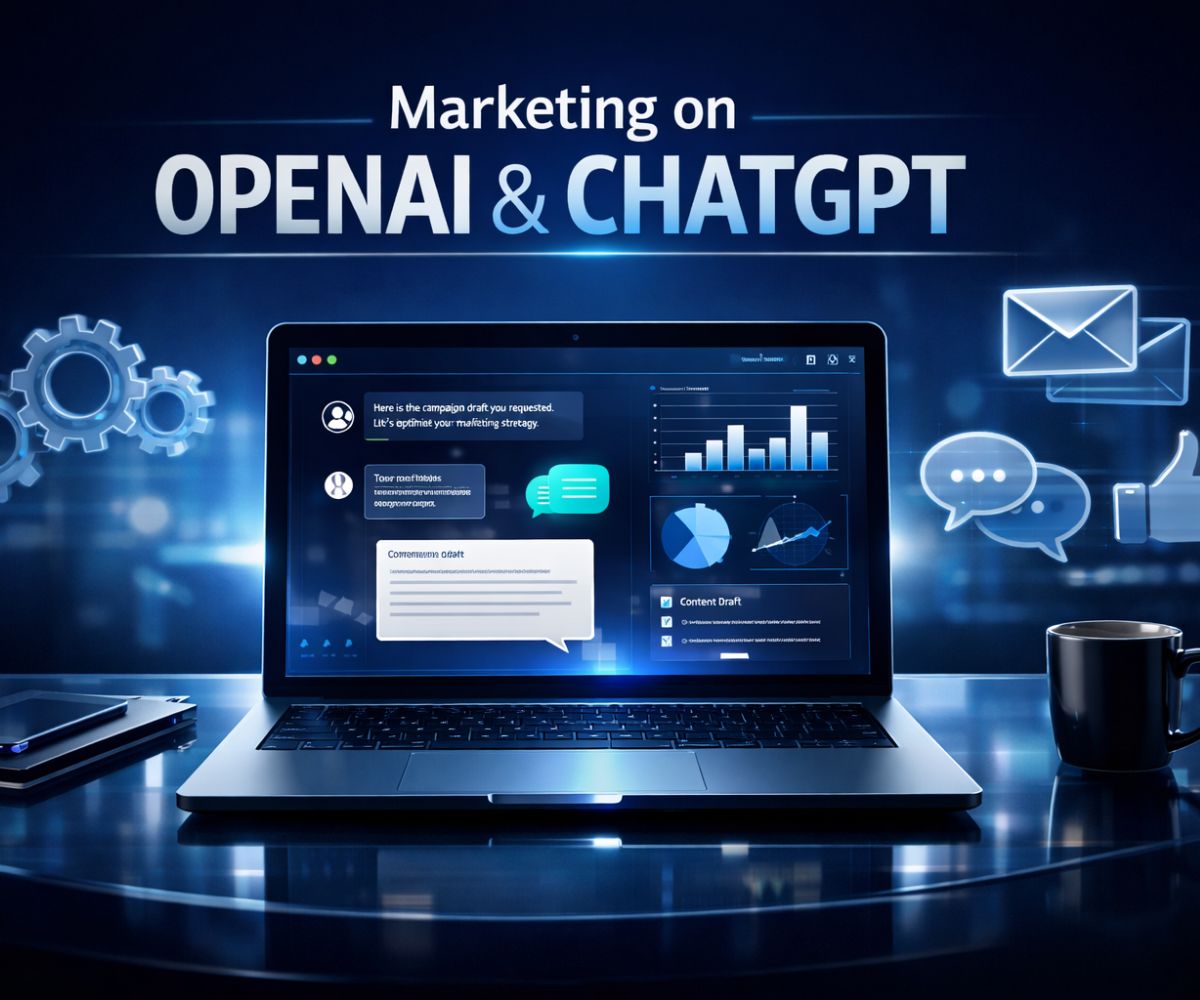
Marketing on OpenAI and ChatGPT represents one of the most significant shifts in the discipline since the emergence of social media. A well-executed ChatGPT marketing strategy can unlock substantial gains in content production speed, personalisation depth, and campaign performance — all while freeing your team to focus on the high-value creative and strategic work that AI cannot replace.
The brands that win in this new era will not be those that use AI the most, but those that use it most intentionally. Start with clear goals, establish strong brand guardrails, pick the right use cases, and commit to a culture of measurement and iteration. The tools are here. The opportunity is now.
AI is no longer the future — it’s the present, and it’s reshaping every corner of digital marketing. In a world where AI writes the content, marketers who know how to strategically command it will lead the industry. As emphasized by NIDM (National Institute of Digital Marketing), the future belongs to professionals who don’t just use ChatGPT — but build smart, brand-aligned ChatGPT marketing strategies that drive real business results. The tools are evolving fast. Are your skills keeping up?