CPC vs CPM vs CPA Explained
Introduction to CPC CPM CPA
CPC CPM CPA are three of the most important advertising models used in digital marketing today. Businesses running ads on Google, Facebook, Instagram, YouTube, and other platforms rely on these pricing methods to control their advertising budgets and improve campaign performance. Whether a company wants more website traffic, brand awareness, or direct conversions, understanding these advertising models helps marketers choose the right strategy for better results.
Digital advertising has become highly competitive, and brands are constantly searching for cost-effective ways to attract customers online. This is where CPC, CPM, and CPA advertising models become essential. Each model works differently and serves a unique purpose. Some campaigns focus on clicks, while others prioritize impressions or conversions. Choosing the wrong advertising method can waste money quickly, while selecting the right one can significantly improve return on investment.
Many beginners often get confused between CPC, CPM, and CPA because all three are related to paid advertising costs. However, their goals and performance measurements are completely different. Understanding the differences between these models can help businesses make smarter marketing decisions and improve campaign efficiency in the long run.
What is CPC in Digital Marketing?
CPC Advertising Explained
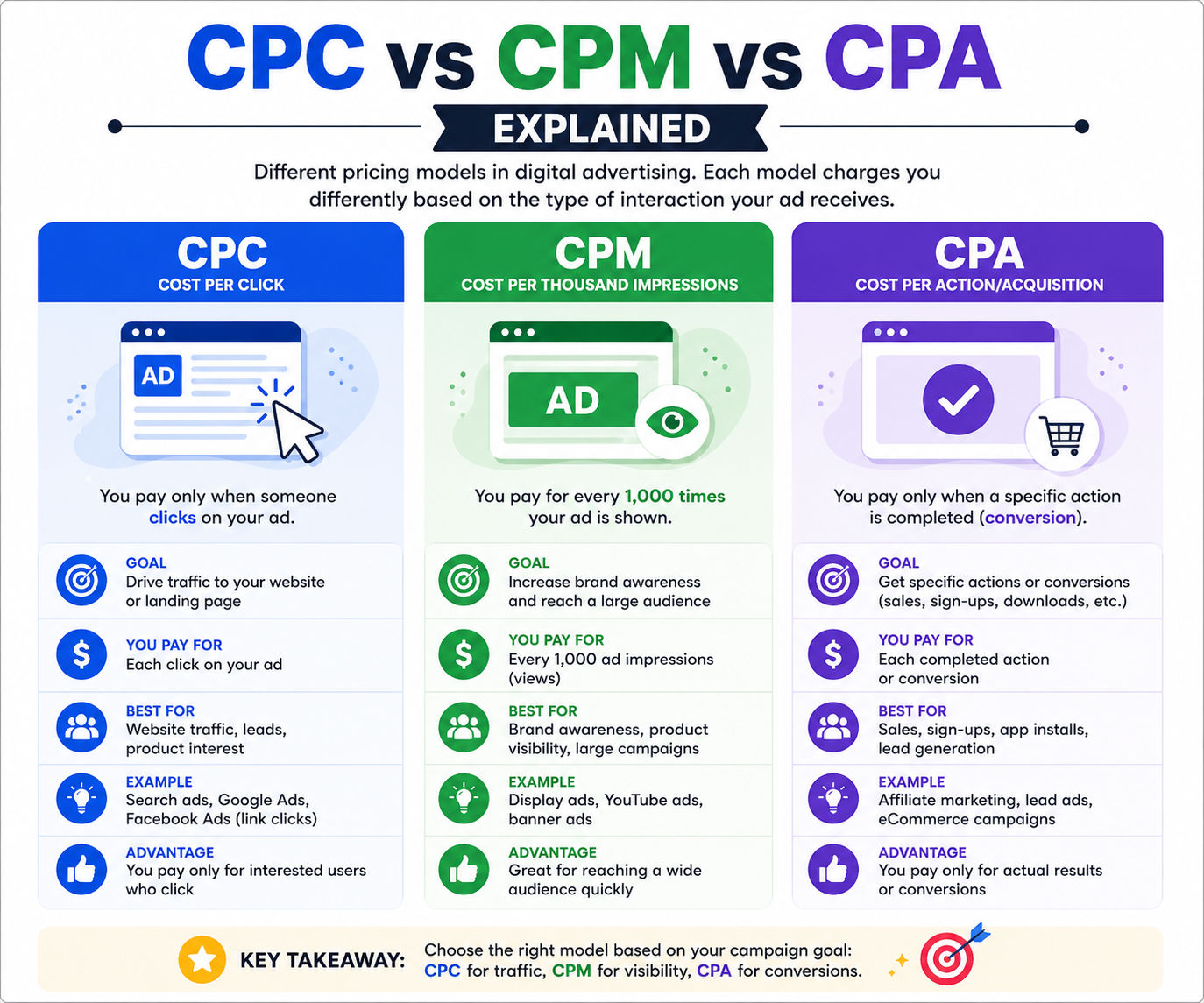
CPC CPM CPA strategies start with understanding CPC, which stands for Cost Per Click. In this advertising model, businesses pay only when someone clicks on their ad. It is one of the most commonly used advertising methods in search engine marketing and social media advertising.
For example, if a company spends ₹1,000 on an ad campaign and receives 200 clicks, the CPC would be ₹5 per click. This means the advertiser pays only for user engagement rather than impressions or views. Google Ads and Meta Ads heavily use the CPC model because it helps businesses drive targeted traffic to websites and landing pages.
CPC campaigns are especially useful for businesses that want visitors to take action, such as reading a blog, purchasing a product, or filling out a form. Since advertisers only pay for clicks, this model provides better control over budget spending. It also helps marketers measure campaign effectiveness easily because every click can be tracked and analyzed.
One of the biggest advantages of CPC advertising is that it targets users with high intent. For example, when someone searches for “best digital marketing course,” they already have interest in that topic. Businesses can use CPC ads to appear in search results and attract potential customers immediately.
Advantages of CPC Advertising
CPC advertising offers several benefits for businesses of all sizes. One major advantage is cost control. Advertisers can set daily budgets and maximum bid amounts, ensuring they never overspend. This makes CPC campaigns suitable for startups and small businesses with limited marketing budgets.
Another important benefit is measurable performance. Marketers can track clicks, conversions, bounce rates, and customer behavior in real time. This helps businesses optimize campaigns quickly and improve overall ROI. CPC advertising also works well for generating website traffic because every click brings a visitor directly to the business website or landing page.
CPC campaigns are also highly targeted. Advertisers can select specific keywords, demographics, locations, devices, and interests to reach the right audience. This increases the chances of attracting quality leads instead of random visitors.
Disadvantages of CPC Advertising
Despite its benefits, CPC advertising also has some challenges. High competition can increase click costs significantly, especially in industries like finance, healthcare, and education. Popular keywords often become expensive because multiple advertisers compete for the same audience.
Another drawback is that not every click converts into a customer. Some users may click accidentally or leave the website without taking action. This means businesses need strong landing pages and conversion strategies to maximize campaign effectiveness.
What is CPM in Digital Marketing?
CPM Advertising Explained
CPC CPM CPA advertising models also include CPM, which stands for Cost Per Mille or Cost Per Thousand Impressions. In this model, advertisers pay for every 1,000 times their ad is displayed to users, regardless of whether people click on it or not.
CPM advertising focuses mainly on brand awareness and visibility. Companies use CPM campaigns when they want maximum exposure for their products or services. Display ads, banner ads, YouTube video ads, and social media awareness campaigns commonly use the CPM pricing model.
For example, if a business spends ₹2,000 on a campaign with a CPM of ₹100, the advertisement will receive around 20,000 impressions. The primary goal here is visibility rather than direct engagement or conversions.
Large brands often prefer CPM advertising because repeated exposure helps improve brand recognition. When users repeatedly see the same brand advertisement, they become more familiar with the company, increasing trust and recall over time.
Benefits of CPM Advertising
One of the biggest advantages of CPM advertising is wide audience reach. Businesses can expose their brand to thousands or even millions of users quickly. This is highly beneficial for product launches, event promotions, and awareness campaigns.
CPM advertising is also generally cheaper compared to CPC campaigns when the goal is visibility. Brands can generate massive impressions without paying for individual clicks. This makes CPM ideal for companies focused on increasing brand recognition rather than immediate conversions.
Another benefit is improved brand recall. Even if users do not interact with the ad immediately, repeated exposure increases the chances of future engagement. Many companies use CPM campaigns to stay visible in competitive markets and maintain customer attention.
Drawbacks of CPM Advertising
The biggest disadvantage of CPM advertising is that impressions do not guarantee engagement. People may see the ad but ignore it completely. This means businesses can spend large amounts on impressions without generating clicks or sales.
CPM campaigns also make ROI measurement more difficult compared to CPC or CPA campaigns. Since advertisers pay for views rather than actions, it becomes harder to determine direct campaign effectiveness.
What is CPA in Digital Marketing?
CPA Advertising Explained
CPC CPM CPA advertising becomes more performance-focused when discussing CPA, which stands for Cost Per Acquisition or Cost Per Action. In this model, advertisers pay only when a user completes a specific action such as making a purchase, signing up for a newsletter, downloading an app, or filling out a lead form.
CPA advertising is considered one of the most effective performance marketing models because businesses pay only for actual results. Unlike CPC or CPM campaigns, CPA focuses directly on conversions and revenue generation.
For example, if a business spends ₹10,000 on a campaign and gains 20 customers, the CPA would be ₹500 per acquisition. This helps businesses understand exactly how much they spend to acquire each customer.
Affiliate marketing platforms commonly use CPA advertising because advertisers want guaranteed actions before making payments. E-commerce brands, SaaS companies, and online education businesses often prefer CPA campaigns for lead generation and sales growth.
Advantages of CPA Advertising
One major advantage of CPA advertising is improved ROI tracking. Businesses know exactly how much each conversion costs, making it easier to measure campaign profitability. This allows marketers to scale successful campaigns more confidently.
CPA advertising also reduces wasted spending because advertisers pay only for completed actions. This makes it highly attractive for businesses focused on sales and lead generation.
Another important benefit is better campaign optimization. Platforms like Google Ads and Facebook Ads use AI-powered algorithms to identify users most likely to convert, improving campaign efficiency over time.
Challenges of CPA Advertising
CPA campaigns often require advanced tracking systems and conversion optimization strategies. Beginners may find CPA advertising more complicated compared to CPC or CPM campaigns.
Another challenge is higher competition for high-converting audiences. Since advertisers target users likely to take action, acquisition costs can increase significantly in competitive industries.
CPC CPM CPA Comparison Table
| Advertising Model | Full Form | Payment Based On | Best For | Main Goal |
|---|---|---|---|---|
| CPC | Cost Per Click | Clicks | Website Traffic | Engagement |
| CPM | Cost Per Mille | 1,000 Impressions | Brand Awareness | Visibility |
| CPA | Cost Per Acquisition | Conversions | Sales & Leads | Revenue |
CPC CPM CPA: Which Advertising Model is Best?
Best Model for Brand Awareness
Businesses focused on visibility and exposure should choose CPM advertising. It helps brands reach large audiences quickly and improve brand recognition across multiple platforms.
Best Model for Website Traffic
CPC advertising works best for driving visitors to websites. It allows businesses to pay only for actual engagement, making it highly effective for blogs, landing pages, and e-commerce stores.
Best Model for Sales and Leads
CPA advertising is ideal for businesses focused on measurable results like purchases, signups, and leads. Since advertisers pay only for conversions, CPA campaigns provide stronger ROI tracking and performance measurement.
Common Mistakes Businesses Make with CPC CPM CPA
Many businesses fail to align advertising goals with the right pricing model. For example, using CPM for direct sales campaigns may lead to poor conversion rates because impressions alone do not guarantee purchases.
Another common mistake is ignoring landing page optimization. Even the best CPC or CPA campaign can fail if the landing page provides poor user experience or weak call-to-action messaging.
Businesses also make the mistake of targeting overly broad audiences. Proper audience segmentation is essential for improving campaign performance and reducing advertising costs.
Future of CPC CPM CPA Advertising
The future of digital advertising is becoming increasingly automated with AI-driven bidding strategies and machine learning optimization. Platforms like Google and Meta now use advanced algorithms to improve targeting and campaign performance automatically.
Privacy regulations and cookie restrictions are also changing how advertisers collect and use user data. Businesses will increasingly rely on first-party data and AI-powered targeting systems to maintain advertising effectiveness.
Video advertising, connected TV ads, and short-form content platforms are expected to drive CPM growth in the coming years, while CPA-focused automation tools will continue improving conversion optimization.
Conclusion
CPC CPM CPA advertising models are essential components of successful digital marketing campaigns. Each model serves a different purpose, whether it is generating traffic, improving brand awareness, or increasing conversions. Businesses that understand the differences between CPC, CPM, and CPA can make smarter advertising decisions and achieve better marketing results.
CPC works best for engagement and website traffic, CPM is ideal for visibility and awareness, while CPA focuses on conversions and revenue generation. Choosing the right model depends entirely on business goals, audience behavior, and campaign objectives.
Learning how these advertising models work can significantly improve marketing performance in today’s competitive digital landscape. Professional training institutes like NIDM (National Institute of Digital Marketing) help aspiring marketers and business owners understand modern advertising strategies, campaign optimization techniques, and performance marketing tools for long-term success.
FAQs
1. What does CPC mean in digital marketing?
CPC stands for Cost Per Click, where advertisers pay only when users click on their advertisements.
2. What is CPM used for?
CPM is mainly used for brand awareness campaigns where businesses want maximum visibility and impressions.
3. Why is CPA important in advertising?
CPA helps businesses measure how much they spend to acquire customers or generate conversions.
4. Which is better: CPC, CPM, or CPA?
The best model depends on campaign goals. CPC is best for traffic, CPM for awareness, and CPA for conversions.
5. Can businesses use CPC, CPM, and CPA together?
Yes, many businesses combine all three models to create balanced and effective marketing campaigns.