How to Measure Social Media ROI
How to Measure Social Media ROI has become one of the most important questions for businesses in 2026. Brands are spending more money than ever on social media campaigns, influencer partnerships, paid ads, and short-form video content, but many marketers still struggle to prove whether these investments actually generate revenue. The days when likes and followers were enough to impress management are long gone. Today, businesses want hard numbers, clear attribution, and measurable business outcomes tied directly to social media activities.
The challenge is real. According to recent industry data, only around 30% of marketers believe they can accurately measure social media ROI despite increasing investments in social campaigns. At the same time, social platforms continue to dominate consumer attention. Global social media users crossed 5.66 billion in 2026, and businesses are rapidly increasing their advertising budgets to capture this audience. This massive growth means companies can no longer afford to guess whether their campaigns work. They need systems, metrics, and strategies that connect social media performance to actual business growth.
Understanding Social Media ROI
What Social Media ROI Really Means
Social media ROI refers to the value a business earns from its social media activities compared to the amount invested. In simple words, it answers one critical question: “Is the money spent on social media generating profitable results?” The return may come in different forms such as direct sales, leads, website traffic, brand awareness, or customer loyalty. Every business defines ROI differently depending on its goals.
Think of social media like planting seeds in a garden. Some seeds bloom quickly through instant sales from ads, while others take time and eventually grow into loyal customer relationships. Many businesses fail because they only look for immediate revenue while ignoring long-term brand value. A company investing in educational Instagram Reels, LinkedIn thought leadership, or TikTok storytelling may not see instant purchases, but over time these strategies build trust that influences buying decisions later.
Modern ROI measurement goes far beyond counting likes or comments. Smart marketers now focus on metrics such as conversion rates, cost per acquisition, customer lifetime value, and attributed revenue. Reports show that 71% of marketers in 2025 and 2026 believe social media delivers measurable ROI when tracked correctly. That shift shows how businesses are moving away from vanity metrics toward meaningful business data.
Why Businesses Struggle to Measure ROI
Measuring ROI sounds simple in theory, but in reality it can feel like trying to solve a puzzle with missing pieces. One major reason is attribution complexity. Customers rarely buy immediately after seeing one social media post. They may watch a Reel, visit a website later, read reviews, and only then decide to purchase. This makes it difficult to identify which touchpoint deserves credit.
Privacy updates and reduced cookie tracking have also complicated measurement systems. Platforms like Facebook and Instagram rely more on AI-driven optimization and first-party data because traditional tracking methods are becoming less reliable. Businesses that fail to adapt to these changes often lose visibility into campaign performance.
Another common issue is unrealistic expectations. Some businesses expect every social post to generate direct sales. Social media often works as a relationship-building channel rather than an instant conversion machine. Community engagement, audience trust, and brand recognition all contribute indirectly to revenue growth. That is why experts now recommend combining direct conversion tracking with broader business indicators like customer retention and brand sentiment.
How to Measure Social Media ROI with Clear Goals
Setting SMART Social Media Objectives
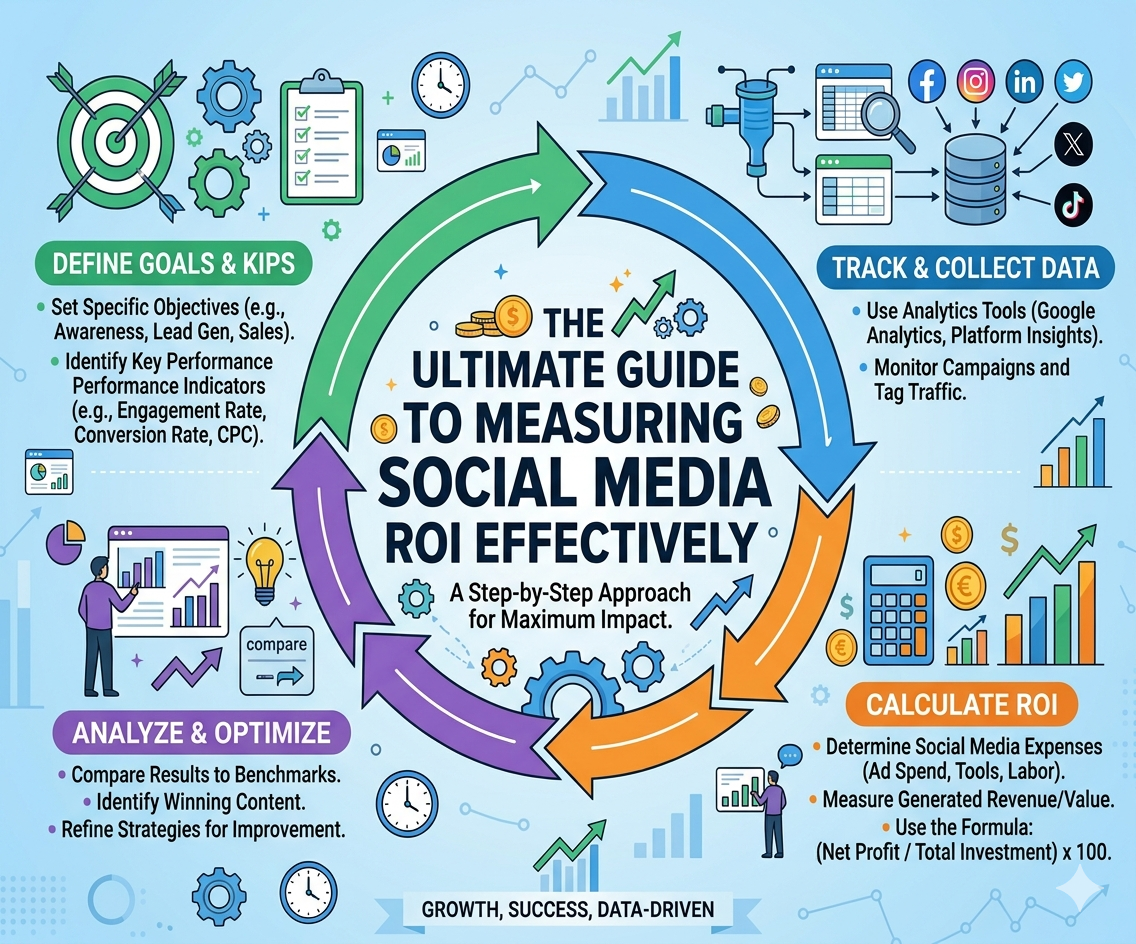
Before measuring anything, businesses must define what success actually looks like. Without goals, ROI measurement becomes meaningless. This is where SMART objectives become powerful. SMART stands for Specific, Measurable, Achievable, Relevant, and Time-bound goals.
A vague goal like “increase brand awareness” creates confusion because it lacks measurable benchmarks. A SMART goal would look more like this: “Increase Instagram website traffic by 25% within three months using short-form video campaigns.” This type of goal provides clear direction and measurable outcomes.
Businesses today use social media for different objectives depending on their industry. E-commerce brands may focus on purchases and return on ad spend. B2B companies often prioritize qualified leads from LinkedIn. Service businesses may aim to generate appointment bookings or consultations. Aligning metrics with objectives ensures marketers track data that actually matters instead of chasing irrelevant numbers.
One of the biggest trends in 2026 is prioritizing engagement quality over audience size. Many marketers now believe smaller but highly engaged communities outperform large inactive audiences. That means businesses should measure comments, saves, direct messages, and repeat interactions instead of obsessing over follower counts alone.
Aligning Social Goals with Business Outcomes
Social media should never operate in isolation from broader business objectives. Every campaign should support measurable company outcomes such as increased sales, stronger customer loyalty, or improved lead generation. When marketing teams fail to connect social metrics with business goals, executives often see social media as an expense rather than an investment.
For example, a fashion brand running influencer collaborations may track referral traffic, promo code usage, and customer purchases generated from creator content. A software company using LinkedIn may measure demo requests and enterprise leads. These measurements provide a direct connection between social activity and business growth.
Industry data supports this approach. Businesses investing over 20% of their marketing budgets into social media reportedly achieve 33% higher ROI compared to those investing less strategically. The difference is not just spending more money but tracking outcomes more effectively and optimizing campaigns based on real performance insights.
Important Metrics Used to Measure Social Media ROI
Engagement Metrics
Engagement metrics help businesses understand how audiences interact with content. These include likes, comments, shares, saves, click-through rates, and video watch time. While engagement alone does not equal revenue, it often acts as an early signal of audience interest and content effectiveness.
Short-form video continues dominating social platforms because it generates significantly stronger engagement and conversion rates. Research suggests short-form video delivers up to 71% higher ROI than many traditional content formats. This explains why Instagram Reels, TikTok videos, and YouTube Shorts are central to modern marketing strategies.
However, not all engagement is valuable. A viral post attracting irrelevant audiences may inflate numbers without generating business value. Smart marketers analyze engagement quality rather than volume alone. Comments that indicate purchase intent or direct messages asking about products are far more meaningful than passive likes.
Traffic and Conversion Metrics
Traffic metrics measure how many users move from social platforms to websites, landing pages, or online stores. Conversion metrics track whether those visitors complete desired actions such as purchases, form submissions, or subscriptions.
Google Analytics plays a major role here because it allows businesses to identify traffic sources, user behavior, and conversion pathways. UTM parameters make it easier to attribute website actions directly to specific campaigns or social posts. Without proper tracking links, businesses often underestimate social media’s contribution to sales.
One of the strongest indicators of ROI is conversion rate. A campaign driving massive traffic but low conversions may indicate poor audience targeting or weak landing pages. On the other hand, a campaign with smaller traffic but high conversions may actually deliver better profitability.
Customer Acquisition Cost
Customer Acquisition Cost, often called CAC, measures how much money a business spends to acquire a new customer. The formula is simple:
CAC=Total Social Media SpendNumber of Customers AcquiredCAC = \frac{\text{Total Social Media Spend}}{\text{Number of Customers Acquired}}
Lower acquisition costs generally indicate more efficient campaigns. Businesses constantly compare CAC across platforms to determine where marketing budgets perform best. LinkedIn may have higher advertising costs than TikTok or Instagram, but for B2B companies the lead quality can justify the investment.
Customer Lifetime Value
Customer Lifetime Value measures the total revenue a customer generates throughout their relationship with a business. This metric is essential because social media campaigns often influence long-term customer behavior rather than immediate purchases.
For example, a skincare brand may spend ₹2,000 acquiring a customer through Instagram ads. If that customer continues purchasing products for three years, the lifetime value could far exceed the acquisition cost. Businesses focusing only on first-purchase revenue may completely misunderstand their true ROI.
Best Tools for Measuring Social Media ROI
Google Analytics
Google Analytics remains one of the most powerful tools for ROI tracking. It helps businesses monitor user behavior after visitors arrive from social platforms. Marketers can see which campaigns drive conversions, how long visitors stay on pages, and which content produces the best results.
The platform becomes even more effective when paired with UTM tracking codes. These small URL parameters help identify the exact campaign, platform, or influencer responsible for website traffic. Without them, attribution becomes guesswork.
Social Media Platform Insights
Every major platform now provides built-in analytics dashboards. Instagram Insights, TikTok Analytics, Facebook Business Suite, and LinkedIn Analytics offer valuable information about audience demographics, engagement, reach, and conversions.
Meta platforms remain particularly strong in ROI tracking because of advanced AI optimization systems. Industry reports show Meta regained dominance in social advertising performance during 2025 and 2026 thanks to lower advertising costs and stronger AI-driven delivery. Businesses using these tools effectively can identify winning campaigns faster and allocate budgets more intelligently.
Third-Party Analytics Tools
Many businesses use advanced third-party tools such as HubSpot, Sprout Social, Hootsuite, and SEMrush to centralize reporting. These platforms combine data from multiple social channels into one dashboard, making it easier to compare performance.
AI-powered analytics tools are also transforming measurement strategies. Automation can now predict campaign outcomes, identify audience trends, and recommend optimization strategies. Reports suggest AI-driven campaigns generate significantly stronger ROI compared to manual optimization methods.
How Different Platforms Impact ROI
Facebook and Instagram ROI
Facebook and Instagram continue delivering strong returns because of their advanced advertising systems and massive audiences. Around 90% of Instagram users follow at least one business account, highlighting the platform’s marketing potential.
Instagram Reels and Facebook video content dominate engagement trends. Businesses that adapt to video-first strategies generally achieve stronger reach and lower acquisition costs. Meta’s AI-powered Advantage+ campaigns also help automate audience targeting and campaign optimization, improving efficiency for advertisers.
LinkedIn ROI for B2B Brands
LinkedIn stands out as the king of B2B marketing. Industry studies show nearly 80% of B2B social leads come from LinkedIn. Although advertising costs are higher, the quality of leads often makes the investment worthwhile.
B2B brands succeed on LinkedIn by focusing on thought leadership, educational content, and professional networking rather than direct sales pitches. Decision-makers on LinkedIn expect value-driven conversations, not aggressive advertising.
TikTok and Short-Form Video Performance
TikTok has transformed social commerce and content discovery. Brands targeting younger audiences increasingly rely on TikTok because of lower advertising costs and strong organic reach potential. Industry reports indicate TikTok-integrated shopping campaigns achieved significantly higher purchase conversion rates compared to traditional feed ads.
Authenticity is the driving force behind TikTok ROI. Overly polished corporate content usually underperforms, while relatable storytelling and user-generated content thrive. Businesses willing to experiment creatively often see exceptional returns.
Common Mistakes Businesses Make While Measuring ROI
Focusing Only on Vanity Metrics
One of the biggest mistakes businesses make is celebrating vanity metrics without analyzing business impact. A post with thousands of likes may look impressive but generate zero revenue. True ROI measurement requires connecting engagement to outcomes like leads, conversions, and customer retention.
Many marketers now agree that meaningful interactions matter more than follower counts.
True ROI becomes clearer when direct actions are tracked, especially conversions and click behavior originating from social platforms.
This shift toward quality engagement is reshaping modern social strategies.
Ignoring Attribution Models
Attribution models determine how credit is assigned across customer touchpoints. Businesses relying only on last-click attribution often underestimate social media’s influence because customers may interact with multiple channels before converting.
Multi-touch attribution provides a more accurate picture by distributing credit across several interactions. Some businesses also use marketing mix modeling to evaluate broader performance trends. This approach is becoming increasingly important as privacy restrictions limit traditional tracking capabilities.
Advanced Strategies to Improve Social Media ROI
Influencer Marketing ROI
Influencer marketing continues evolving rapidly. Brands now prioritize long-term creator relationships instead of one-off promotions. Studies show micro and nano influencers often deliver better ROI because audiences perceive them as more authentic.
Successful influencer campaigns track metrics such as affiliate sales, referral traffic, engagement quality, and branded search growth. Businesses that give creators more creative freedom often see stronger results because audiences respond better to authentic storytelling.
AI and Automation in Social Media Analytics
AI is reshaping social media marketing faster than many expected. Automated campaign systems optimize targeting, bidding, and creative delivery in real time. Experts predict over 70% of digital ad spending will soon rely heavily on algorithm-driven optimization.
Businesses using AI-powered analytics tools gain a major advantage because they can identify patterns humans may miss. AI helps marketers predict customer behavior, personalize campaigns, and improve content performance with greater precision.
The Future of Social Media ROI Measurement
Social media ROI measurement will continue evolving as technology changes consumer behavior and advertising systems. Privacy-first marketing, AI-driven analytics, and social commerce integration are shaping the future. Businesses will increasingly focus on first-party data and community-driven engagement rather than mass audience targeting.
The rise of creator partnerships, conversational marketing, and interactive video content also signals a major shift. Brands that adapt quickly will gain stronger competitive advantages. Those relying on outdated metrics may struggle to justify their marketing budgets in an increasingly performance-focused environment.
Social media is no longer just a branding channel. It has become a full-scale revenue engine capable of driving awareness, engagement, customer acquisition, and long-term loyalty when measured correctly.
Conclusion
How to Measure Social Media ROI is no longer optional for businesses competing in the digital era. Every campaign, post, and advertisement should contribute to measurable business objectives. The smartest marketers focus on meaningful metrics such as conversions, acquisition costs, customer lifetime value, and attributed revenue rather than chasing vanity numbers.
As social platforms continue evolving, businesses must adopt advanced analytics tools, stronger attribution models, and AI-powered optimization strategies. Companies that combine creativity with data-driven decision-making will consistently outperform competitors in the crowded social media landscape.
Learning these skills professionally can make a huge difference for marketers and entrepreneurs. Institutions like National Institute of Digital Marketing help aspiring digital marketers understand real-world ROI measurement, campaign analytics, and advanced social media strategies that businesses demand today.
FAQs
1. What is the best way to measure social media ROI?
The best way is to align social media metrics with business goals. Track conversions, website traffic, customer acquisition cost, and attributed revenue rather than focusing only on likes or followers.
2. Which platform gives the highest social media ROI?
The answer depends on your business type. LinkedIn often performs best for B2B companies, while Instagram and TikTok deliver strong ROI for e-commerce and lifestyle brands.
3. Why is social media ROI difficult to track?
Customers usually interact with multiple touchpoints before purchasing. Privacy restrictions and attribution complexities also make tracking more challenging.
4. What tools help measure social media ROI?
Google Analytics, Meta Business Suite, LinkedIn Analytics, TikTok Analytics, HubSpot, Sprout Social, and SEMrush are among the most effective tools.
5. How can businesses improve social media ROI?
Businesses can improve ROI by creating high-quality content, using AI-powered analytics, focusing on engagement quality, optimizing campaigns continuously, and building long-term influencer partnerships.