You’ve published great content. You’ve built backlinks. Yet your pages still aren’t climbing the rankings. The missing piece might not be more links – it might be how link equity is flowing (or leaking) across your site.
In this guide, you’ll learn exactly what link equity is, how it works, and why it’s more important than ever in 2026’s AI-driven search landscape.
What Is Link Equity?
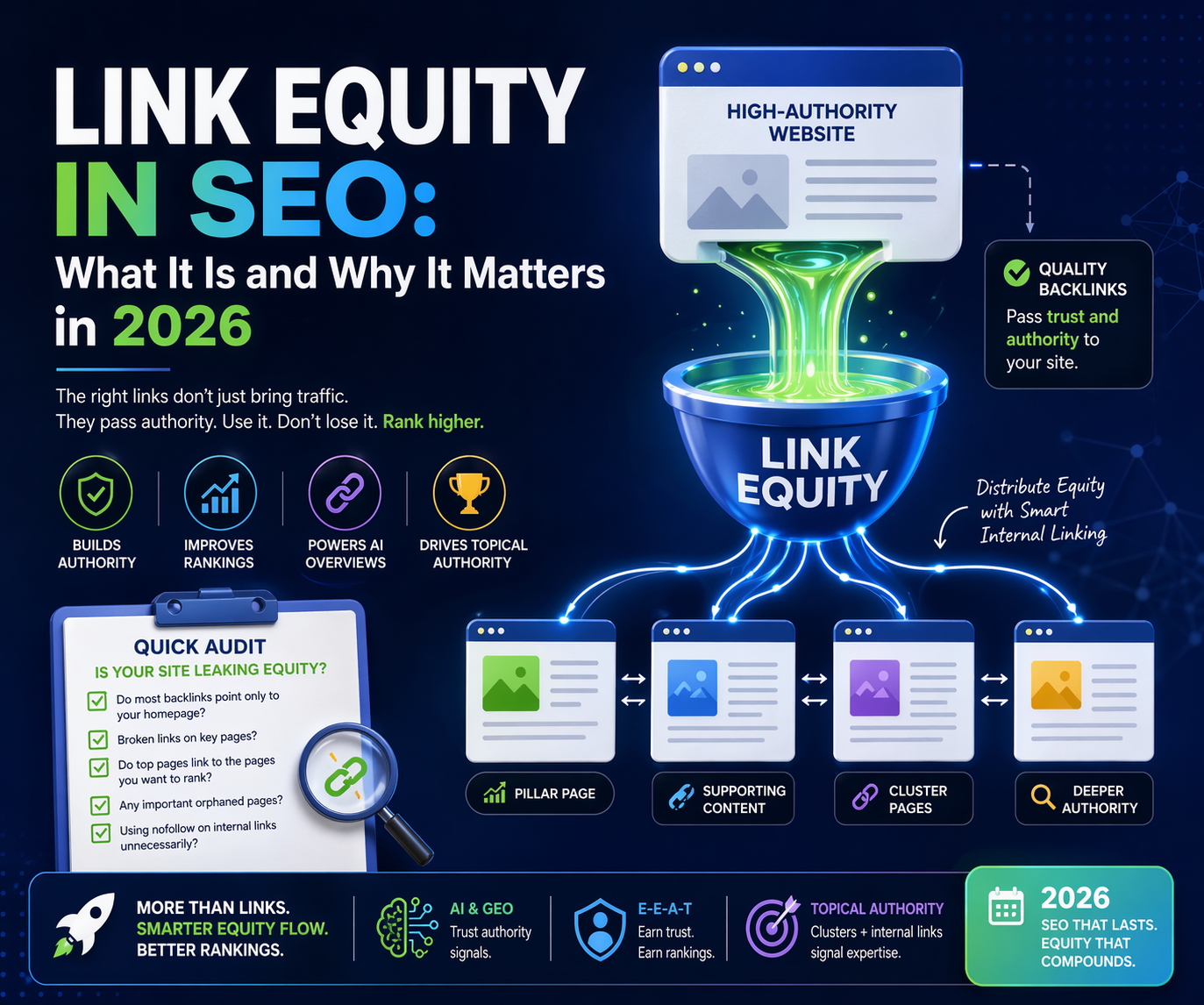
Link equity – sometimes called “link juice” – is the value or authority passed from one webpage to another through hyperlinks. When a trusted website links to your page, it doesn’t just send traffic. It passes a portion of its credibility to you.
Think of it like a vote of confidence. The more respected the voter, the more weight that vote carries.
There are two types of link equity every marketer needs to understand:
External link equity is passed from other websites to yours through backlinks. A link from a high-authority domain like Forbes or HubSpot carries far more equity than one from a brand-new blog.
Internal link equity is passed between your own pages through internal links. This is where most beginners leave value on the table.
How Link Equity Works
Not all links pass the same amount of equity. Several factors influence how much value a link actually transfers:
- Domain authority of the linking site – a link from a trusted, established site passes more equity
- Relevance – a link from a page in the same niche or topic carries more weight
- Link placement – editorial links within body content pass more equity than footer or sidebar links
- Follow vs. nofollow – standard (dofollow) links pass equity; nofollow links generally do not
- Number of outbound links on the page – equity is divided among all links on a page, so a page with 100 outbound links passes far less per link than one with just 3
Understanding these factors helps you make smarter decisions about where to earn links and how to structure your site.
Why Link Equity Still Matters in 2026
With AI reshaping how search works, some marketers have questioned whether traditional SEO signals like link equity still hold weight. The short answer: absolutely yes – and in some ways, more than before.
AI Overviews and GEO (Generative Engine Optimization) rely heavily on authority signals to decide which sources to cite. When Google’s AI summarizes a topic, it pulls from pages it already trusts. Link equity is one of the clearest signals of that trust. If your pages aren’t earning and distributing equity effectively, they’re less likely to appear in AI-generated answers.
Zero-click search is rising fast. In 2026, a growing number of searches are answered directly on the results page without any clicks. But even in zero-click scenarios, showing up as a cited source still drives brand awareness and demand. That visibility is powered by your page’s authority – which link equity builds.
E-E-A-T (Experience, Expertise, Authoritativeness, Trustworthiness) has become Google’s core quality framework. Earning links from credible, relevant sources is one of the strongest signals that your site is authoritative. Link equity and E-E-A-T reinforce each other.
Topical authority is now a major ranking factor. When link equity flows logically through a well-structured content cluster – from a pillar page to supporting articles and back – it signals to Google that your site covers a topic in depth. This is how modern SEO wins rankings, not isolated pages.
Common Link Equity Mistakes to Avoid
Before you start building more links, make sure you’re not wasting the equity you already have.
Ignoring internal links is the most common mistake. Most beginners focus entirely on backlinks and never think about how equity flows inside their own site. A single high-authority page that doesn’t link to your other content is wasted potential.
Hoarding equity on the homepage is another problem. Your homepage likely receives the most backlinks, but if it doesn’t pass that equity deeper into your site, your inner pages never benefit.
Broken links leak equity. Every broken internal or external link is a dead end where equity disappears. Regular link audits are essential.
Overusing nofollow on internal links is a mistake some technical SEOs make. Using nofollow internally prevents equity from flowing where you want it to go.
How to Build and Distribute Link Equity in 2026
Building external link equity:
Start with creating genuinely linkable assets – original research, in-depth guides, free tools, or data-driven posts that others naturally want to reference. Guest posting on relevant, high-authority sites in the digital marketing space is still one of the most reliable tactics. Being cited in industry roundups and resource pages also compounds over time.
Distributing internal link equity:
Use a pillar page and content cluster model. Your pillar page should link to all supporting articles, and those articles should link back to the pillar and to each other where relevant. Importantly, link from your highest-traffic pages to the pages you most want to rank – this funnels existing equity toward your priority content.
Use descriptive anchor text that includes your target keywords. Avoid generic phrases like “click here.” Fix any broken internal links. Check for orphaned pages – pages with no internal links pointing to them – as these receive zero equity from the rest of your site.
Useful tools: Google Search Console (find underlinked pages), Ahrefs or SEMrush (analyze backlink equity), Screaming Frog (map internal link structure).
Quick Audit: Is Your Site Leaking Link Equity?
Run through this checklist right now:
- Do most of your backlinks point only to your homepage?
- Are there broken internal or external links on key pages?
- Do your highest-traffic posts link to the pages you want to rank?
- Are any important pages “orphaned” with no internal links pointing to them?
- Are you using nofollow tags on internal links unnecessarily?
If you answered yes to any of these, you have a link equity leak – and fixing it costs nothing but time.
Final Thoughts
Link equity is one of the most underused levers in SEO, especially for beginners. You don’t always need more backlinks. Sometimes, you just need to use the authority you already have more strategically.
Start with an internal link audit. Map how equity is currently flowing through your site, identify your orphaned pages, and connect your strongest content to the pages you most want to rank. It’s one of the fastest and most cost-effective SEO wins available in 2026.
Want to go deeper?
Understanding link equity is just one piece of the puzzle. If you want to master SEO, content strategy, paid ads, and everything in between – with hands-on training from industry experts – check out NIDM India (National Institute of Digital Marketing), one of India’s most trusted digital marketing training institutes.
Whether you’re a student, freelancer, or marketing professional, NIDM’s courses are designed to take you from the basics all the way to advanced strategy – with practical exposure, live projects, and placement support.