Why Cost Per Click (CPC) Matters
Cost Per Click (CPC) directly affects your return on investment. In other words, lower costs allow you to drive more traffic with the same budget, while higher costs demand stronger conversions to remain profitable.
Additionally, this metric works as a performance indicator. For instance, if your cost is unusually high, it may suggest issues such as poor ad relevance, weak landing pages, or intense competition.
How CPC Works in Google Ads
Google Ads Auction System
Cost Per Click (CPC) is determined through a real-time auction system. Whenever a user searches on Google, advertisers compete by placing bids on keywords.
However, bidding alone does not decide the outcome. Instead, Google evaluates both your bid and ad quality. As a result, even advertisers with lower bids can rank higher if their ads are more relevant.
#Actual CPC vs Maximum CPC
Cost Per Click (CPC) includes two important values: maximum CPC and actual CPC. While the maximum CPC is the highest amount you’re willing to pay, the actual CPC is usually lower.
This happens because Google uses a second-price auction model. Therefore, you only pay slightly more than the next highest bidder rather than your full bid.
How CPC is Calculated
CPC Formula
The formula is simple:
CPC = Total Ad Spend ÷ Total Clicks
Thus, it gives a clear understanding of how much each visitor costs.
Example Calculation
Consider this scenario: you spend $500 and receive 200 clicks. In this case, your CPC becomes $2.50.
More importantly, this number should always be evaluated alongside conversions. If the revenue generated exceeds your ad spend, then your campaign is profitable.
Average CPC in 2026
Industry Benchmarks
Cost Per Click (CPC) varies significantly across industries. For example, high-value sectors such as legal and finance tend to have higher costs.
Here are some averages:
- Legal: $8.58+
- Finance: $3.46+
- Real Estate: $2.53
- Travel: $2.12
- Entertainment: $1.60
High vs Low CPC Industries
On one hand, industries like legal and insurance can see costs exceeding $50–$150 per click due to strong competition. On the other hand, sectors like travel or e-commerce often have much lower costs.
Therefore, there is no universal “ideal CPC.” Instead, it depends entirely on your business goals and margins.
Factors That Influence CPC
Keyword Competition
Naturally, highly competitive keywords lead to higher costs. As demand increases, advertisers must bid more to stay visible.
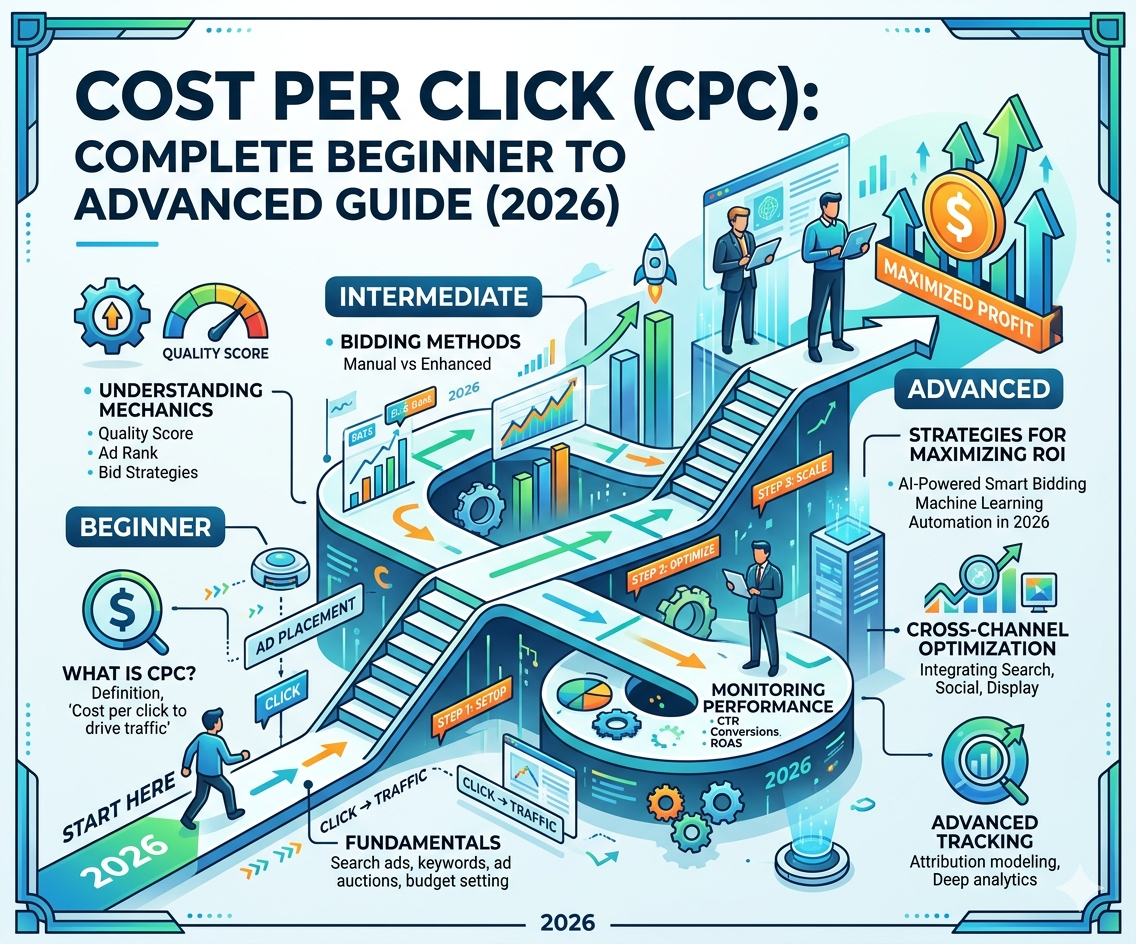
Quality Score
Equally important, Google evaluates ad quality using:
- Click-through rate
- Ad relevance
- Landing page experience
As a result, higher scores can significantly reduce costs.
Bidding & Targeting
Moreover, your bidding strategy and audience targeting also play a role. While automated bidding may increase cost slightly, it often improves conversions.
Types of CPC
Manual CPC
With manual bidding, you have full control over how much you pay per click.
Enhanced CPC
In contrast, enhanced CPC adjusts your bids automatically based on conversion likelihood.
Smart Bidding
Meanwhile, smart bidding uses AI to optimize campaigns. For instance, strategies like Target CPA and ROAS help maximize performance.
How to Reduce CPC
Cost Per Click (CPC) can be optimized with the right approach. For example, improving ad relevance can lower your costs significantly.
Additionally, you should:
- Use long-tail keywords
- Add negative keywords
- Improve landing page experience
As a result, your campaigns become more efficient and cost-effective.
CPC vs Other Metrics
CPC vs CPM
CPC focuses on clicks, whereas CPM charges per 1,000 impressions. Therefore, CPC is better suited for performance-driven campaigns.
CPC vs CPA
Similarly, CPA measures conversion cost instead of traffic cost. Hence, both metrics should be used together for better insights.
Common Mistakes to Avoid
Many advertisers focus only on reducing costs. However, this approach can lead to poor results if conversions are ignored.
Common mistakes include:
- Ignoring Quality Score
- Targeting broad keywords
- Skipping negative keywords
Is High CPC Bad?
Cost Per Click (CPC) is not always a negative factor. In fact, higher costs can still be profitable if conversions generate strong returns.
Therefore, it’s important to evaluate performance based on ROI rather than cost alone.
Future Trends
Cost Per Click (CPC) is expected to rise due to increasing competition. Additionally, automation and AI will continue shaping how campaigns are optimized.
Key trends include:
- AI-driven bidding
- Intent-based targeting
- Growing competition
Conclusion
Cost Per Click (CPC) is a crucial metric that determines how effectively your advertising budget is used. Instead of focusing only on reducing costs, businesses should aim to maximize value from each click.
Moreover, gaining practical knowledge can make a significant difference. For example, learning through NIDM (National Institute of Digital Marketing) can help you understand real-world strategies and improve campaign performance.
FAQs
1. What is a good CPC?
It depends on your industry; however, profitability matters more than the number itself.
2. Why is my CPC high?
It may be due to high competition, poor ad quality, or expensive keywords.
3. Can I control CPC?
Yes, you can optimize it through better targeting, bidding, and ad relevance.
4. Is CPC better than CPA?
Not necessarily; instead, both metrics serve different purposes.
5. How to reduce CPC quickly?
Focus on relevance, keyword strategy, and filtering irrelevant traffic.