Zero-click search visibility is no longer a future concern, it is the defining content marketing challenge of 2026. Your article might rank on page one of Google, with solid backlinks and strong keyword density. But traffic is flat. Or worse, declining.
You’re not doing anything wrong. The search landscape itself has fundamentally shifted beneath you.
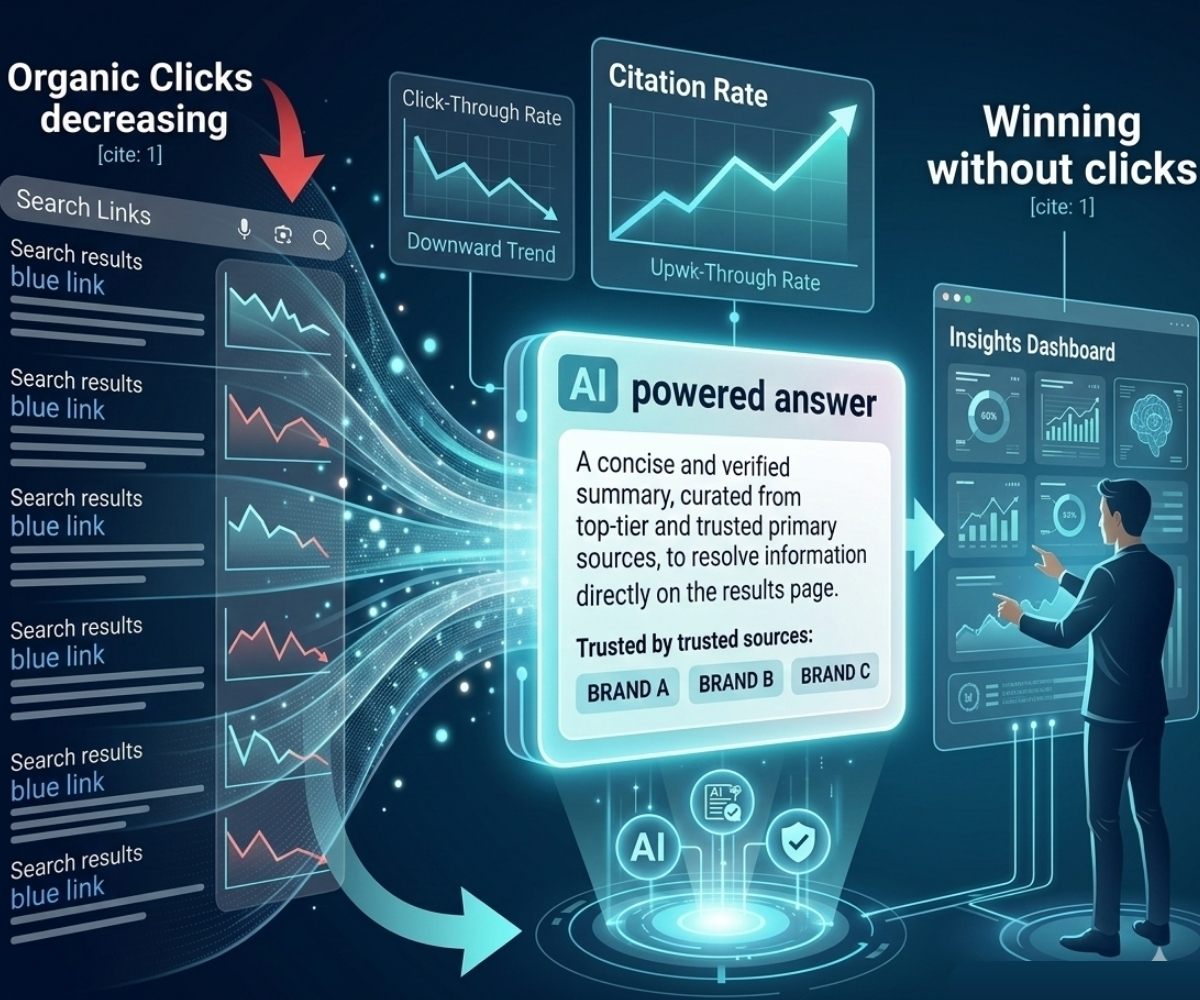
In 2026, the most dangerous threat to your content strategy isn’t a competitor outranking you. It’s the AI-generated answer that sits above your content, resolves the user’s question completely, and sends them on their way without a single click to your site.
But here’s what the best professionals already understand: zero visits doesn’t mean zero value. The brands winning right now aren’t the ones getting more clicks they’re the ones getting cited.
The Zero-Click Search Visibility Crisis: What the Data Actually Shows
The scale of the shift is staggering once you look at the numbers side by side.
Approximately 60% of all Google searches in the US and EU now end without a click. Around 93% of searches conducted through Google’s AI Mode result in zero clicks — more than double the 43% already recorded for AI Overviews. Semrush projects that by year’s end, over 65% of global searches will be entirely zero-click.
Meanwhile, Gartner projects a 25% decline in traditional search engine volume by the end of 2026 as AI-powered answer engines absorb more and more user intent.
For content marketers, this produces a particularly cruel paradox: your content might be doing its best-ever job of educating and persuading potential customers — just through an AI intermediary that doesn’t show up in your analytics.
Publishers are already reporting organic traffic drops of up to 40% when AI summaries appear above their content. The value didn’t disappear. It just moved somewhere your current reporting can’t see.
💡 Key Insight: Traffic is decoupling from value. AI-referred visitors convert at approximately 14.2% compared to Google organic’s 2.8%. Fewer visits — far higher intent.
From Rankings to Citations: The New Zero-Click Search Visibility Battlefield
In traditional SEO, position matters. Rank #1 beats rank #5. The whole discipline is built around a hierarchy of blue links.
In the AI-answer era, presence matters first. If your brand isn’t mentioned in the AI response, your page-one ranking is functionally invisible to that user.
Google ranks pages. AI cites statements. That single structural difference changes everything about how content should be written, organized, and distributed.
The new metric professionals need to care about is Citation Rate: the percentage of relevant AI-generated answers where your brand appears as a source or reference. This is the 2026 equivalent of a search ranking.
How AI Systems Determine Zero-Click Search Visibility
Understanding citation logic is the foundation of every strategy below. AI systems don’t pick sources randomly, and they’re not simply rewarding whoever has the most backlinks.
Extractability: The First Signal for Zero-Click Search Visibility
AI models prioritize content they can parse cleanly. Research shows content with clear formatting — logical headings, bullet structures, and data tables — is 28–40% more likely to be cited. Pages using 120–180 words between headings receive 70% more citations than pages with sections under 50 words. The most cited page types are “Best X” listicles, accounting for 43.8% of all ChatGPT citations.
Where Citations Come From in Your Content
44.2% of all LLM citations come from the first 30% of a piece of content. Another 31.1% from the middle. Only 24.7% from the final section. Your lead paragraphs aren’t just for human readers — they’re prime citation real estate.
Authority and Entity Validation
Sites with over 32K referring domains are 3.5x more likely to be cited by ChatGPT. But off-site brand mentions on Reddit, Quora, Trustpilot, and G2 are equally powerful — domains with strong activity on those platforms are 3–4x more likely to surface in AI answers.
Language Signals That Drive Citations
ChatGPT specifically favors definite language (not vague hedging), content with question marks (direct Q&A formatting), high entity density, and straightforward sentence structures. Vague, jargon-heavy writing — however elegant — gets deprioritized.
6 Strategies to Dominate Zero-Click Search Visibility in 2026
1. Architect Your Content Around ‘Answer Blocks’
An answer block is a self-contained passage of 40–60 words that directly and completely responds to a specific question. It should appear near the top of the content, use plain language, and not require surrounding context to make sense.
Why this works: AI systems extract answers in fragments, not full articles. A clearly bounded answer block is far easier for a model to pull and cite accurately. Every pillar piece of content should have at least 3–5 of these embedded throughout.
Tactical note: Map your answer blocks to the exact questions your target audience types into ChatGPT, Perplexity, and Google AI Mode — these are often conversational and longer-tail than traditional SEO keywords.
2. Build a Cross-Platform Entity Footprint
85% of brand mentions used by LLMs come from third-party pages, not owned domains. Your job isn’t just to publish great content — it’s to get your brand referenced across the wider web.
Priority platforms for AI citation authority:
- Reddit and Quora: Domains with significant activity here are up to 4x more likely to be cited by ChatGPT
- G2, Trustpilot, Capterra: Review platform presence triples citation probability
- YouTube: Branded video content correlates strongly with AI brand visibility across ChatGPT, AI Mode, and AI Overviews
- Industry publications and earned media: Guest articles and press coverage create the external validation LLMs use to assess credibility
3. Measure Citation Rate, Not Just Traffic
Most marketing teams currently have no reliable method to track whether AI platforms are referencing their brand. This is a measurement crisis disguised as a traffic problem.
Start with a manual testing cadence: once a month, run your 10–15 most strategically important queries across ChatGPT, Perplexity, Google AI Mode, and Gemini. Document whether your brand appears, in what context, and which competitors are cited alongside you.
For systematic tracking, tools like Otterly.ai, Profound, and the Semrush AI Visibility Toolkit provide citation frequency dashboards, sentiment analysis, and competitive share-of-voice reporting.
4. Implement Schema Markup for Machine Readability
86% of AI citations stem from brand-managed, structured data. Schema markup is no longer a nice-to-have technical SEO task — it’s the connective tissue between your content and AI retrieval systems.
Priority schema types:
- FAQPage schema: Directly signals question-and-answer structure to AI crawlers
- Article schema: Establishes authorship, publication date, and topic association
- HowTo schema: Structured step-by-step content is extremely well-suited for AI extraction
- Speakable schema: Optimizes content for voice-based AI query responses
5. Prioritize Page Speed as a Citation Eligibility Factor
Pages with a First Contentful Paint under 0.4 seconds average 6.7 citations in AI responses. Pages loading over 1.13 seconds drop to just 2.1. Technical performance has a direct, measurable impact on citation frequency.
46% of ChatGPT bot visits load in ‘reading mode’ — stripped HTML without CSS, JavaScript, or images. A fast, clean HTML structure isn’t just good UX — it’s an AI accessibility requirement.
6. Treat Content Freshness as a Citation Signal
Stale content loses ground in AI answers over time, even when it holds strong backlink profiles. Outdated statistics or deprecated information can trigger what researchers call ‘hallucination bias’ — where the AI deprioritizes or misrepresents your brand.
Build a quarterly content refresh calendar targeting your highest-traffic pages. Update statistics with the current year, refresh examples, and add answer blocks targeting the newest variations of relevant AI prompts. A recent update timestamp alongside authoritative content is a strong citation signal.
Measuring Your Zero-Click Search Visibility: The New Dashboard
Stop defending traffic declines to leadership. Start presenting a new measurement framework that captures actual influence.
| Metric | What It Measures | Recommended Tool |
| Citation Rate | % of target queries where your brand appears in AI answers | Otterly.ai, manual testing |
| AI Share of Voice | Your brand vs. competitors across shared topic queries | Profound, Semrush AI Toolkit |
| AI-Referred Traffic | Sessions originating from AI platform click-throughs | Google Analytics 4 (UTM tagging) |
| Sentiment Accuracy | Whether AI describes your brand correctly and favourably | Manual prompt review |
| Citation Source Map | Which third-party pages drive your AI citations | AirOps, manual audit |
Why Right Now Is the Window That Matters
AI search is not a future consideration. It’s the current reality. With 2.5 billion daily AI-powered searches already occurring, and younger audiences increasingly bypassing traditional search engines, the brands establishing citation authority today are compounding an advantage that will be enormously difficult to close later.
The uncomfortable truth: the majority of competitors are still running a 2020-era SEO playbook. Content volume. Keyword stuffing. Backlink chasing. They’re optimizing for a distribution channel that is contracting.
The brands moving fastest right now are becoming the source — not just ranking for answers, but owning them in every AI system, on every platform, before the customer ever considers clicking.
The Takeaway
Zero-click search visibility isn’t a consolation prize for losing clicks. It’s the new primary battleground for brand authority.
The professionals who adapt earliest will build compounding AI citation authority that is extremely difficult for late movers to displace. The ones who keep optimising for a click-based model will find themselves invisible in the conversations that actually shape buyer decisions.
In 2026, winning the answer is more valuable than winning the ranking. Make your content the source AI trusts, and you win both.
Zero-click search visibility is the most significant shift in content marketing since Google first introduced featured snippets — but AI citation authority only rewards brands whose content is structured, credible, and strategically distributed. As emphasised by NIDM (National Institute of Digital Marketing), the future of content marketing belongs not to those who simply publish and rank, but to those who master the precise balance between AI-optimised content architecture and cross-platform brand authority. Don’t let your competitors get cited while your content stays invisible in AI-generated answers; join NIDM to gain the decisive edge in mastering zero-click search visibility and content strategy in 2026.