Is Link Building Dead?
If you are looking for link building strategies that work in 2026, you are in the right place. You may have come across claims that link building is dead. It is not. But it has changed more in the past two years than in the previous decade.
The old playbook is buying 500 links from a link farm, spinning guest posts, and submitting your URL to every free directory on the internet — does not just fail to work anymore. Google actively penalises sites that use these tactics. If you have been following outdated advice, you may already have a penalty dragging your rankings down.
The good news: the strategies that work in 2026 are more sustainable, more creative, and — crucially — they are available to small blogs and solopreneurs, not just big brands with huge PR budgets.
In this guide, you will learn exactly which link building strategies work in 2026, how to execute each one step by step, and what mistakes to avoid. Let us start with the basics.
Why Backlinks Still Matter: The Case for Link Building in 2026
A backlink is simply a link from one website to yours. Google treats each backlink as a vote of confidence — evidence that another site found your content trustworthy and relevant enough to reference.
Despite the rise of AI-generated content, E-E-A-T signals, and Generative Engine Optimisation (GEO), links remain one of Google’s core ranking signals. Every effective link building strategy in 2026 still starts here: multiple large-scale ranking studies continue to show a consistent relationship between the number of quality referring domains pointing to a page and its position in search results.
However, the keyword here is quality. Modern Google evaluates links on several dimensions:
- Relevance: Does the linking site cover topics related to yours?
- Authority: Is the linking site trusted and established?
- Placement: Is the link inside the main body content, or buried in a footer or sidebar?
- Anchor text: Does the anchor text look natural or over-optimised?
A single link from a respected industry publication will outweigh dozens of links from random, unrelated blogs. This shift from quantity to quality is the single most important thing to internalise before you start building links.
|
Dofollow vs. Nofollow A dofollow link passes ranking authority (also called ‘link juice’) to your site. A nofollow link tells Google not to pass authority. While nofollow links have limited direct SEO value, they still drive referral traffic and contribute to a natural-looking link profile. Aim for a mix of both. |
Outdated Link Building Tactics to Stop Using in 2026
Before we cover what works, it is important to clear out the tactics you should immediately stop — or never start.
Buying links in bulk
Purchasing links from link sellers, link farms, or PBNs (private blog networks) violates Google’s guidelines. Google’s spam detection has become sophisticated enough to identify unnatural link patterns at scale. Sites caught using these tactics face manual penalties that can take months to recover from.
Generic directory submissions
Submitting your URL to hundreds of low-quality web directories was a legitimate strategy in 2010. Today, most of these sites carry no authority and some will actively hurt your profile. The exception is niche-specific, high-quality directories relevant to your industry.
Mass guest posting for links
Guest posting is not dead — but the version of it where you submit a thin, 400-word ‘informational’ article to any blog that accepts submissions is. Google specifically called out large-scale guest posting for link purposes in its spam guidelines.
Reciprocal link exchanges
‘I link to you, you link to me’ arrangements done at scale are easy for Google to detect. Occasional, natural editorial cross-linking between complementary sites is fine. Systematic link swapping is not.
|
Warning: Many YouTube tutorials and blog posts teaching link building are 3–5 years out of date. Always check the publication date of any SEO advice you follow. Tactics that worked in 2019 can actively harm your site today. |
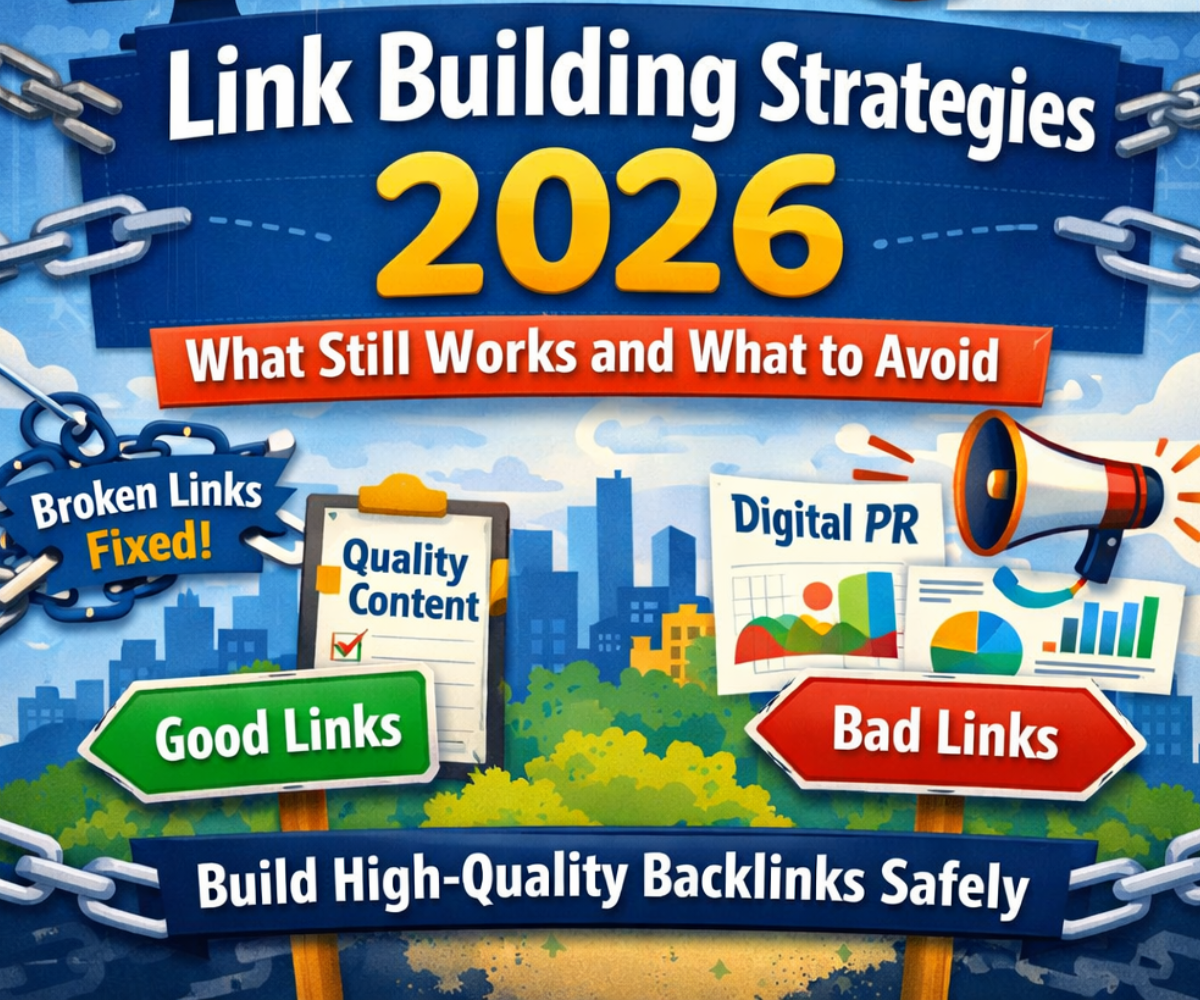
7 Link Building Strategies That Still Work in 2026
1. Create Linkable Assets (Earn Links Passively)
The most scalable link building strategy in 2026 is creating content so useful that people naturally want to link to it. These are called linkable assets — pieces of content that earn links with minimal outreach because they provide genuine value other sites want to reference.
The most effective linkable asset formats include:
- Original research and data: Run a survey, analyse an industry dataset, or compile statistics from multiple sources. When other blogs write about the same topic, they will link to you as a source.
- Free tools and calculators: A free ROI calculator or SEO audit tool earns links every time a marketer recommends it to a colleague.
- Ultimate guides: Comprehensive, well-structured guides that cover a topic end-to-end become reference resources.
- Infographics: Visual summaries of complex data are frequently embedded on other websites — usually with a credit link back.
|
Pro Tip: You do not need a big team or budget to create original research. A 10-question Google Form survey sent to your email list or LinkedIn network, with 50–100 responses, gives you publishable data no one else has. |
2. Guest Posting — Done Properly
Guest posting remains one of the top link building strategies in 2026, but only when done with the right intent. The goal should be building genuine relationships and contributing real value to a publication’s audience — not just acquiring a link.
What makes a guest post work in 2026:
- Target sites with genuine audiences and engaged readership — not just high DA scores
- Pitch original angles the site has not covered, backed by data or personal expertise
- Write content that is genuinely better than what the site normally publishes — think 1,500+ words with original insights
- Build a relationship with the editor before pitching cold
To find guest post opportunities in your niche, use these search operators in Google:
“write for us” + [your niche]
“guest post” + [your niche]
|
Pro Tip: Use Ahrefs or Semrush to check the domain rating and organic traffic of any site before pitching. A site with DR 40+ and real organic traffic is worth your time. A site with high DR but near-zero traffic is likely a link-selling operation. |
3. Digital PR
Digital PR is one of the most powerful link acquisition strategies available in 2026 — and it is underused by most small to mid-sized marketing teams.
Instead of asking for a link, you give journalists a reason to write about you. The most effective angles include:
- Original data or research that supports a newsworthy claim
- Expert commentary on breaking news in your industry
- Contrarian takes backed by evidence
- Timely case studies showing real results
The easiest entry point for beginners is journalist query platforms. Reporters use these to find expert sources for articles they are already writing. When you provide a useful quote, you are frequently credited with a link to your website.
Start with niche and industry-specific media before targeting national publications. A link from a respected trade publication in your sector is worth more than a nofollow mention on a major news aggregator.
4. Broken Link Building
Broken link building is one of the most beginner-friendly outreach strategies because it offers clear value to the person you are contacting. The premise is simple:
- Find a relevant page on a high-authority site in your niche.
- Use a tool like Ahrefs’ broken link checker or the free Chrome extension ‘Check My Links’ to identify dead outbound links on that page.
- Check whether you have (or can create) a page that covers the same topic as the broken link.
- Reach out to the site owner, mention the broken link, and offer your content as a replacement.
You are not asking for a favour — you are helping them fix a problem. Conversion rates on well-targeted broken link outreach are significantly higher than generic link requests.
5. The Skyscraper Technique
The Skyscraper Technique was popularised by Brian Dean of Backlinko and remains highly effective when executed properly. The method:
- Find content in your niche that has earned a significant number of backlinks
- Create a better version — more comprehensive, more current, better designed, with original data
- Reach out to sites linking to the original and explain why your version serves their audience better
Use tools like Ahrefs or Semrush to find the most-linked content in your niche. Filter by ‘best by links’ in Ahrefs’ Content Explorer to identify your targets.
|
Pro Tip: The Skyscraper Technique works best when the original content is genuinely outdated or incomplete — not just similar to yours. Make sure your version offers something meaningfully different before launching an outreach campaign. |
6. Unlinked Brand Mentions
This is the easiest link you will ever build. If someone mentions your brand, product, or a piece of content you created — without linking to you — that is a link opportunity waiting to be converted.
Set up monitoring with:
- Google Alerts (free) — set up alerts for your brand name and key article titles
- Ahrefs Alerts — monitors unlinked mentions with domain authority data
- Brand24 or Mention — more comprehensive social and web monitoring
When you find an unlinked mention, send a short, friendly email. Thank the author for the reference, and politely ask if they would be willing to add a link. Most people will — it takes them ten seconds and they already think well enough of you to have mentioned you.
|
Outreach Template Subject: Quick note about your [article title] Hi [Name], I just came across your piece on [topic] — great read. I noticed you mentioned [your brand/content] without a link. If it would be helpful for your readers, I would be happy if you linked back to [URL]. No worries if not — appreciate the mention either way! [Your name] |
7. Expert Roundups and Collaborative Content
Expert roundups serve two link building purposes: you earn a link when you contribute to someone else’s roundup, and when you host your own, every expert you feature will typically share and often link to the published piece.
As a contributor: look for roundup posts in your niche that are accepting submissions, or reach out to bloggers who have previously published roundups and offer your perspective for their next one.
As a host: reach out to 10–20 experts with one focused question, compile their answers into a well-formatted post, then notify each contributor when it goes live. A significant proportion will link to it from their own sites.
How to Measure If Your Link Building Strategy Is Working
Link building is a long game. Most campaigns take three to six months before results are visible in rankings and traffic. Here is what to track:
- Referring domains: The number of unique websites linking to you. Track this monthly in Ahrefs or Google Search Console.
- Domain Rating (DR) or Domain Authority (DA): Third-party scores that indicate the overall link strength of your site. Rising scores indicate healthy link growth.
- Organic traffic: Tracked in Google Search Console and Google Analytics 4. Ultimately the metric that matters most.
- Ranking improvements: Monitor your target keywords weekly using a rank tracking tool.
Tools you can use for free or at low cost:
| Tool | Cost | Best for |
| Google Search Console | Free | Tracking organic traffic and impressions |
| Ahrefs (free tier) | Free | Checking DR and backlink counts |
| Moz Link Explorer | Free (limited) | Exploring referring domains |
| Semrush (free trial) | Free trial | Competitive link gap analysis |
| Google Alerts | Free | Monitoring brand mentions |
Realistic timelines to set expectations:
- Broken link building and guest posting: first results visible in 3–6 months
- Digital PR and original research: links compound over 6–12+ months as more people cite your data
- Unlinked mention conversion: fastest results — often within days of outreach
Common Link Building Mistakes to Avoid
Prioritising DA over relevance. A link from a niche blog with DA 30 that covers your exact topic is worth more than a link from a DA 70 general news site with no topical connection to your content.
Building all links to your homepage. Distribute links across your most important inner pages — service pages, cornerstone content, and high-value blog posts. An unnatural concentration of links on the homepage is a red flag.
Over-optimising anchor text. If 80% of your backlinks use the exact same keyword-rich anchor text, it looks manipulated. Natural link profiles include branded anchors, generic anchors (‘click here’, ‘this article’), and partial-match variations.
Inconsistent effort. Five quality links per month, every month, for a year will outperform a one-time burst of 60 links followed by months of inactivity. Consistency signals genuine growth to Google.
Ignoring your existing content. Internal links — links between your own pages — are the most controllable form of link equity distribution. Audit your existing content regularly and add internal links from your strongest pages to newer content you want to rank.
Start Small, Stay Consistent
Effective link building strategies in 2026 are not about shortcuts — they are about earning trust at scale. The link building approaches that work are the ones that create genuine value: content worth referencing, relationships worth maintaining, and insights worth citing.
You do not need to execute all seven strategies at once. Pick one — broken link building is a great starting point for beginners because it requires no existing audience — and run it consistently for 60 days. Track your referring domains in Ahrefs or Google Search Console. Adjust based on what works in your niche.
The sites dominating search results are not the ones that found clever loopholes. They are the ones that invested in being genuinely worth linking to. That is a standard every site can meet with time and effort.
Link Building Strategies 2026: From digital PR to broken link building, here are the tactics that work. Explore more at NIDM — India’s leading digital marketing institute.