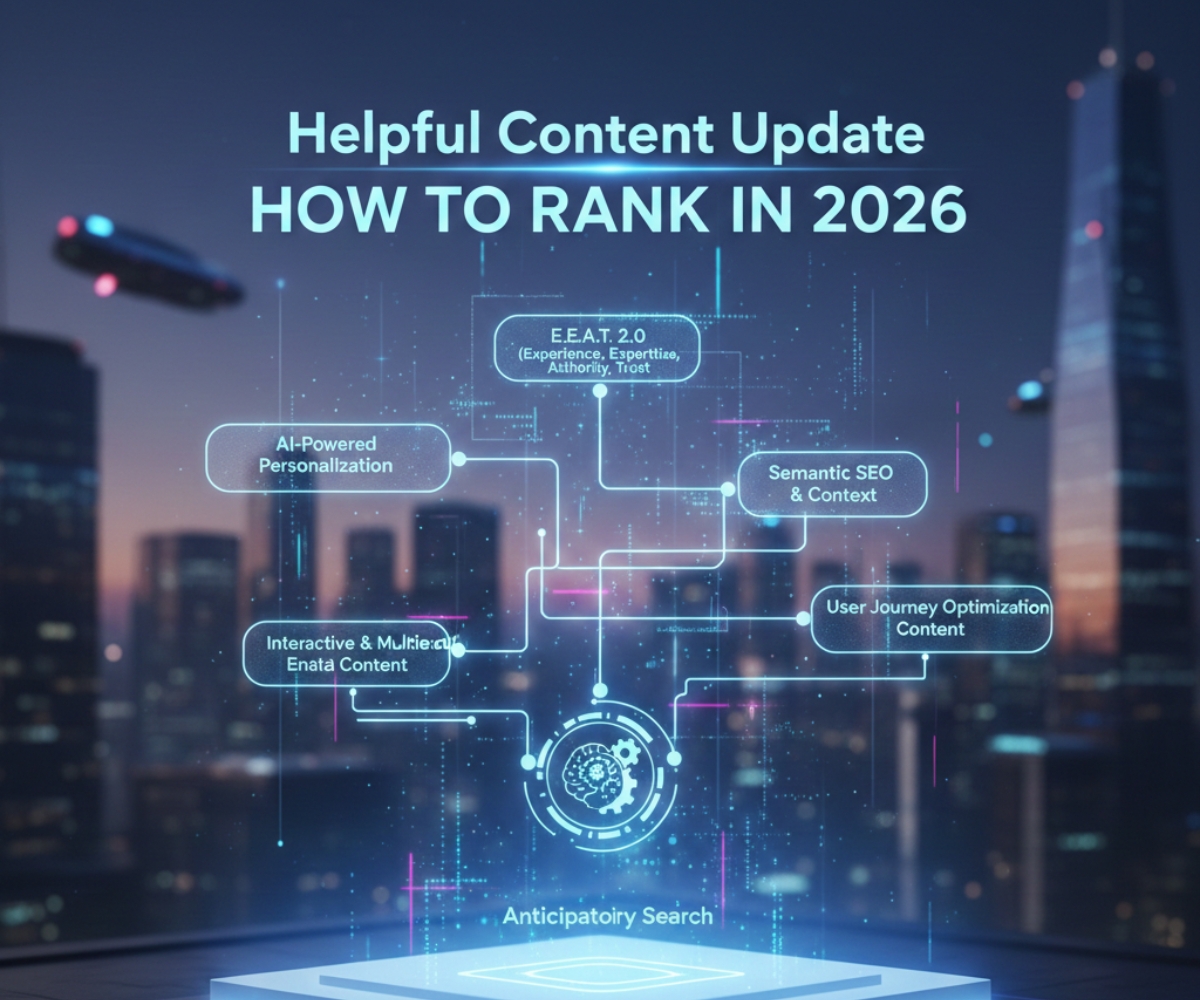
Helpful Content Update: How to Rank in 2026
Search engines are changing fast, and the Helpful Content Update is one of the biggest shifts we’ve seen in SEO. As we move into 2026, understanding how to rank in 2026 on Google is no longer about tricks, keyword stuffing, or writing only for algorithms. It’s about real value, real people, and real expertise that genuinely helps users and builds long-term trust.
In this guide, we explain what the Helpful Content Update means and how you can future-proof your SEO strategy to rank higher in 2026.
What Is the Helpful Content Update? How to Rank in 2026 with Google
The Helpful Content Update is Google’s way of rewarding content that is created for humans, not just for search engines. Pages that exist only to rank — without offering genuine value — are gradually pushed down in search results.
Google now evaluates content based on:
- Usefulness and relevance
- Original insights and expertise
- Clear intent matching
- Trust and authority
If your content truly helps users solve a problem or make a decision, you’re on the right path.
Helpful Content Update in 2026: Why It Matters and How to Rank in 2026
By 2026, AI-generated content will be everywhere. This makes human-first content more important than ever. Search engines are becoming smarter at identifying:
- Thin or repetitive content
- Over-optimized articles
- AI-written text with no real insight
Websites that focus on experience, authenticity, and depth will dominate search rankings in the coming years.
How to Rank in 2026 with Helpful Content
1. Write for Users, Not Just Keywords
Keywords still matter, but context matters more. Focus on search intent:
- What problem is the user trying to solve?
- Are they looking for information, a comparison, or a solution?
Use keywords naturally and avoid forcing them into every sentence.
2. Show Real Expertise and Experience
Google values E-E-A-T (Experience, Expertise, Authoritativeness, Trustworthiness).
To improve this:
- Share real-world examples
- Add author profiles and credentials
- Use original data, case studies, or insights
- Keep content accurate and regularly updated
Search engines trust content created by people with genuine knowledge and experience.
3. Create In-Depth, Original Content
Short, generic blogs won’t work in 2026. Instead:
- Cover topics in depth
- Answer related questions in one place
- Add unique perspectives instead of rewriting existing articles
Long-form, well-structured content performs better and keeps users engaged longer.
4. Improve Content Readability and User Experience
Helpful content is easy to read and scan. Use:
- Short paragraphs
- Clear headings (H2, H3)
- Bullet points
- Simple and direct language
Also make sure your website is:
- Mobile-friendly
- Fast-loading
- Easy to navigate
A good user experience directly improves SEO performance.
5. Update and Refresh Old Content
One of the easiest SEO wins is refreshing existing content. Regularly:
- Update statistics and facts
- Improve outdated sections
- Add new insights and examples
- Remove irrelevant or low-quality content
This shows search engines that your website stays fresh and relevant.
6. Build Trust with Transparency
Trust is a major ranking factor in 2026. You can build it by:
- Linking to credible sources
- Showing clear contact information
- Adding author details and credentials
- Avoiding misleading headlines
Long-term credibility matters more than short-term ranking tricks.
Common Mistakes to Avoid After the Helpful Content Update
- Writing content only for SEO tools
- Publishing mass AI-generated articles without human editing
- Targeting too many keywords on one page
- Ignoring user intent
- Creating content without a clear purpose
Avoiding these mistakes will already put you ahead of many competitors.
Final Thoughts: SEO in 2026 Is About Value
The Helpful Content Update sends one clear message: helpfulness wins. To rank in 2026, your content must educate, guide, and genuinely help users.
By focusing on quality, experience, and user satisfaction, you can build sustainable rankings and long-term organic traffic.
At the National Institute of Digital Marketing (NIDM), learners are trained with these future-ready SEO principles, focusing on people-first content, real expertise, and ethical digital marketing practices. As an institute dedicated to practical digital education, NIDM helps marketers prepare for the evolving search landscape and succeed in the era of helpful, trustworthy content.
If you want to master SEO for the future, now is the time to shift from “SEO-first” to “people-first” content — and learn it the right way.