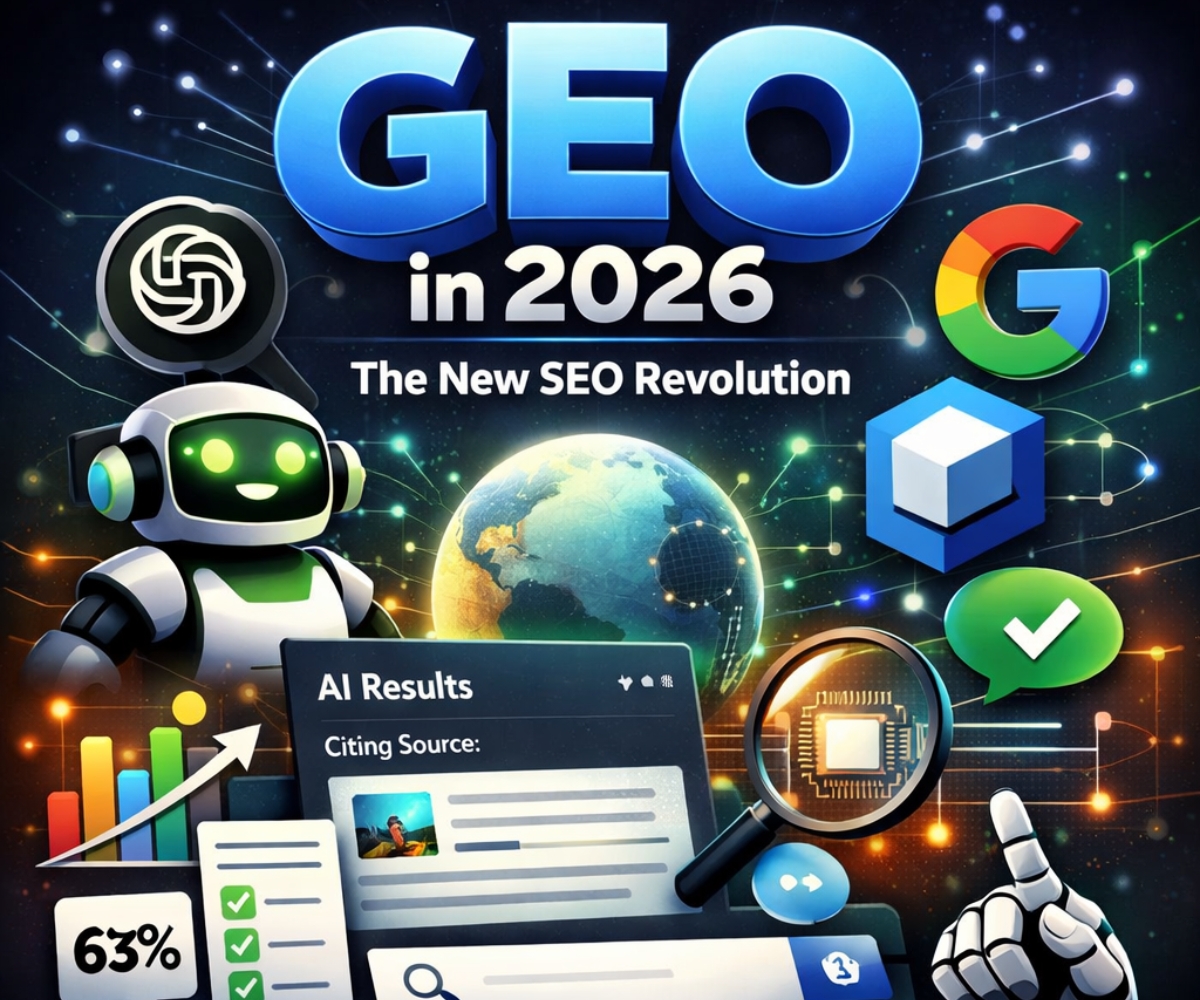
If you’ve been optimizing your content for Google and calling it a day, you might already be invisible to a fast-growing chunk of your audience. Welcome to the era of GEO in 2026, Generative Engine Optimization, the discipline that determines whether your brand gets cited by ChatGPT, Perplexity, Google AI Overviews, or not at all.
Traditional SEO is far from dead. But it’s no longer the whole story. As AI-powered search engines become the first stop for hundreds of millions of people, a new set of rules is reshaping what it means to be visible online. This post breaks down exactly what GEO is, why it matters right now, and how you can start applying it even if you’re just getting started with digital marketing.
1. What Is GEO in 2026? (And How It Differs From Traditional SEO)
Generative Engine Optimization (GEO) is the practice of structuring your content so that AI-powered platforms like ChatGPT, Google Gemini, Perplexity, Microsoft Copilot can select, cite, and recommend your brand when they generate answers for users.
Here’s the key difference in one sentence:
| Traditional SEO
User sees your link in position 3. They may or may not click. |
GEO
AI cites your brand, statistic, or definition directly in its answer — no click required. |
The term was coined by Princeton researchers in 2023, and by 2026 it has moved firmly from academic theory into front-line marketing practice. The unit of competition in traditional SEO is the webpage. In GEO, the unit of competition is the individual claim — a single, verifiable sentence an AI can extract and attribute to your brand.
2. Why GEO Matters Right Now
The Numbers That Should Make Every Marketer Pay Attention
Let’s look at what’s already changed:
- 60% of all searches now end without a click — users get their answer directly from AI summaries
- The click-through rate for the #1 organic position when an AI Overview is present has dropped to just 2.6%
- ChatGPT now reaches over 800 million weekly users; Google’s Gemini app has surpassed 750 million monthly users
- 58% of consumers have already replaced traditional search engines with AI tools for product and service discovery
- AI search is estimated to power 50% of all queries worldwide in 2026, with McKinsey projecting 75% by 2028
- 47% of brands currently have no GEO strategy at all — meaning the competitive window is wide open
|
Key Insight 25% of traditional searches are projected to disappear entirely by the end of 2026. A purely SEO-focused strategy is no longer enough. |
This isn’t a future prediction. It’s already happening. For bootstrapped tools like Tally (a form builder), ChatGPT became their #1 referral source — not Google. Across industries, AI-driven discovery is measurable and growing fast.
The brands that start building GEO now will be the brands AI systems cite in 2027 and beyond. Citation authority, much like domain authority before it, compounds over time.
3. How AI Decides What to Cite
Structured Data, Topical Authority & Entity-Rich Content
AI engines don’t scroll through web pages the way a human reader does. They break content into individual passages and evaluate each one against several signals. Understanding these signals is the foundation of any GEO strategy.
Here are the five content-level factors that consistently determine whether an AI cites your source:
|
1. Claim-Level Specificity Every factual statement must be a complete, self-contained sentence. LLMs extract sentences, not paragraphs. Vague phrasing like ‘many companies benefit from AI’ is invisible to generative engines. Precise phrasing like ‘63% of companies that optimised for GEO reported an increase in AI visibility’ is citation-worthy. |
|
2. Statistical Grounding Adding statistics to your content makes it up to 33.9% more visible to AI engines, according to Princeton research. Numbers are verifiable, specific, and make content stand out as authoritative. |
|
3. Structured Data (Schema Markup) AI systems cross-reference signals across multiple formats. Schema.org markup, FAQ schema, and entity datasets all make content easier for LLMs to parse and reuse. FAQ schema alone can deliver a +2–3% citation rate improvement almost immediately. |
|
4. Topical Authority & E-E-A-T AI engines favour sources that demonstrate consistent expertise on a focused topic area. A niche site that owns its topic clearly and shows up consistently can outperform larger, more generic brands. E-E-A-T signals (Experience, Expertise, Authoritativeness, Trustworthiness) apply to GEO as much as they do to SEO. |
|
5. Entity Clarity Your brand description on LinkedIn, your website, Crunchbase, and industry directories should all reinforce the same category and positioning. When these signals are consistent across sources, AI systems can reference your brand with confidence. When they conflict, your brand is less likely to be cited. |
4. 5 GEO Tactics You Can Apply Today
The research is clear: specific GEO tactics can boost your visibility in AI-generated responses by 30–40%. Here are five you can start with today, ranked from highest to lowest immediate impact.
Tactic #1: Add FAQ Schema (Highest Single Impact)
FAQ schema is the single highest-impact GEO tactic available right now. Adding properly structured FAQ schema to your top pages can improve citation rates by 2–3% within days. AI systems are specifically designed to retrieve question-and-answer pairs because they mirror exactly how users query AI engines.
- Add an FAQ section to every major piece of content
- Mark it up with FAQ schema (schema.org/FAQPage)
- Write questions the way real people would ask an AI — conversational, specific
Tactic #2: Build Pillar Pages Around Topic Clusters
Pillar pages establish topical authority — the signal that tells AI engines your site owns a specific subject area. A comprehensive pillar page supported by a cluster of related posts shows AI systems that you cover a topic deeply and consistently.
- Choose 3–5 core topics your brand genuinely specialises in
- Create a comprehensive pillar page for each (1,500+ words with clear H2/H3 structure)
- Publish supporting cluster content that links back to the pillar
- Internally link the cluster tightly to establish topical connection
Tactic #3: Use Semantic Clusters to Expand Your Footprint
Semantic clusters go beyond keyword targeting. The goal is to publish content that covers every meaningful angle of a topic so that AI engines recognise your site as a comprehensive, trustworthy resource on the subject.
- Map out all the questions users ask around your core topic
- Create content that answers each question with self-contained, claim-level specificity
- Update existing content to add related entities (people, places, concepts) that AI engines can understand
Tactic #4: Add Statistics and Cited Sources
Princeton researchers found that adding statistics and source citations to content improves AI visibility by up to 40%. This is because AI engines value verifiable, attributable claims over general statements. Every key claim in your content should have a number, a date, or a source attached to it.
- Replace vague assertions with specific, sourced statistics
- Add a ‘Last Updated’ timestamp to cornerstone pages — freshness is a direct citation signal
- Cite reputable external sources — it signals that your content meets verification standards
Tactic #5: Front-Load Direct Answers (TLDR-First Structure)
AI systems that use real-time retrieval evaluate a page’s relevance primarily on its opening content. The first 200 words of any article should directly and completely answer the primary query — not build up to the answer. This is called TLDR-first structure, and it’s one of the most impactful formatting changes you can make.
- Start every post with a clear 2–3 sentence summary that answers the main question directly
- Use clean H2 and H3 heading hierarchy so each section can stand alone as a passage
- Add a brief TL;DR statement under key headings
|
Results You Can Expect A 4–6 hour effort applying FAQ schema, direct answers, and updated statistics can deliver a 40–60% citation rate improvement within 2–4 weeks, according to GEO implementation data from Cleversearch. |
5. GEO vs. SEO Side-by-Side
A Simple Comparison for Beginners
GEO and SEO are complementary — not competing — disciplines. Here’s how they differ at a glance:
| Factor | Traditional SEO | GEO |
| Goal | Rank in search results (blue links) | Get cited in AI-generated answers |
| Unit of competition | The webpage | The individual claim/sentence |
| Primary signals | Keywords, backlinks, page speed | Structured data, E-E-A-T, freshness |
| Measured by | Rankings, CTR, organic traffic | Share of Model (SoM), citation rate |
| Target platforms | Google, Bing | ChatGPT, Perplexity, Gemini, AI Overviews |
| Content format | Keyword-rich long-form pages | Claim-dense, FAQ-structured, entity-clear |
| Keyword stuffing | Sometimes effective | Makes content LESS visible to AI |
|
Remember 99% of AI Overview citations come from the organic top 10. Strong SEO remains the foundation of GEO success. However, fewer than 10% of sources cited in ChatGPT rank in Google’s top 10 for the same query — meaning SEO alone does not guarantee AI visibility. |
6. The Bridge: Running SEO and GEO Together
How to Build a Unified Visibility Strategy
The most common mistake marketers make is treating GEO as something separate from their existing SEO workflow. It isn’t. The best GEO performers in 2026 are typically the same brands with strong traditional SEO foundations.
Here’s how to bridge the two strategies:
| → | Start with your existing SEO foundation
Your current high-ranking pages are already your best GEO candidates. 99% of AI Overviews cite from the organic top 10, so your existing rankings give you the entry point. Don’t start from scratch — start by GEO-optimising what’s already working. |
|
→ |
Apply GEO tactics to top-performing content first Identify your top 5–10 pages by organic traffic. Add FAQ schema, front-load direct answers, update statistics, and tighten your entity clarity on these pages before creating new content. |
|
→ |
Track both SEO and GEO metrics Traditional SEO metrics (rankings, CTR, organic traffic) tell part of the story. GEO requires additional metrics: AI citation share (how often your brand appears in AI answers), citation sentiment (how favourably AI describes you), and zero-click displacement (traffic gained or lost from AI answer formats). |
| → |
Allocate 20–30% of optimisation effort to GEO tactics You don’t need to overhaul your entire content strategy overnight. A sensible starting point is allocating 20–30% of your content optimisation time to GEO-specific improvements — FAQ schema, statistics updates, entity clarity — while continuing your existing SEO work. |
|
→ |
Think long-term GEO results develop over 3–6 months of consistent effort as AI engines recrawl content and update their knowledge bases. Plan for ongoing optimisation rather than one-time changes, and monitor regularly for shifts as AI platforms update. |
Final Thoughts: The Window Is Open — For Now
GEO in 2026 is where SEO was in 2010. The opportunity is real, the tactics are accessible, and most of your competitors haven’t started yet. The GEO market is projected to grow from $886 million in 2024 to $7.3 billion by 2031 — this isn’t a niche discipline, it’s the next foundation of digital discovery.
The good news? You don’t need to choose between SEO and GEO. You need both, and they reinforce each other. Start by applying the five tactics in this post to your best-performing existing content. Add FAQ schema, front-load your direct answers, add sourced statistics, tighten your entity signals, and build out your topical pillar structure.
The brands that build GEO into their marketing stack now will earn compounding advantages as AI becomes the primary way customers discover, evaluate, and decide who to trust.
|
Your Next Step Pick your top 5 pages by organic traffic. Spend 4–6 hours this week adding FAQ schema, front-loading direct answers, and updating at least one statistic per page. That single effort can deliver a measurable uplift in AI citation rates within 2–4 weeks. |
GEO in 2026 isn’t optional — it’s the new baseline for digital visibility. If you want to go beyond reading about it and actually build the skills to implement Generative Engine Optimization, AI-driven SEO, and modern content strategies from the ground up, NIDM (National Institute of Digital Marketing) is where serious marketers train.