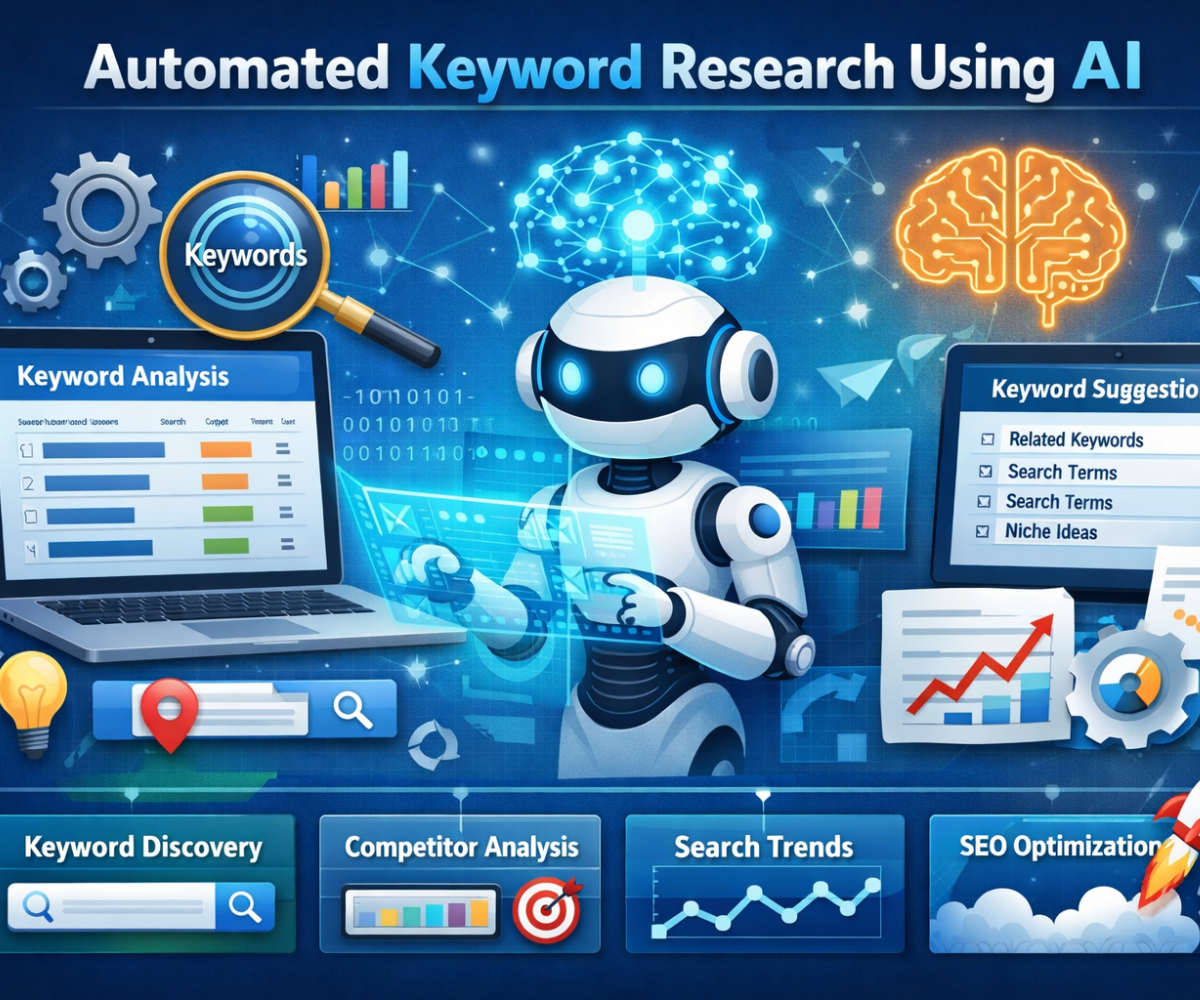
Automated Keyword Research Using AI
What Is Automated Keyword Research Using AI?
Keyword research used to feel like digging for gold with a spoon. Marketers manually typed search queries into tools, analyzed spreadsheets, and tried to predict what users wanted to search for. Today, automated keyword research using AI has completely transformed this process by making it faster, smarter, and more data-driven.
Automated keyword research refers to using artificial intelligence technologies such as machine learning and natural language processing (NLP) to discover search queries people use online. Instead of relying on a few seed keywords, AI tools analyze billions of search queries, user behavior patterns, and search engine results pages (SERPs) to generate highly relevant keyword suggestions.
Recent research shows that over 70% of SEO professionals now use AI tools for keyword discovery, and many rely on AI to identify long-tail keywords that traditional research methods often miss. AI can analyze massive datasets in seconds, making keyword research far more efficient than manual analysis.
For businesses running blogs, e-commerce stores, or SaaS platforms, automated keyword research helps uncover hidden search opportunities and improves the chances of ranking higher on search engines.
How AI Is Transforming Traditional Keyword Research
Traditional keyword research required manual effort and time-consuming analysis. SEO professionals used tools like keyword planners, spreadsheets, and competitor research to identify potential keywords. Although effective, this process was slow and often limited by the amount of data a human could analyze.
AI has changed this workflow by introducing automation, predictive analytics, and search intent analysis. Modern AI-powered keyword tools can scan millions of search queries and organize them into meaningful keyword clusters.
Studies suggest that AI-based keyword tools can identify up to 95% more long-tail keywords compared to manual research. Long-tail keywords are extremely valuable because they reflect highly specific user queries and often have stronger conversion intent.
Another major advantage is speed. AI tools can reduce keyword research time by up to 60%, allowing marketers to focus more on content strategy, SEO optimization, and audience engagement rather than repetitive data analysis.
Instead of guessing what users might search for, AI tools reveal real search behavior patterns, making SEO strategies more accurate and data-driven.
Why Keyword Research Matters More Than Ever
Search behavior has changed significantly over the past decade. Users no longer search using short phrases like “SEO tips.” Instead, they ask more natural questions such as “how to improve SEO rankings for a new website.”
Reports indicate that around 70% of online searches now use conversational language, especially with the growth of voice search and mobile assistants.
Because of this shift, modern SEO strategies must focus on topics, questions, and search intent, rather than individual keywords alone. AI-powered keyword research tools help marketers identify these patterns by analyzing real user queries and search behavior.
Another important trend is the rise of zero-click searches, where users get answers directly on the search results page. Nearly 34% of searches now end without a website click, making it essential for marketers to optimize for featured snippets and informational queries.
AI keyword tools help identify these opportunities and ensure that content aligns with what users are actually searching for.
Understanding Search Intent with AI Keyword Research
Search intent refers to the purpose behind a user’s search query. Every time someone searches online, they usually have a specific goal such as learning information, comparing products, or making a purchase.
AI-powered keyword tools are highly effective at analyzing search intent because they study SERP results, user engagement signals, and contextual language patterns.
For example:
-
“Best laptops 2026” indicates comparison or research intent
-
“Buy MacBook online” indicates transactional intent
AI tools automatically categorize such queries and recommend keywords that match the correct stage of the customer journey.
This insight allows marketers to create highly targeted content such as tutorials, product reviews, or buying guides. As a result, content becomes more relevant to user needs and performs better in search rankings.
Natural Language Processing in AI Keyword Discovery
One of the most powerful technologies behind AI keyword research is Natural Language Processing (NLP).
NLP enables machines to understand human language, analyze context, and identify relationships between words. Instead of simply matching exact keywords, AI tools understand semantic meaning and topic relevance.
For example, when searching for “digital marketing strategy,” AI tools may suggest related keywords such as:
-
online marketing plan
-
content marketing framework
-
SEO strategy guide
These suggestions are generated by analyzing semantic connections between keywords across massive datasets.
NLP also helps AI tools create keyword clusters, which are groups of related search terms organized around a specific topic. This aligns with modern search algorithms that prioritize topic authority rather than individual keywords.
Machine Learning for Predicting Search Trends
Machine learning adds predictive capabilities to keyword research. Unlike traditional keyword databases that rely on historical data, machine learning models continuously learn from new search behavior.
This allows AI tools to identify emerging keyword trends before they become highly competitive.
For instance, an AI tool may detect a sudden increase in searches for “AI marketing automation tools” before it appears in standard keyword databases.
Businesses using AI-driven keyword research often report up to a 37% increase in organic traffic, largely due to improved targeting and early trend detection.
Machine learning essentially turns keyword research into a predictive strategy, helping marketers stay ahead of the competition.
Benefits of Automated Keyword Research Using AI
Faster Keyword Analysis
One of the biggest advantages of AI keyword research is speed. Traditional research methods required hours of manual analysis, whereas AI tools generate keyword insights within seconds.
This efficiency allows marketers to experiment with multiple keyword strategies and quickly adjust their SEO plans.
Deeper Data Insights
AI tools analyze multiple data points simultaneously, including search queries, competitor rankings, and user behavior patterns. This enables them to identify keyword opportunities that manual research might overlook.
Businesses using AI-powered keyword tools often see up to a 30% increase in organic traffic due to improved keyword targeting.
AI Keyword Clustering and Topic Authority
Keyword clustering is another major benefit of automated keyword research. AI tools group related keywords into structured topic clusters that represent broader subject areas.
For example, a topic cluster around email marketing might include keywords like:
-
email automation tools
-
email campaign strategy
-
email marketing best practices
Publishing multiple pieces of content around these related keywords helps websites build topical authority, which improves search rankings.
Research suggests that AI-powered clustering can improve topic authority by up to 35%, strengthening overall SEO performance.
AI Keyword Research vs Traditional Keyword Research
AI-powered keyword research offers several advantages compared to traditional methods.
Traditional keyword research relies heavily on manual data collection, limited datasets, and reactive strategies. In contrast, AI tools analyze billions of queries instantly, identify keyword clusters automatically, and predict emerging search trends.
These capabilities make AI-driven keyword research far more efficient and effective for modern SEO strategies.
Challenges of AI Keyword Research
Although AI offers powerful capabilities, it is not perfect. AI tools depend heavily on data quality, and inaccurate datasets can sometimes affect keyword recommendations.
Another challenge is over-automation. Some marketers rely entirely on AI suggestions without applying strategic thinking. While AI excels at data analysis, human expertise is still essential for content planning and creative decision-making.
The most effective approach is to combine AI insights with human strategy to achieve the best SEO results.
The Future of AI in Keyword Research
Artificial intelligence is continuing to reshape the SEO landscape. Future keyword research tools will likely integrate deeper predictive analytics, improved voice search optimization, and advanced conversational query analysis.
Another emerging concept is Generative Engine Optimization (GEO), where content is optimized not only for traditional search engines but also for AI-powered search systems.
As AI-driven search experiences grow, automated keyword research will become an essential part of every digital marketing strategy.
Conclusion
Automated keyword research using AI has revolutionized the way marketers approach SEO. Instead of manually analyzing large datasets and guessing user intent, businesses can now use AI-powered tools to discover valuable keywords, identify search trends, and build strong content strategies.
AI enables marketers to analyze billions of search queries, detect long-tail keywords, and understand user intent more accurately. This leads to faster keyword discovery, better SEO planning, and improved search rankings.
As search engines evolve and user behavior becomes more conversational, AI-powered keyword research will play an even bigger role in digital marketing strategies. Businesses and marketers who learn to use these tools effectively will gain a strong competitive advantage in search visibility.
For individuals who want to build strong expertise in AI-driven SEO and modern digital marketing strategies, learning from professional training institutes such as NIDM (National Institute of Digital Marketing) can help develop the skills needed to succeed in the rapidly evolving digital marketing industry.