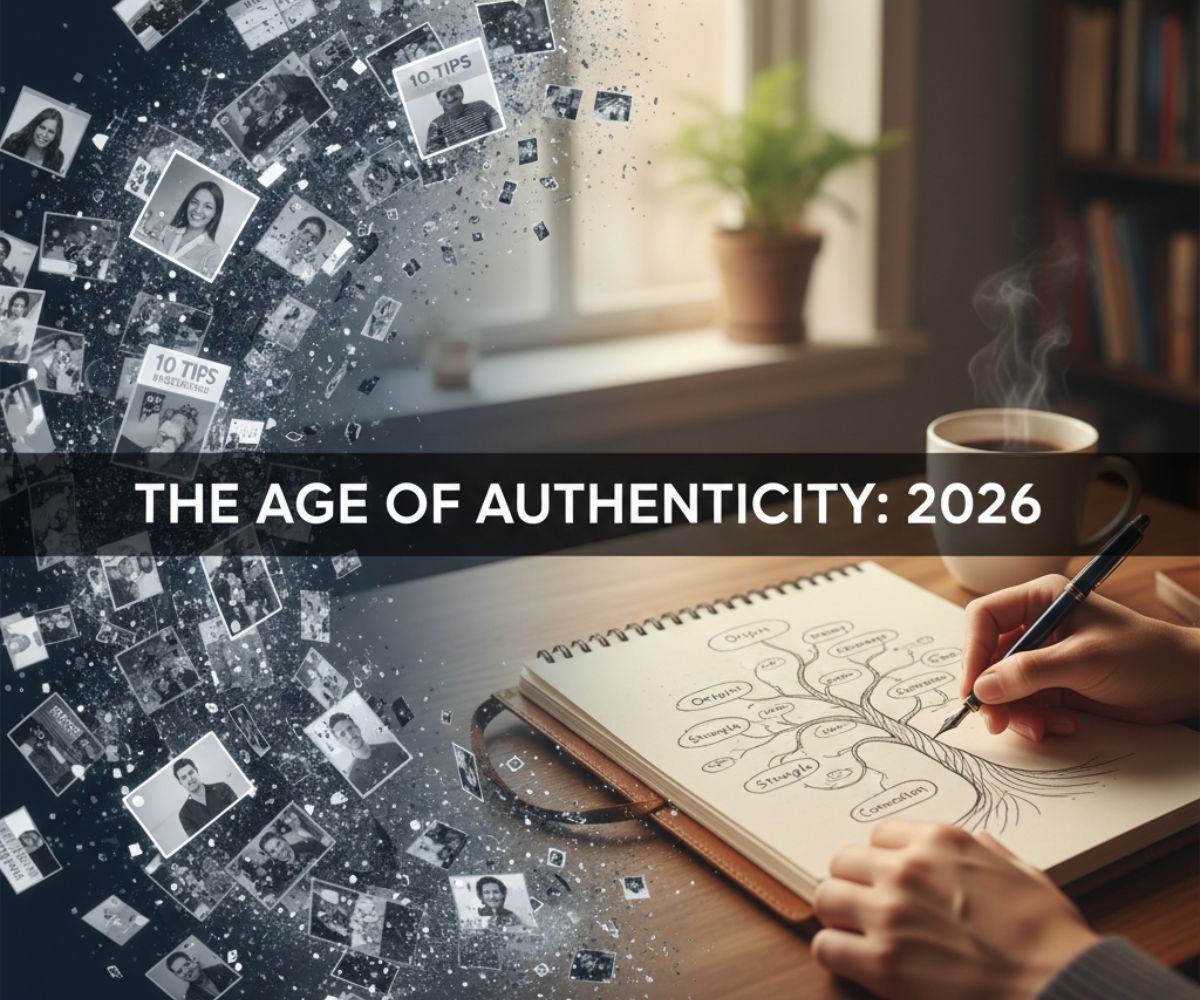
Open any social media feed right now and you will see the same parade of content: stock photos of people pointing at laptops, “10 Tips to Grow Your Business” posts, motivational quotes on gradient backgrounds, and captions so broad they could apply to literally any brand on the planet. This is the opposite of brand storytelling — and in 2026, audiences can smell it from a mile away.
It looks familiar because you have seen it a thousand times. And that is exactly the problem.
The internet is drowning in what marketers are calling “AI slop” — a tidal wave of fast, cheap, templated content that says everything and means nothing. Audiences have developed a near-automatic scroll reflex against it. And here is the thing: they are not scrolling past your content. They are scrolling past your brand.
The antidote? Authentic brand storytelling. It is not a new idea — but in 2026, it has become the single most powerful competitive advantage a brand can own.
What Is Brand Storytelling (And What It’s Not)?
Brand storytelling is the practice of using genuine, human narratives to connect with your audience emotionally — not just to sell, but to mean something to them.
It is your founding struggle. Your product’s origin in a real problem. Your team’s behind-the-scenes failure that led to a breakthrough. It is the imperfect, honest, specific story that no competitor can replicate because it is entirely and undeniably yours.
Generic content, on the other hand, is the marketing equivalent of a form letter. It is technically correct. It is probably well-designed. But it is interchangeable with a hundred other brands in your space — and audiences know it.
Here is a simple test: Could your competitor copy-paste your last 10 pieces of content onto their brand page without changing much? If the answer is yes, you are creating generic content.
Why Generic Content Is Killing Your Brand Storytelling in 2026
Generic content was once harmless — even effective — when digital content was still novel. Today, it is quietly corrosive.
It signals that you have nothing unique to offer. When a brand churns out recycled tips and platitudes, the subtext is clear: there is no distinctive expertise, no real perspective, no actual person behind the logo. Audiences read that signal loud and clear.
It disappears instantly. The human brain craves novelty and connection — two things generic content systematically eliminates. Studies on content engagement show that audiences scroll past generic posts without a second glance because they have seen identical messages hundreds of times before.
It is being produced at catastrophic volume by AI. With 83.2% of content marketers planning to use AI tools in 2026, the internet is being flooded with competent-but-soulless content. The brands winning right now are those doing the opposite: doubling down on what AI cannot replicate — human experience, vulnerability, and specific lived expertise.
It competes on price, not trust. Generic brands end up in a race to the bottom, undercut by whoever publishes faster or cheaper. Authentic brands command higher prices because customers understand the unique value — they compete on trust and expertise, not cost.
The Business Case for Authentic Brand Narrative
If “be more authentic” sounds like vague advice, the data makes the business case concrete.
Companies that master brand storytelling see 30% higher customer retention rates and 23% increased revenue growth compared to competitors who rely solely on traditional marketing approaches.
Authentic, relatable content outperforms polished, corporate messaging in driving direct purchases — and B2C content generates 9.7x more social shares on average when emotional connection is the driving force.
Meanwhile, marketing leaders are issuing the same warning from every direction. 42 experts surveyed by the Content Marketing Institute agree: success in 2026 will not come from volume or AI prompts — it will come from authority, trust, and differentiated, credible, outcome-driven storytelling.
Brand Storytelling vs. Generic Content: A Side-by-Side Breakdown
| Generic Content | Authentic Brand Storytelling | |
|---|---|---|
| Origin | Templates, trending formats, AI drafts | Real experiences, specific expertise, company history |
| Voice | Could be anyone | Unmistakably yours |
| Emotion | Surface-level, performative | Earned, specific, resonant |
| Audience reaction | Scroll past | Stop, read, share, remember |
| Longevity | Disposable | Builds compounding brand equity |
| Competition | Easily replicated | Impossible to copy |
| Business result | Traffic spikes | Loyal audience, premium positioning |
5 Elements of Powerful Brand Story Marketing
1. Specificity: The Core of Great Brand Storytelling
The fastest way to identify generic content is vagueness. “Work hard and stay focused” is advice that could come from anyone. But when you share the exact framework you developed after five failed product launches, the specific conversation with a customer that changed your strategy, or the measurable result of one risky decision — you become irreplaceable.
Generic content pretends expertise in everything, which audiences see through immediately. Specific, personal, detailed storytelling makes you the only brand who could have written that piece.
2. Real Stories Over Polished Brand Narratives
Dove’s “Real Beauty” campaign did not succeed because it had a big budget. It succeeded because it told a story audiences had never seen a brand dare to tell — one grounded in real women, real insecurities, and a genuine challenge to industry norms. LEGO’s “Rebuild the World” campaign works because it celebrates real creativity, not polished perfection.
Authentic content shares actual experiences — the project that failed spectacularly, the client conversation that changed your perspective, or the behind-the-scenes struggle that taught valuable lessons. Generic content recycles motivational platitudes. Authentic brand storytelling mines real life.
3. Vulnerability: The Heart of Storytelling in Marketing
The most counterintuitive truth about brand storytelling is this: your struggles make you more credible, not less. Admitting to failures, discussing hardships, and explaining how your company got through challenging times promotes business transparency — a crucial part of authentic marketing and customer trust.
In a content landscape where every brand projects curated perfection, vulnerability is a genuine differentiator. It is also the one thing AI-generated content fundamentally cannot fake.
4. The Human Behind the Emotional Brand Content
In 2026, more companies are building founder brands, with executives doing significantly more video content. Why? Because people want to follow people, not logos. Putting a real face, voice, and personality behind your brand content transforms followers into advocates.
This does not mean you need a flawless CEO with perfect camera presence. It means showing real people — their actual opinions, quirks, and expertise — rather than a polished corporate persona.
5. Consistency: What Separates Brand Stories from Campaigns
The most successful brands in 2026 treat marketing as a real conversation, not just a series of announcements. Instead of going quiet for months and reappearing with a big launch, they keep the conversation going — and their messaging becomes natural, like chatting with a friend.
Authentic brand storytelling is always-on, not episodic. It does not live in a single viral post; it lives in the accumulated weight of every piece of content you publish over months and years.
How to Start Your Brand Storytelling Strategy (Practically)
You do not need a rebrand, a new agency, or a six-figure campaign budget. Here is where to start:
Audit your last 20 pieces of content. How many could have been published by a competitor without changing a word? That ratio is your authenticity gap. Close it.
Build an experience bank. Start documenting real moments: the customer email that surprised you, the strategy that flopped and why, the internal debate that shaped your product. This becomes your storytelling reservoir — one that replenishes itself constantly.
Find your founder story. Every business has a reason it exists. What problem were you personally frustrated by? What did you see that others were not seeing? That origin is story gold — and almost no brands tell it with enough honesty or detail.
Show the process, not just the outcome. Audiences do not just want to see your wins. They want to see the work. Behind-the-scenes content, work-in-progress updates, and “here is what we are figuring out” posts consistently outperform polished reveal posts.
Use video to make it human. Short-form video is the preferred content format for 78% of consumers — and it is the hardest format to fake. A 90-second founder talking about a real challenge they solved will outperform a beautifully designed infographic almost every time.
Real Brands Winning with Authentic Brand Storytelling
Rhino Sports — Community-Rooted Brand Story Marketing
Rhino Sports launched the “A Ball for the Planet” campaign, anchoring its sustainability story in the real community of children in Kolkata where its recycled rubber balls are made. The result was a 17% increase in global sales — driven purely by authentic, community-rooted storytelling.
Travel Oregon — $50M Impact Through Brand Narrative
Travel Oregon built an entire content strategy around the real stories of the state’s people, places, and experiences — and generated more than $50 million in economic impact, winning the Content Marketing Institute’s Content Strategy of the Year award.
Dove — The Gold Standard of Emotional Brand Content
Dove invited its audience into a conversation about real beauty, used real people instead of models, and built one of the most enduring brand loyalty stories in modern marketing — not through advertising, but through authentic, participatory storytelling.
The common thread? None of these campaigns were built on what the brand wanted to say. They were built on stories that were genuinely true, and that audiences already felt but had not yet seen reflected back to them.
The Bottom Line: In 2026, Brand Storytelling Is the Strategy
In 2026, the shift is finally happening — away from mere ‘brandtelling’ and toward authentic brand storytelling: genuine, human, and immersive narratives that connect with your audience and reflect your brand’s true character.
AI can write a blog post. It can design a social graphic. It can draft 50 email subject lines in 10 seconds. What it cannot do is live your brand’s story. It cannot fail at something, learn from it, and speak with honesty about that experience. It cannot build the kind of trust that comes from showing up, consistently, as something real.
That is your edge. And it is one that compounds over time.
The brands that will be remembered in five years are not the ones that published the most content in 2026. They are the ones that told stories worth remembering — specific, human, vulnerable, and unmistakably theirs.
Start there.
In a world flooded with AI-generated content, authentic brand storytelling is no longer optional — it’s the only thing that makes your brand worth remembering. The brands that win are the ones that lead with real human narratives, not recycled templates. At the National Institute of Digital Marketing (NIDM), aspiring marketers are trained to craft compelling brand stories, build content strategies that connect emotionally, and create content that converts — because in 2026, story is the strategy.