Content marketing vs strategy is one of the most misunderstood topics in digital marketing today. While many people use these terms interchangeably, content marketing vs strategy represents two very different—but closely connected—approaches to building successful digital content.
In fact, understanding the difference between content marketing vs strategy can be the deciding factor between content that merely exists online and content that actually delivers traffic, engagement, and conversions.
Therefore, before creating blog posts, videos, or social media content, it’s essential to understand how content marketing and content strategy work together—and why confusing them often leads to poor results.
In this in-depth guide, we’ll break down everything you need to know—clearly, practically, and without fluff. By the end, you’ll not only understand the difference, but you’ll also know how to use both together to create powerful, results-driven content.
What Is Content Marketing?
At its core, content marketing is the act of creating, publishing, and promoting content to attract, engage, and convert a target audience.
Content marketing focuses on execution. It’s about what you put out into the world—blogs, videos, social posts, emails, podcasts, case studies, and more.
Key Characteristics of Content Marketing
- Focuses on content creation and distribution
- Aims to attract and engage an audience
- Supports brand awareness, leads, and conversions
- Is often ongoing and campaign-driven
In simple terms:
Content marketing is the action.
Examples of Content Marketing
- Publishing weekly blog posts
- Posting Instagram Reels or YouTube videos
- Sending email newsletters
- Creating lead magnets like ebooks or checklists
- Running content-driven ad campaigns
If you’ve ever asked, “What content should we publish this week?”—you were thinking about content marketing.
What Is Content Strategy?
Content strategy is the planning, structuring, and governance behind content marketing. It answers the “why,” “who,” and “how” before any content is created.
A content strategy ensures that every piece of content has a purpose, aligns with business goals, and fits into a larger system.
Key Characteristics of Content Strategy
- Focuses on planning and decision-making
- Aligns content with business objectives
- Defines target audience, messaging, and channels
- Determines what content to create, when, and why
In simple terms:
Content strategy is the thinking.
Without a strategy, content marketing becomes random, inconsistent, and often ineffective.
Content Marketing vs Strategy: What’s the Real Difference?
Let’s clarify this once and for all.
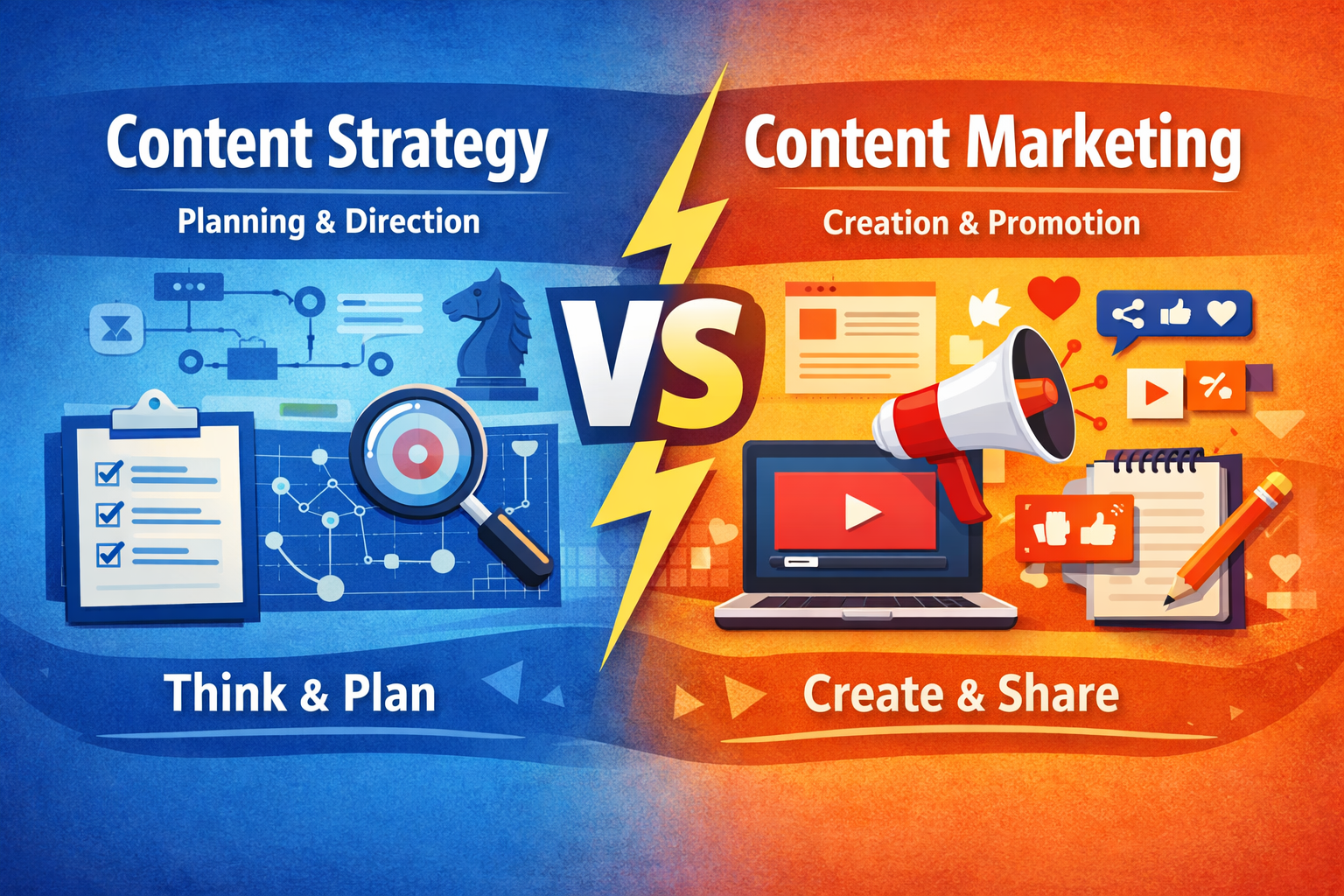
| Aspect | Content Strategy | Content Marketing |
|---|---|---|
| Purpose | Planning & direction | Execution & promotion |
| Focus | Why and how | What and where |
| Timeline | Long-term | Short-term & ongoing |
| Role | Foundation | Action |
| Outcome | Clarity & consistency | Traffic, engagement, leads |
Content strategy decides what should be done.
Content marketing does the doing.
You can’t build a house by painting walls first. Similarly, you can’t expect content marketing to succeed without a content strategy.
Why People Confuse Content Marketing and Strategy
The confusion happens for a few common reasons:
- They work together closely
Strategy and marketing are interconnected, so people assume they’re the same. - Many businesses skip strategy
They jump straight into posting content and call it “content marketing.” - Agencies often bundle the terms
Some agencies sell content marketing without offering a true strategic foundation. - Results can happen accidentally
Occasionally, content performs well without a strategy—this creates false confidence.
But sustainable success never comes from randomness.
Why Content Strategy Comes First (Always)
Before creating a single piece of content, a solid content strategy answers critical questions:
- Who is our target audience?
- What problems are we solving for them?
- What platforms should we focus on?
- What tone and voice should we use?
- How does content support our business goals?
- What does success look like?
Without clear answers, content marketing becomes guesswork.
The Cost of Skipping Content Strategy
- Inconsistent messaging
- Low engagement
- Poor lead quality
- Wasted time and budget
- Difficulty scaling content
A strategy saves you from publishing content that looks good but does nothing.
The Key Elements of a Strong Content Strategy
A high-performing content strategy includes several essential components.
1. Audience Research and Personas
You must deeply understand:
- Your audience’s pain points
- Their goals and motivations
- Their content consumption habits
Content strategy is not about what you want to say—it’s about what your audience needs to hear.
2. Clear Business Goals
Every piece of content should support a goal such as:
- Brand awareness
- Lead generation
- Sales enablement
- Customer retention
- Authority building
If content doesn’t support a goal, it’s noise.
3. Content Positioning and Messaging
This defines:
- Your brand voice
- Key themes and topics
- What makes your content different
Consistency builds trust. Strategy ensures that consistency.
4. Content Types and Formats
Your strategy decides:
- Blogs vs videos vs podcasts
- Long-form vs short-form
- Educational vs promotional content
Different formats serve different purposes in the buyer journey.
5. Content Distribution Plan
Creating content is only half the job. Strategy answers:
- Where will content be published?
- How will it be promoted?
- Which channels deserve priority?
Great content without distribution rarely performs.
What Content Marketing Looks Like in Practice
Once the strategy is in place, content marketing brings it to life.
Common Content Marketing Activities
- Writing SEO-optimized blog posts
- Creating social media content
- Designing infographics
- Publishing videos and reels
- Sending email campaigns
- Repurposing content across platforms
Content marketing is execution-focused and often fast-paced.
Content Marketing Without Strategy: A Common Mistake
Many brands create content consistently but still struggle to see results. Why?
Because:
- Content lacks focus
- Topics are chosen randomly
- Messaging changes frequently
- There’s no clear conversion path
This is like running ads without a targeting plan. You may get impressions, but results remain unpredictable.
How Content Strategy Improves Content Marketing Results
When content marketing is guided by strategy:
- Traffic becomes more relevant
- Engagement increases
- Leads are better qualified
- Content compounds over time
- Teams work more efficiently
Strategy turns content from activity into asset.
Content Strategy vs Editorial Calendar
Another common misconception is equating content strategy with a content calendar.
Let’s be clear:
- Content strategy defines the framework
- Editorial calendar schedules the execution
A calendar without strategy is just a list of dates.
SEO’s Role in Content Strategy and Content Marketing
SEO is not just a marketing tactic—it’s a strategic layer.
In Content Strategy, SEO Helps:
- Identify content opportunities
- Understand search intent
- Prioritize topics
- Structure content architecture
In Content Marketing, SEO Helps:
- Optimize headlines and content
- Improve rankings and visibility
- Drive consistent organic traffic
SEO works best when strategy and marketing align.
Measuring Success: Strategy vs Marketing Metrics
Content Strategy Metrics
- Content alignment with goals
- Audience relevance
- Topic coverage
- Content lifecycle efficiency
Content Marketing Metrics
- Traffic
- Engagement
- Leads
- Conversions
- Shares
Strategy measures direction.
Marketing measures performance.
Both are essential.
Do Small Businesses Need Both?
Absolutely.
Even if you’re a solo creator or small business:
- You still need clarity
- You still need focus
- You still need purpose
Your strategy may be simpler, but skipping it entirely leads to burnout and inconsistent results.
How Content Strategy and Content Marketing Work Together
Think of it this way:
- Content strategy is the blueprint
- Content marketing is the construction
One without the other is incomplete.
A Healthy Workflow Looks Like This:
- Define goals
- Research audience
- Build content strategy
- Create content
- Distribute content
- Measure and optimize
- Refine strategy
This cycle creates sustainable growth.
Which One Should You Invest in First?
If you’re starting from scratch, always invest in content strategy first.
Once the strategy is clear:
- Content creation becomes easier
- Decisions become faster
- Results become predictable
Content marketing without strategy is expensive.
Strategy without marketing is useless.
You need both—but in the right order.
Is There Really a Difference?
Yes a big one.
- Content strategy is about thinking, planning, and direction.
- Content marketing is about doing, creating, and promoting.
They are not competitors. They are partners.
If you want content that:
- Ranks on search engines
- Connects with people
- Supports business goals
- Delivers long-term value
Then you must stop choosing between content marketing and content strategy—and start using them together.
Final Thought
Content marketing and content strategy are often confused, but they serve distinct and equally important roles. Content strategy provides the foundation—defining the purpose, audience, messaging, and structure—while content marketing executes that plan through creation and distribution.
When combined effectively, they transform content from random output into a powerful business system. If your goal is sustainable growth, stronger engagement, and meaningful results, the answer is clear: you don’t need one or the other—you need both, working in sync.
That’s where real content success begins.
Whether you’re a student, working professional, or business owner, National Institute of Digital Marketing (NIDM) equips you with real-world digital marketing skills that align with current industry demands.
Learn smart. Learn practical with NIDM.